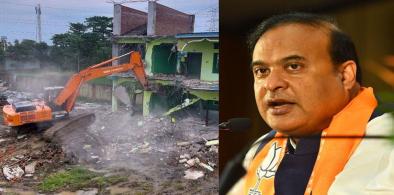
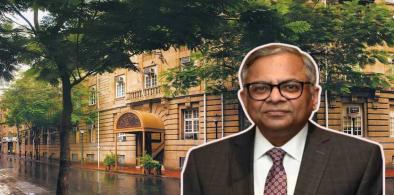

File photo of former encounter specialist Pradeep Sharma

A strong message on custodial deaths from an Indian Court: Extra-judicial Actions Cannot be Celebrated

The effect of the award of a death sentence to as many as nine policemen in one go can be electrifying in the way it can jolt a system that has resisted all reform. The signals this verdict sends out will hopefully serve to warn law enforcers across the county that the law will catch up with them too and make them pay a heavy price for crossing boundaries. Society has to begin seeing custodial deaths and their attendant staged killings, called as "fake encounters", and extra judicial killings as cold-blooded murders for which the nation must have zero tolerance.

Shifting Perceptions in a Multipolar World

In a world moving toward multipolarity, information itself has become contested terrain. Events are no longer just events; they are immediately absorbed into competing narratives. The same incident is read differently depending on where one stands and what one is inclined to believe. 

Geopolitical Uncertainties and the International Student:Need for Transformational Shift in Thinking for Education Providers

For parents of Indian and South Asian students, who are risk-averse, going to the US for an overseas education was fraught with too many imponderables. It was better to travel to a more reliable destination, such as, Australia. Germany and Ireland also featured as potential destinations but in terms of scale, Australia was the preferred beneficiary.

Ghost Murmur: How AI Rescued a Lost US Pilot in the Iran War

The Ghost Murmur AI rescue of a U.S. pilot in Iran is an epochal event in the history of warfare. It shows how new technologies can be used to go around old restrictions and can allow carrying out operations that were not possible a decade ago.

More on Perspective

Rahul Bajaj was a visionary, an industrialist who promoted Gandhian values

He used his annual presence in Davos to make a convincing tour de horizon of the great strengths and resilience of the Indian economy, writes Amb Bhaswati Mukherjee (retd) for South Asia Monitor

Cooked meals for the poor in India: An idea whose time has come

If the rural poor can be given a basic ‘thali’ at subsidized price, they will not only get proper food but do away with the drudgery of cooking, writes Anil K. Rajvanshi for South Asia Monitor

Film on Godse’s killing of Gandhi: Falsehoods galore

The real motive behind murdering Gandhi was that he was for inclusive nationalism, the dream of revolutionaries, and for his attempts to work against untouchability and caste inequality, writes Ram Puniyani for South Asia Monitor

'Learning from Ghalib about the world we live in': Cross-border collaboration around shared couplets

This unique India-Pakistan collaboration developed into this latest venture, “Thinking with Ghalib: Poetry for a New Generation”, a collection of 30 couplets with translation and commentary, write Anjum Altaf and Amit Basole for South Asia Monitor

Can the subcontinental deadlock be broken?

If the meeting of Indian and Pakistani officials—expected to take place next week as per a report in The Hindu– comes through, it will be a departure from the recent past as formal dialogue has remained frozen for almost two years, writes Shraddha Nand Bhatnagar for South Asia Monitor

Historic changes at India Gate and their significance

The Amar Jawan Jyoti -- an upturned rifle with a helmet customarily marking a battlefield grave -- amounted to nothing short of a poor apology for a war memorial at India Gate 

South Asia's divisive politics: Modi election speech stirs up an 'artificial' boundary issue between India and Nepal

India’s position on the boundary issue is “well known, consistent and unambiguous”, the Indian Embassy in Kathmandu said, days after political parties in Nepal stoked a simmering territorial dispute in Lipulekh, Limpiyadhura and Kalapani, especially after Prime Minister Narendra Modi mentioned road construction in Lipulekh at an election rally in Uttarakhand state

No travel ban; instead India offers vaccines, life-saving drugs to Africa

Even as most countries began slapping travel bans on African countries, India has offered support for Africa to combat the newly-emerged Omicron variant of the Covid-19 pandemic, including through supply of vaccines, life-saving drugs, PPE kits, gloves and ventilators

Cross red lines at your own peril in Pakistan: Message to opposition and media

The Asma Jahangir Conference in Pakistan last week sparked a somewhat balanced and much-needed discussion on the issues concerning the country

Rising above hate, a Hindu businessman and a Sikh gurdwara offer prayer space to Muslims

In a country known for its traditional inter-faith tolerance and harmony, one of the headline news for the last few months has been how groups of right-wing Hindus, supported by local leaders of India's ruling BJP of Prime Minister Narendra Modi, have been obstructing and protesting against the offering of namaz in public places by Muslim citizens in Gurugram, a satellite city of capital New Delhi

Decoding Pakistan NSA Moeed Yusuf's refusal to attend India-hosted regional conference on Afghanistan

On 15 August 2021, the day the Taliban seized power militarily in Kabul, the world watched with trepidation the scenes of an ignominious end to the twenty-year-long efforts of the US to prop up a democratic government there

A Middle East Quad? Scope for synergies, but divergences over Iran

Within the new Middle East/West Asia Quad, there is space for trilateral economic cooperation between India, the UAE and Israel

Fake tea issue: Solution to Indian tea industry's problems lies in cooperation with Nepal and Bangladesh

India should assist Nepal and Bangladesh to obtain GI certification for their teas

The spirit of sport: When hate took a back seat

Will this demonstrable assertion of sportsmanship lead to a revival of bilateral sporting ties, particularly cricket, in the near future?

Making sense of New Delhi’s restrained response to Bangladesh’s anti-Hindu violence

The recent widespread anti-Hindu violence will not make any difference to the bilateral ties between India and Bangladesh, said Dinesh K Patnaik, Director General, Indian Council for Cultural Relations (ICCR), calling the recent events “small incidents”