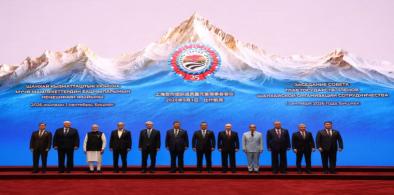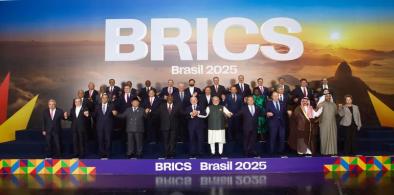
BRICS leaders

India, BRICS Fail the Iran Test: It Could Seek to Bridge Divides

For India, the failure is particularly significant as its presidency was an opportunity to translate “strategic autonomy”, the current buzzword in foreign policy circles, into multilateral leadership. True, its response is shaped by structural constraints. The country imports more than 85% of its crude oil, much of it from West Asia and Russia. Some nine million of its citizens live in the Gulf. The United States is its largest trading partner. Iran anchors the Chabahar port project and India’s access to Afghanistan and Central Asia. Each relationship is too consequential to risk.

Bhutan Under China’s Doklam Shadow: Delhi Needs to Move Away From Protector-Protected Dynamic With Thimpu

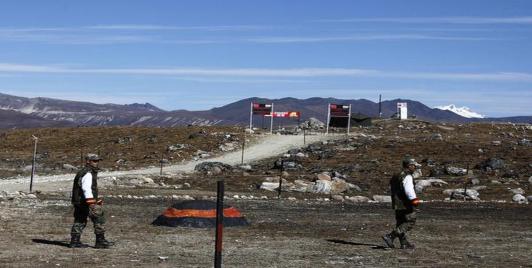
A key consideration for Delhi is Bhutan’s occasional denial or downplay of any Chinese encroachment on its territory, even when satellite data suggests otherwise. This is coupled with a growing perception within Bhutan that India is preventing it from completing its border negotiations with China. Although Thimphu remains closely aligned with Delhi, there is growing interest in expanding its engagement with China.

AI in Elder Care: Potential for Broader Social Transformation

For India, the opportunity is significant as its robust digital infrastructure and large demographic dividend can create a significant opportunity for adoption and deployment of Artificial Intelligence across sectors, particularly in the care economy. There is an ample room for the development of age-friendly products and services using AI innovation which are of scalable commercial value.

South Asia's EdTech Moment: Centre of Gravity of Global Education is Shifting

South Asia's higher education ecosystem — with over 1,500 universities and 60 million enrolled learners — is uniquely positioned to absorb and scale new models: work-integrated degrees, on-demand micro-credentials, lifelong learning. The Global South — Africa, Southeast Asia, Latin America, the Middle East — shares the same structural challenges. The solutions that work at scale in India, Bangladesh or Nepal will travel naturally to these geographies.

More on Spotlight

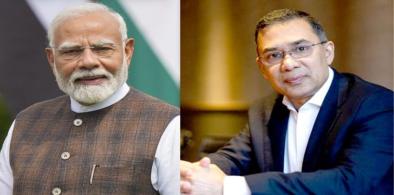
Cultural Diplomacy and Reviving Bangladesh–India Ties Beyond Political Divisions

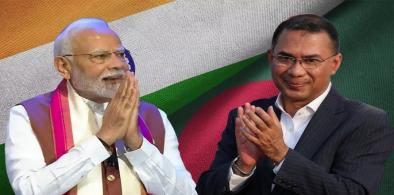
At the iftar gathering, attended by civil society members, ministers, bureaucrats and other distinguished guests, High Commissioner Verma emphasised the shared aspirations of Bangladesh and India. He stated that both nations stand at the threshold of a promising future as two vibrant and forward-looking societies. The event served as a platform to strengthen people-to-people connections and diplomatic goodwill between the two neighbours. By bringing together influential members of Bangladeshi society, the gathering reflected a clear intention to foster deeper engagement 

Raw Courage Amid Patriarchal Terror: Where Girls Have to Disguise as Boys to Survive in Taliban-ruled Afghanistan

The system under the Taliban regime treats girls as disposable items. They take away childhood experiences and destroy personal identities, creating permanent emotional scars. Yet these girls are not victims without agency. They are survivors carrying entire families on their small shoulders. Omid, Parvana, and every unnamed bacha posh are proof of Afghan, and Pashtun, resilience. The world must see them. The Taliban must hear us that no amount of disguises will hide the truth that women and girls are not lesser.

Khamenei's Assassination and a Fractured Iran: Regional and Global Ramifications of a War of Attrition

Khamenei’s assassination terminates an epoch of ideological confrontation, yet inaugurates profound uncertainty. Legally and normatively, it imperils protections for sovereign leaders; strategically and politically, it probes Iran’s institutional fortitude; religiously and narratively, it unveils unifying and divisive societal forces. Diplomatic containment—through intermediaries such as Oman or Qatar—must prioritise the transition's fragility without incitement. Absent such prudence, this strike risks catalysing a wider regional conflagration, where initial tactical triumphs yield enduring strategic costs.

Reimagining a Cooperative South Asia: A Next-Gen Agenda to Revive SAARC

The revival of SAARC will not come from dramatic diplomatic breakthroughs. Instead, it will emerge through incremental cooperation in education, digital infrastructure, disaster response and trade facilitation. Crucially, the future of South Asian regionalism may depend on a generation that increasingly experiences the region not through borders but through shared digital, economic and cultural networks.

US–India Tariff Framework: Trade Concessions Should not Dictate Foreign Policy Choices

Trade adjustments between major economies inevitably reverberate beyond bilateral channels. Bangladesh’s potential tariff advantages in textiles could redirect labour-intensive supply chains. Pakistan, operating within the China-Pakistan Economic Corridor framework, may use India’s perceived alignment with Washington to advance its own strategic narratives. China itself will interpret these developments within the broader context of great-power competition and recalibrate its economic and strategic posture accordingly.

Why Nepal’s Gen Z Succeeded Where Bangladesh’s Failed

A more comprehensive lesson about 21st-century youth politics can be learned from the story taking place between Kathmandu and Dhaka. Gen Z has extraordinary mobilization skills. Protests can grow quickly and upend established power structures thanks to social media networks. But mobilization is insufficient on its own. Successful political transformation requires organization, leadership, and institutional strategy. Nepal’s youth built those structures quickly. Bangladesh’s did not.

Competition for Critical Minerals can be a New Arena for International Conflict

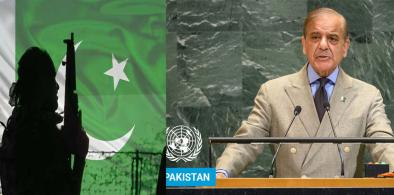
The move by Pakistan in the Security Council is an indicator of increased apprehension among developing countries about the fact that the fruits of energy transition need to be shared more equitably. The Global South has many mineral-rich countries which usually do not get much economic benefit from extraction while bearing its environmental and social costs.
 

Gorkhas are Not Nepalese: Ending the Migrant Myth and the Indian Gorkha Identity Crisis

The valour of Gorkha regiments in the Indian Army is often used by the community as the ultimate proof of their Indianness. Since 1947, Gorkha soldiers have participated in every major conflict, be it Indo- Pakistan wars of 1947,1971,1999 or the Indo-China war of 1962. However, this valor is frequently undermined by the very state they defend, as civil and administrative bodies often treat them as "foreigners" even as they receive gallantry awards. 

Iranian Ship's Sinking Near Sri Lanka: India’s Moral Dilemma

India’s aspiration to be a leading maritime power rests not only on naval capability but on the trust of smaller regional states—from Sri Lanka to Maldives and Indonesia. These states increasingly look to New Delhi as a stabilizing presence in the Indian Ocean. If India appears unwilling to defend diplomatic norms in its own maritime neighborhood, it risks weakening the normative foundation of that leadership.  

Is National Sovereignty in the 21st Century Conditional - Mediated by Hierarchy?

The strikes on Iran are not just another flashpoint in the Middle East. They are a reminder that the rules of the system are applied through hierarchy. Law speaks the language of equality; power writes the terms of enforcement. For smaller states, this is not a philosophical dilemma — it is a strategic one. Their sovereignty is rarely absolute. It must be guarded, bargained, and constantly recalibrated in response to forces beyond their control.

Needed An Independent and Sovereign Foreign Policy for Bangladesh Centred on National Interests

In shaping foreign policy toward India, the people of  Bangladesh expect a relationship based on mutual respect, sovereignty, and fairness. Public opinion often emphasises resolving border-related tensions, preventing cross-border push-in incidents, and ensuring humane management of migration and security issues. There is also a domestic expectation for constructive dialogue regarding political matters, including discussions surrounding the status or repatriation of former Prime Minister Sheikh Hasina, if relevant under legal and diplomatic frameworks. 

Defining the End Game: Challenges of Power, Pacts and Faith in the West Asia Conundrum

History offers a consistent lesson: the difficulty is rarely in beginning a conflict; it lies in defining its limits. Sovereignty can be defended. Regimes can be challenged. Alliances can be activated. Yet none of these guarantee clarity about the end state. Without a defined objective and a disciplined exit, events gather their own momentum.

Nepal at a Crossroads: Will the Elections Usher in a Generational Shift in Country's Murky Politics?

A prominent feature of this election is the massive influx of youth participation. Approximately 800,000 first-time voters are preparing to cast their ballots, and over 1,000 candidates under the age of 40 are contesting, signaling a profound generational shift. The political landscape is witnessing fierce competition between established traditional parties and emerging youth-centric forces. A key contest is unfolding in the Jhapa 5 constituency, a traditional stronghold where 35-year-old former Kathmandu mayor Balendra "Balen" Shah, representing the Rastriya Swatantra Party (RSP), is challenging former Prime Minister KP Sharma Oli of the Communist Party of Nepal (UML).   

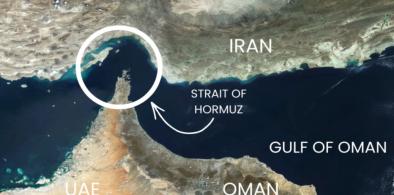
Khamenei’s Killing: West Asia, Region at the Hormuz Flashpoint

Escalation around Iran narrows diplomatic manoeuvring room across South Asia. India has cultivated strong defence ties with Israel, expanded strategic cooperation with Washington and maintained pragmatic engagement with Tehran, particularly in connectivity and energy sectors. A widening US–Iran confrontation complicates this balancing act. 

AI: Social Disruptor or National Security Risk? How Will Countries Respond

There is a darker side to AI, it is now seen. Firms have established that AI can manipulate, blackmail and threaten. Findings by Anthropic have revealed that advanced AI systems can resort to blackmailing and threatening human users to achieve assigned goals or ensure their survival. As AI writes better versions of itself and big business powers it to seek new frontiers to occupy, will India re-skill and re-arm to keep its independence or run the risk of becoming a digitised colony?