Black clouds floating over Kathmandu valley, at Swayambhu temple. Photo by Pragyan Srivastava.

Air Pollution Knows No Borders: Smog Over Kathmandu Is A Regional Failure

As the World Bank notes, isolated national actions are insufficient when pollution itself ignores borders. India, Nepal, Bangladesh, and Pakistan share the same airshed. Without cooperation, each country keeps breathing its neighbour’s mistakes. “As the government representing the largest population affected by air pollution, India should lead this effort. Instead, the region has drifted away from cooperation, and the cost has been catastrophic,” Dr Subedee said.

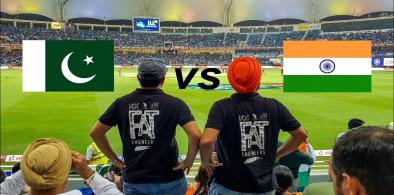
When Cricket Stops Being ‘Just Cricket’: South Asian Sporting Diplomacy in Retreat

This is certainly not a call to romanticise sport or overstate its diplomatic capacity. Neither did cricket ever resolve South Asia’s conflicts. But it softened their edges. It reminded the public that despite borders and disputes there existed a cultural language. The erosion of that language should now concern the whole of South Asia. Because when even the simplest forms of cultural exchange become difficult, rebuilding trust happens to be infinitely harder.      

Bangladesh’s February Referendum and the Future of Secularism

Bangladesh, though Muslim‑majority, has historically significant Hindu, Buddhist, Christian, and Indigenous minorities. Removing secularism would create a profound democratic dilemma as it is the safeguard against majoritarian dominance and structural exclusion. The South Asian experience shows the risks of privileging religion in constitutions.

With India-EU Trade Deal, It's Time To Recast India's Foreign Policy

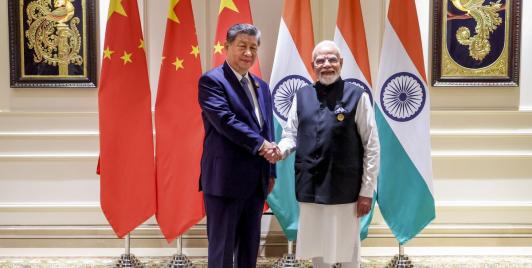
What India next needs to consider is opening a dialogue with Beijing, while remaining mindful of its security concerns. Years of hostility and China’s anti-India posturing, coupled with its hegemonic aspirations, have understandably created an atmosphere of deep distrust. However, the atmospherics are now right for a rethink as to whether current distancing serves mutual interest. The middle path approach justifies seeking out areas of collaboration, especially through enhanced trade and thereby dilute the overdependence on the US market, both for China and for India.

More on Spotlight

Violence against women: Indian society must internalise the message of Durga Puja

If rape in India is to be meaningfully addressed, the onus lies on society to review and correct deeply ingrained socio-cultural norms and practices that are inherently biased against women and the girl child, writes Cmde C Uday Bhaskar (retd) for South Asia Monitor

Maryam Nawaz: Will she be on the right side of history?

As Pakistan enters its winter of discontent, yet again, Maryam Nawaz has emerged as a front-ranking leader in a male bastion, writes Mahendra Ved for South Asia Monitor

China-Pakistan naval axis to contain India's dominance in IOR

China is enabling Pakistan to set up a network-enabled warfare capability with satellite feeds to monitor the Indian Ocean Regions (IOR) like the Indian Navy employs Centrix provided by the US Navy, writes Cmde Ranjit B. Rai (retd) for South Asia Monitor

Has BJP’s hubris let it down in Kashmir?

In the BJP’s case, the arrogance bred by two successive general election victories convinced the party that it was now in a position to do more or less whatever it wanted, of which the first and foremost was the implementation of its longstanding desire to abolish Article 370, writes Amulya Ganguli for South Asia Monitor

India needs to play a bigger role in resolving Rohingya issue

Shringla also assured Myanmar of India’s support for the safe repatriation of displaced Rohingya Muslims from Bangladesh. About 40,000 or more Rohingya live in Indian cities, including Kolkata and Delhi, so India has its own reasons to push for a solution to the Rohingya problem, writes Subir Bhaumik for South Asia Monitor

India's agri reform: Will the new farm bills benefit its farmers?

Given that around 86.2 percent of farmers in India are small or marginal, all the activities require capital that they cannot afford without the middlemen. The bills in no way tries to create alternate credit mechanisms to aid farmers, writes Akshat Singh for South Asia Monitor

Recalling the pain of 1962 Sino-Indian war: Lessons forgotten, truth buried

October 1962 is a sad chapter of Indian history and greater the pity that it remains under wraps, writes Cmde C Uday Bhaskar (retd) for South Asia Monitor

Indo-US relationship unlikely to sway the Indian American vote

The Indian American community is sophisticated, knows and understands the domestic political compulsions and will not allow themselves to be led around by short term promises, writes Dr. Sridhar Krishnaswami for South Asia Monitor

Lessons of COVID-19 for US and India: Need to invest in global public health, promote democratic norms

Both the US and India are remarkable democratic experiments and their ability to champion democratic norms and freedoms - rather than weaken them - will prove critical to global peace and prosperity in the years ahead, write Sohini Chatterjee & Swadesh Chatterjee for South Asia Monitor

South Asian nations need to harness resources to cope with pandemic fallout

South Asian nations need to work together to cope with COVID-19 and unlock new opportunities to build economic resilience, connectivity, and human capital, writes Partha Pratim Mitra for South Asia Monitor

India needs serious rethink of its POK policy

The Pakistan army has never won any war but they are also aware that the political hierarchy in India is apprehensive of waging war on Pakistan with the Chinese presence in POK-Pakistan, writes Lt Gen Prakash Katoch (retd)  for South Asia Monitor

COVID-19 calls for resetting targets under SDGs: Health and education needs fresh strategies

The pandemic has laid bare some fault lines and vulnerabilities in the domains of education and health, and the lessons need to reflect in the SDGs as fresh strategies, writes Ram Krishna Sinha for South Asia Monitor

Lessons from Bangladesh: India can learn from its neighbour's development model

Bangladesh’s export-led model of development is the major factor behind its growth dynamism and has altered its status from being a bottomless basket case to an Asian tiger in the making writes N Chandra Mohan for South Asia Monitor

Agri reforms in India: What should be the true price of farm produce?

The wealth of a country comes from its land.  Around 55 percent of India’s population is connected with farming, writes Anil K Rajvanshi for South Asia Monitor 

A lend-lease charter with the US will bolster India's maritime security

An Indo-US Charter with a lend-lease clause on the lines of the Atlantic Charter in 1941 is the need of the hour, writes Cmde Ranjit B Rai (retd) for South Asia Monitor