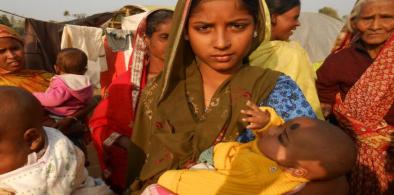
India has repositioned its earlier policy of providing a home to refugees from Tibet, Afghanistan, Bhutan and Sri Lanka and is forcefully deporting Rohingya refugees
The killing of Ayatollah Ai Khamenei is not an isolated headline; it is a defining chapter in the evolving story of Middle Eastern and regional geopolitics. It forces a reckoning with questions of power, legality, and consequence. Whether this moment becomes the spark of broader conflict or a catalyst for renewed diplomatic urgency will depend on decisions made now, in Tehran, in Jerusalem, in Washington, and beyond. One era has undeniably ended. What begins next will shape the region for years to come.
Iran’s constitution explicitly anticipates such scenarios. Article 111 provides that if the supreme leader dies or becomes incapacitated, authority transfers immediately to an interim council consisting of the president, the head of the judiciary, and a cleric chosen through the Expediency Council. The aim is continuity, not transformation. While qualifications for the next leader are specified, the constitution leaves room for interpretation rather than imposing a rigid religious pathway.
After Munich, Rubio travelled to Budapest and aligned himself warmly with Orbán’s government, praising Hungary’s trajectory. For European leaders committed to participatory democracy and the rule of law, the signal must have been disquieting. It suggested that Washington’s conception of Western solidarity may prioritise cultural homogeneity over liberal pluralism.
The structural transformation of India’s export basket is no longer incremental—it is systemic. Technology-driven industries with higher value addition are steadily outpacing traditional sectors. If managed strategically, external tariff pressures could accelerate this transition. Rather than viewing tariff hikes solely as a threat, India can leverage them as a catalyst for deeper integration into global supply chains and stronger positioning in high-technology manufacturing. The reshaping of India’s export architecture is already underway. The tariff shock may simply fast-forward the process.
India has repositioned its earlier policy of providing a home to refugees from Tibet, Afghanistan, Bhutan and Sri Lanka and is forcefully deporting Rohingya refugees
Given these roadblocks, it is not a surprise that the BJP, led by Prime Minister Narendra Modi, is a runaway winner in every opinion poll to the dismay of its adversaries who wonder why the economic difficulties of inflation and unemployment are not holding it back
While this exercise was a long overdue and necessary measure, the whole gamut of India’s coastal security in view of terrorist threats and other crimes must function effectively and consistently as there have been instances of breaches in coastal security after 26/11
Defence sources said it was significant that the Dornier was handed over to Sri Lanka by India a day before the high-tech Chinese satellite tracking ship docked at Hambantota
India should also project the values and aspirations of the Indo-Pacific into Atlantic waters to help global development. The SAGAR (Security And Growth for All in the Region) model can be extended to a much larger canvas of mutual cooperation and benefit
If Australia is to emerge as the destination of choice for Indian students, its India strategy needs to be rethought. If this were to happen, international education and institutional collaboration would emerge as a critical building blocks in the bilateral space
The world must remember the refugees’ lives depend on how the international community responds to caring for them as Bangladesh alone cannot afford to support this huge Rohingya population
The question being raised in Pakistan@75 should be welcomed, that how come Pakistan, carved out as a safe home for the Muslim minorities of the Indian subcontinent, has failed to provide safety to its own minorities? Only Pakistan has the answer
We need to learn a lot from China’s foreign policy; and when our own response to China is weak-kneed, how do we expect Sri Lanka to take up cudgels with Beijing?
If the Taliban’s original purpose in taking over Kabul last year was to gradually gain some international recognition for what it calls the Islamic Emirate of Afghanistan, it now stands fully destroyed
The ideological shift in politics towards prioritizing the majority religious denomination that has morphed into assertive political Hindutva goes against the fabric of the 'Idea of India' enshrined in the constitution
During the last eight years, Prime Minister Modi has elevated the quality of governance to a higher level and has introduced several imaginative schemes, keeping in view the requirement of the people at the lower economic level as well as the compulsive need to forge ahead in terms of technology and productivity
In recent years there has been a paradigm shift in the manner in which the government is bringing about significant policy measures to make India self-reliant and instituting mechanisms to overcome bureaucratic bottlenecks which had plagued the system for long
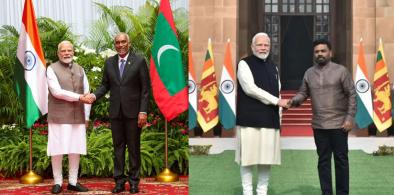
Although the Solih visit went off very well, concerns remained over domestic politics in the Maldives.
To reconcile the people of Bhutan and bring peace, we need collaborative efforts. Community agencies, local organizations, religious leaders, politicians, the King of Bhutan and businesses, all can play essential roles in this process