

Iranian Ship's Sinking Near Sri Lanka: India’s Moral Dilemma
India’s aspiration to be a leading maritime power rests not only on naval capability but on the trust of smaller regional states—from Sri Lanka to Maldives and Indonesia. These states increasingly look to New Delhi as a stabilizing presence in the Indian Ocean. If India appears unwilling to defend diplomatic norms in its own maritime neighborhood, it risks weakening the normative foundation of that leadership.
 Mar 06, 2026
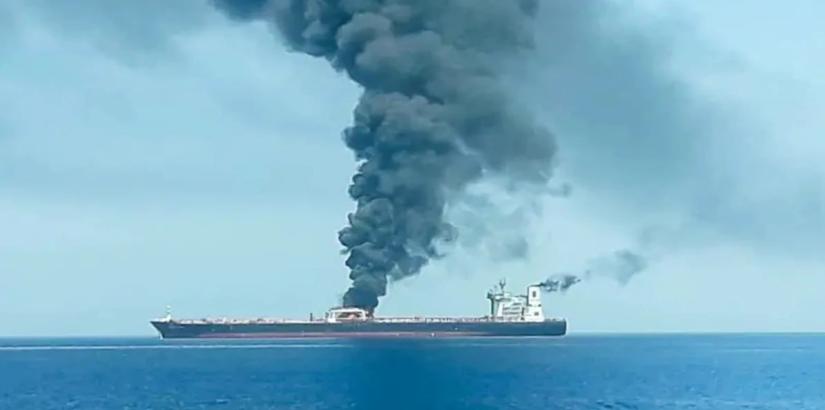
The attack on the Iranian warship Dina near Sri Lanka, while en route home from India for a ceremonial visit, has thrust New Delhi into an uncomfortable spotlight. The vessel, unarmed and invited by the Indian government, was not a military threat but a guest. Its targeting by the US Navy has ignited a debate that goes far beyond maritime security—it raises profound questions about India’s moral obligations, its diplomatic posture, and its credibility as a rising power in the Indian Ocean.
The incident also unfolds against a backdrop of intensifying maritime tensions between Iran and the United States, stretching from the Persian Gulf to the wider Indian Ocean. In such a climate, even routine naval movements risk being interpreted through the lens of strategic rivalry. That is precisely why diplomatic signaling—such as ceremonial port visits—exists: to prevent miscalculation and preserve channels of engagement even amid geopolitical tensions.
The episode is not simply a tactical confrontation at sea; it is a moment that tests how India reconciles its strategic partnerships with the moral expectations that accompany leadership in its region.
A Vital Question
India’s invitation to the Iranian warship was not a trivial gesture. Naval visits are instruments of maritime diplomacy, signaling recognition, respect, and a willingness to maintain professional engagement even among states with complex relations. By extending such an invitation, India assumed a moral responsibility to ensure the dignity and safety of its guest. The attack near Sri Lanka, therefore, is not just an assault on Iran’s vessel—it is a challenge to India’s role as host and to the norms of ceremonial diplomacy.
Under the United Nations Convention on the Law of the Sea, warships enjoy sovereign immunity (Article 32), meaning they cannot be subjected to enforcement actions by foreign states. While UNCLOS does not explicitly regulate all forms of military confrontation at sea, customary maritime practice strongly discourages interference with vessels engaged in peaceful or diplomatic missions.
The analogy with the Vienna Convention on Diplomatic Relations is instructive. Just as diplomats and embassies enjoy inviolability because they represent sovereign communication between states, ceremonial naval visits function as maritime equivalents of diplomatic engagement.
The Dina incident also raises a practical but vital question: was the vessel’s status as a ceremonial guest of India clearly communicated to other naval powers operating in the region, particularly the United States? When a warship is invited for a diplomatic naval engagement, the host country assumes not only symbolic responsibility but also a diplomatic obligation to notify others of its peaceful mission.
In practice, such communication is often conveyed through diplomatic channels, maritime advisories, or navigational warnings. If India formally informed Washington that the Dina was traveling under invitation, then the attack represents a direct violation of international norms and an affront to India’s sovereignty as host. If, however, India failed to communicate this status, the responsibility becomes more complex: the United States may claim it acted under the assumption that any Iranian warship was a legitimate target, given the broader context of US–Iran hostilities.
This ambiguity sharpens India’s dilemma. On one hand, silence risks signaling that India cannot even guarantee the dignity of vessels it invites. On the other, asserting that the Dina was a ceremonial guest whose status was communicated would compel India to defend the principle of inviolability—even if it means challenging a major partner. Ultimately, the credibility of India’s claim to be a “net security provider” in the Indian Ocean depends not only on operational readiness but also on its ability to uphold the diplomatic responsibilities that accompany ceremonial invitations.
India’s operational response was measured. The Indian Navy reportedly dispatched aircraft and surface vessels to assist in search-and-rescue operations, demonstrating both professionalism and situational readiness. Yet New Delhi’s public messaging avoided direct criticism of Washington, reflecting a familiar instinct in Indian diplomacy: to manage tensions quietly rather than escalate them publicly.
Strategic Silence
This restraint may be pragmatic. But it inevitably raises a question: can India remain strategically silent when an incident touches a vessel it had formally invited?
India’s cautious posture is not difficult to understand. The United States remains one of New Delhi’s most important strategic partners in defense technology, intelligence sharing, and Indo-Pacific maritime cooperation. Maintaining alignment with Washington is central to India’s long-term effort to balance the expanding influence of China.
In such a context, restraint becomes the default diplomatic response. Public confrontation would carry tangible costs—potentially complicating defense cooperation and wider geopolitical coordination.
Yet strategic silence also carries reputational risks. India has increasingly portrayed itself as a “net security provider” and a guardian of maritime stability in the Indian Ocean. If incidents involving invited vessels occur without diplomatic protest, smaller regional states may question how far India is willing to defend the norms it invokes.
History shows that naval diplomacy carries symbolic weight. During the Cold War, port visits by Soviet and American warships to third countries were carefully protected diplomatic events. Any interference with such visits was widely interpreted as a political provocation rather than a routine military act. The logic was simple: ceremonial naval exchanges were designed precisely to prevent escalation between rival powers.
During the Cold War, Turkey and Indonesia issued strong diplomatic protests when invited vessels were harassed, underscoring that ceremonial naval visits are treated as inviolable symbols of sovereignty. India’s silence now risks setting a precedent that such norms can be disregarded without consequence.
For emerging powers, credibility is often built less through declarations than through responses to unexpected crises. Silence may protect strategic relationships, but it can also create the perception that principles are negotiable when major partners are involved.
Ethical Responsibility
The alternative path would not necessarily require confrontation. India could articulate a broader principle: that vessels engaged in diplomatic or ceremonial visits should be protected from hostile action regardless of their origin. Such a statement could reaffirm international norms without directly targeting any specific actor. It would signal that India’s position is grounded in rule-based maritime order rather than geopolitical alignment.
This approach would also resonate with India’s long-standing diplomatic identity. From its role in the Non-Aligned Movement to its contemporary advocacy for the Global South, India has historically sought to project itself as a defender of sovereign equality and international fairness.
Political philosophy reinforces this logic. The Enlightenment philosopher Immanuel Kant, in his vision of cosmopolitan law, emphasized the ethical duty of hospitality in international relations, while the liberal political philosopher John Rawls highlights fairness and reciprocity as foundations of just international conduct. When a state extends a diplomatic invitation, these principles imply at least a moral obligation to safeguard the dignity of the guest.
Speaking in defense of these norms would therefore strengthen India’s image as a principled actor rather than diminish its strategic autonomy.
Strategic Consideration
Unsurprisingly, the incident has sparked a lively debate across India’s policy community. Critics argue that failing to respond diplomatically risks undermining India’s credibility as a regional leader. If New Delhi cannot defend the norms surrounding a vessel it invited, they contend, its claims to maritime stewardship in the Indian Ocean may appear hollow.
Defenders counter that India cannot be held responsible for military actions undertaken by another state outside its territorial waters. From this perspective, restraint reflects strategic maturity rather than moral abdication. Maintaining stable relations with Washington—particularly amid intensifying great-power competition—remains a vital national interest.
Policy analysts increasingly frame the issue in broader terms. The real dilemma is not the fate of one ship but the strategic identity India seeks to cultivate. Can India simultaneously maintain deep partnerships with major powers while projecting itself as a principled voice for the Global South? This tension—between geopolitical pragmatism and normative leadership—is likely to shape India’s foreign policy choices for years to come.
There is also a wider strategic consideration. India’s aspiration to be a leading maritime power rests not only on naval capability but on the trust of smaller regional states—from Sri Lanka to Maldives and Indonesia. These states increasingly look to New Delhi as a stabilizing presence in the Indian Ocean. If India appears unwilling to defend diplomatic norms in its own maritime neighborhood, it risks weakening the normative foundation of that leadership.
Credibility and Power
The attack on Dina is more than an isolated maritime episode. It illustrates a recurring dilemma for rising powers: whether to prioritize strategic partnerships or normative consistency when the two appear to diverge. Strategic silence may preserve valuable alliances in the short term. But credibility in international politics is built through the defense of principles, especially in moments of ambiguity.
India does not need confrontation to demonstrate leadership. What it needs is clarity. A carefully articulated defense of maritime diplomatic norms would reinforce India’s claim to be a stabilizing force in the Indian Ocean. Ultimately, the question raised by the Dina incident is simple but consequential: Will India define its rise primarily through power, or through the principles that guide how that power is used?
How New Delhi responds will shape not only the memory of this incident, but also the credibility of India’s claim to lead in the Indian Ocean. Rising powers are ultimately judged not only by the strength of their alliances, but by the consistency with which they defend the principles that give those alliances legitimacy.
(The author is Professor and Chair of the Department of Economics, International University of Business Agriculture and Technology (IUBAT), Dhaka. His research focuses on regional trade, sustainable development, and South Asian economic cooperation. Views expressed are personal. He can be reached at golam.grasul@gmail.com)





Post a Comment