

Representational Photo

Violence Against Hindus: Is Bangladesh Burying Its Founding Ideals Of Secularism And Pluralism?

For Bangladesh’s Hindus, each funeral deepens the message that their lives are negotiable and their suffering invisible. If this trajectory continues unchecked, the country risks normalizing a culture of impunity that will ultimately consume more than one community. Violence ignored does not fade; it spreads. And the price of silence, as history repeatedly shows, is always paid in lives.

Tarique Rahman's Past Will Shadow His Nation's Future: Is Bangladesh Headed For Post-Election Conflict?

Keen observers of international and regional politics will not have missed the tacit presence of the invisible hand of the US in determining the democratic transition in Bangladesh.  Obviously, TarIque had been tutored by the Americans about the best way forward for the transition towards democratic rule and delivering on the promises on cooperation on regional security. The intelligentsia inside the country could have hoped for Tarique referring to ‘’historical’’ figures from the Indian subcontinent, the Muslim world, and Bangladesh’s past.

Nepal's Use Of Lethal Force And South Asia's Enforcement Vacuum

The South Asian Association for Regional Cooperation's (SAARC) Charter, by contrast, establishes no regional human rights treaty, monitoring body, or court. Scholars emphasize that governments in the subregion demonstrate a lack of deep commitment to human rights and remain unwilling to acknowledge subregional solutions. Victims of systemic violations have no forum for binding adjudication.

Trumpian Caprice Has India In A Bind: Will Need Foreign Policy Recalibration

This fully unfettered approach to everything Trump does also has serious consequences for India. At least through the duration of the Trump administration until 2028, the Modi government will have to spread around its geostrategic and geoeconomic needs among various countries such as Japan, Australia, Germany, France and the United Kingdom or collectives such as the European Union, even as it deals with America with some judicious leveraging.

More on Spotlight

Growing Islamic Fundamentalism In Bangladesh: A Security Challenge For India

Yunus’s actions increasingly reflect the anti-India agenda of pro-Pakistan fundamentalists. This is illustrated by a book he recently presented to a visiting Canadian delegation - its cover featured a map of Bangladesh appearing to encompass large parts of India’s northeast—a symbolic gesture aimed at globalising the anti-India narrative.

The Crisis in Trade Multilateralism: Developing Nations Need To Form Alliances

At this critical juncture, developing countries such as India need to forge alliances to rescue multilateral trade. This would require a vociferous championing of multilateral trade at all forums and the use of all means to challenge American unilateralism. Sadly, India has not done much in this regard. 

Bangladesh: Born In Hope, Trapped In Instability, Can Become Strategic Liability

Has India faltered in “handling” these two neighbours? In theory, perhaps. As the dominant regional power, expectations are inevitably high. In practice, however, India’s very dominance generates suspicion in both Pakistan and Bangladesh, sharply limiting its influence. Meanwhile, the United States, with its strategic weight, and China with its economic clout, have exercised far greater leverage over Pakistan for decades. A similar dynamic applies to Bangladesh. 

Nepal's Political Transition: An Unfinished Business

Moderator Khushi Kabir repeatedly situated Nepal’s uprising within a broader South Asian context, drawing parallels with recent mass movements in Sri Lanka and Bangladesh. She described Nepal’s experience as part of a regional reckoning driven by youth demanding accountability, dignity, and meaningful participation in governance.

PNS Khaibar: A Milestone in Pakistan-Turkey Strategic Cooperation

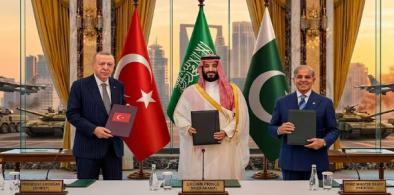
With PNS Khaibar's delivery Pakistan and Türkiye are taking their relationship to a new level which is not limited to traditional political friendship. At the handover ceremony, Erdoğan described the relationship between the countries as "brotherly ties" and emphasised the need to further collaborate in defence production. The naval leadership of Pakistan also pointed to the fact that the partnership should benefit Pakistan in achieving its overall maritime modernisation.

A Nation At Crossroads: Islamist Terror, Minority Persecution, And The Burning of Bangladesh’s Conscience

What is unfolding in Bangladesh bears unsettling resemblance to trajectories seen in Pakistan and Afghanistan, where false blasphemy accusations have long been used to terrorize minorities and silence dissent. Once such violence is tolerated, it expands - devouring journalists, artists, reformist Muslims, and eventually the state itself.

Bangladesh–India Relations at a Crossroads: Needed Recalibration, Not Rupture

The current strains in Bangladesh–India relations should therefore be seen not as an inevitable deterioration, but as a test of diplomatic maturity. Bangladesh and India share more than geography and history; they share a responsibility to ensure that temporary political frictions do not harden into structural mistrust. In a time of regional uncertainty, neither country benefits from a relationship defined by grievance or miscommunication. 

A Dangerous Power Grab in Pakistan; Unpredictable Consequences For Region

The 27th Amendment, celebrated by its proponents as a security reform, is in reality a political coup executed through constitutional means. It marks not only Munir’s personal triumph but the institutional victory of the military over all other state authorities. As history warns, empowering any unelected institution above the republic’s elected will invites instability—not strength. Pakistan may soon discover that consolidating military power does not secure the nation’s future, but instead places it at greater risk

How Foreign Digital Influencers Are Tarnishing India’s Global Image

India must now transition from conventional soft-power thinking to visibility governance—the systematic management of how the country appears, circulates, and is emotionally interpreted across global platforms. Failure to do so will leave India’s global image increasingly shaped by commercial incentives outside Indian control.  

Afghanistan Should Not Get Caught In The India-Pakistan Strategic Rivalry

The strengthening of Taliban-India ties runs counter to Pakistan’s interests. The more border clashes intensify between the Taliban and Pakistan, the more secure the Kashmir region and the Line of Control (LoC) become for India. Under such conditions, Pakistan will remain preoccupied with its northwestern border, giving India a unique opportunity to consolidate its control over Kashmir and potentially weaken, drive out, or eliminate Kashmiri militant groups 

The Inescapable Grip Of Foreign Influence On Sri Lanka

Although U.S. military deployments overseas are common, their presence in Sri Lanka has historically been rare. For the first time, both Indian and American troops are now actively engaged in rescue and relief operations on Sri Lankan soil. This marks a significant departure from past sensitivities surrounding foreign military footprints in the island nation.

Turning Strategic Autonomy Into Genuine Influence: Route To A Resurgent India Runs Through Europe And The Global South

This twin strategy -- institutionalised engagement with Europe and practical leadership of the Global South -- would broaden India’s repertoire. A strengthened European partnership would sharpen India’s industrial and technological edge; robust South-South initiatives would deepen its diplomatic capital and soft power. Together they would blunt the effect of whimsical shifts in U.S. policy and give New Delhi greater leverage with Moscow and Beijing.

Putin’s visit to India: More Messaging Than Substance

India has thus far shown that it is willing to continue its friendship with Russia and expand relations in diverse areas from defence to energy, from manpower mobility to innovation, from investment and technology exchange to culture and tourism. In short, Putin’s visit was meant to prepare both countries to defy sanctions and explore new areas of cooperation - in Russia’s Far East and Arctic, cooperation in areas of climate change and green energy, and work together to strengthen multilateral forums like the BRICS, SCO and G-20.

Changing Bangladesh: Where Women Are Silently Rewriting the Rules of Society

The expansion of education in Bangladesh has played a key role in this transformation. Girls are now equal to boys in schools, colleges, and universities and sometimes even ahead of them. Women have proven their capabilities as doctors, engineers, teachers, researchers, and even pilots. This achievement is not just personal;  this is the evolution of the mentality of a society.

Whither SAARC, As Cyclone-Devastated Sri Lanka Seeks South Asian Climate Compact

However. the desire to collaborate regionally has faced many hurdles such as geopolitical tensions arising from the India–Pakistan rivalry and limited SAARC summit activity that has greatly weakened implementation of regional initiatives. The Rapid Response Mechanism remains largely on paper, with no standing regional force or pre-positioned assets. Smaller nations like Bhutan, Maldives, Nepal and Sri Lanka face financial/technical limitations in aligning with regional standards.