

New Civilisational Thesis of Western Renewal Risks Reviving Spectres of Colonialism and Racism
After Munich, Rubio travelled to Budapest and aligned himself warmly with Orbán’s government, praising Hungary’s trajectory. For European leaders committed to participatory democracy and the rule of law, the signal must have been disquieting. It suggested that Washington’s conception of Western solidarity may prioritise cultural homogeneity over liberal pluralism.
 Feb 28, 2026
When the U.S. Secretary of State Marco Rubio rose to speak at the Munich Security Conference on Valentine’s Day, his language resonated with faith and kinship. “Thousands of years of Western civilization hung in the balance,” he warned, describing the United States and Europe as bound not merely by interests but by Christian faith, ancestry and shared heritage. America, he said, would “always be a child of Europe.”
Beneath the civility of the speech lay a civilisational thesis characterised by many assumptions that have long been rubbished. By framing the West as a cultural bloodline under siege -- threatened by migration, demographic change and rival power -- Rubio revived a narrative that has long accompanied the empire - that history belongs to a particular people, ordained by faith and inheritance to shape the world.
Within days of Munich, the rhetoric of civilisational entitlement resurfaced in a more explicit register. Mike Huckabee, the U.S. ambassador to Israel, told journalist Tucker Carlson that Israel has a biblical right to the land stretching from the Nile to the Euphrates. “It would be fine if they took it all,” he said, endorsing a territorial claim rooted in faith rather than international law.
A Christian Vision of Europe?
The Palestinian foreign ministry responded sharply, describing Huckabee’s remarks as “an explicit call to violate the sovereignty of states.” The statement said his comments contradicted religious and historical facts, international law, and even previous statements by President Donald Trump rejecting annexation of the occupied West Bank.
Several Middle Eastern countries such as Saudi Arabia, Egypt, Jordan, United Arab Emirates, Qatar, Kuwait, Oman, Bahrain, Lebanon, and Syria as well as other Muslim majority countries such as Pakistan and Indonesia denounced Huckabee’s views as provocative and extremist.
The juxtaposition of Munich and the U.S. ambassador’s interview is revealing. Rubio spoke of civilisational unity and Western renewal. Huckabee articulated a theological claim to territory spanning multiple sovereign states. Together, they expose a worldview in which borders, rights and sovereignty are subordinated to a sense of questionable and arbitrary mandate.
Rubio’s insistence that the West is defined by Christian faith and ancestry narrows the scope of belonging. Europe’s Muslim citizens, secular traditions and postcolonial diversity are awkward fits within such a scheme. The language of cultural cohesion and demographic threat echoes ideas advanced by, among others, Hungary’s Prime Minister Viktor Orbán, who has championed a white, Christian vision of Europe.
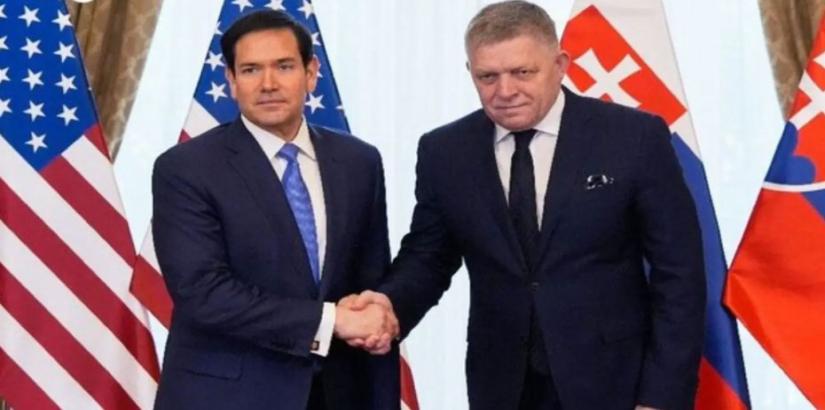
After Munich, Rubio travelled to Budapest and aligned himself warmly with Orbán’s government, praising Hungary’s trajectory. For European leaders committed to participatory democracy and the rule of law, the signal must have been disquieting. It suggested that Washington’s conception of Western solidarity may prioritise cultural homogeneity over liberal pluralism.
The language of “civilizational erasure” or cultural survival is not new. In Europe and the United States, it has been linked to the “great replacement” theory, which posits that white populations are being supplanted by migrants from the Global South. Such thinking recasts economic and demographic trends as existential racial contests.
Rubio lamented the decline of “the great Western empires” after 1945, attributing their contraction to communist revolutions and anti-colonial uprisings. (That should include India’s liberation in 1947 from the yoke of British colonialism that inspired other freedom movements across the world). He urged Europe not to be burdened by guilt and shame over its past, celebrating instead the continent as the birthplace of liberty, rule of law and scientific inquiry.
Colonialism’s Vices Ignored
This account foregrounds Europe’s intellectual achievements while sidelining the violence, plunder and racial hierarchies that sustained empire. Anti-colonial struggles are rendered as unfortunate interruptions to civilisational ascent rather than movements for self-determination.
Huckabee’s assertion that Israel could justifiably “take it all” from the Nile to the Euphrates invokes a vision often described as “Greater Israel.” Israeli Prime Minister Benjamin Netanyahu has spoken of feeling “very attached” to such a vision and described his leadership as a historic and spiritual mission, invoking generations past and future.
For Palestinians and much of the international community, the Gaza Strip and the West Bank, including East Jerusalem, are occupied under international law. Annexation or permanent control without equal rights for inhabitants would violate foundational principles of the post-1945 order. The Palestinian foreign ministry’s statement underscored this, calling on Washington to clarify its position and reaffirm commitments to peace and non-annexation.
The US ambassador, a former Republican Governor of Arkansas, is an evangelical Christian who has long framed Israeli claims to the West Bank in terms of divine right. The theological underpinnings of such positions resonate with a broader revivalist current in American politics, where Christianity is sometimes cast not merely as faith but as civilisational identity.
Rubio’s Munich speech did not cite scripture. Yet his repeated emphasis on shared Christian heritage as the glue of the West situates contemporary geopolitics within a religiously inflected narrative.
In the 20th century, international law evolved precisely to constrain such claims. The prohibition on acquisition of territory by force, the principle of sovereign equality, and the right of peoples to self-determination were responses to the catastrophes of imperial rivalry and racial ideology. To treat these principles as secondary to so-called civilisational destiny is to reopen settled questions.
Global South as Mere Markets
Rubio also sketched a blueprint for a renewed Western century built on coordinated supply chains and competition for “market share in the economies of the Global South.” China hovered implicitly as rival. In this framing, the Global South appears less as a sovereign actor than as terrain for strategic contest.
Such bloc politics risks reproducing patterns of extraction and dependency familiar from the colonial era. When combined with rhetoric of civilisational superiority, it reinforces perceptions that the West sees itself as custodian rather than partner.
The irony is that Western modernity itself is deeply entangled with non-Western contributions, from mathematical concepts developed in India and the Islamic world to technologies pioneered in China, from African diasporic cultural forms to agricultural exchanges with Latin America that reshaped European demography. The narrative of self-contained Western genius is historically incomplete. A worldview that defines alliance through ancestry, aligns with illiberal leaders, and entertains theological justifications for territorial expansion is fatally flawed.
If the West’s confidence rests on law, pluralism and the equal dignity of peoples, then its leaders must articulate those principles unequivocally. If instead it retreats into a narrative of cultural siege and providential entitlement, it risks reviving the spectres of colonialism and racism that the postwar order sought to lay to rest.
(The writer is a former UN spokesperson and a contemporary affairs commentator. Views expressed are personal. He can be reached at edmathew@gmail.com/tweets @edmathew)





Post a Comment