

Violence Against Hindus: Is Bangladesh Burying Its Founding Ideals Of Secularism And Pluralism?
For Bangladesh’s Hindus, each funeral deepens the message that their lives are negotiable and their suffering invisible. If this trajectory continues unchecked, the country risks normalizing a culture of impunity that will ultimately consume more than one community. Violence ignored does not fade; it spreads. And the price of silence, as history repeatedly shows, is always paid in lives.
 Jan 11, 2026
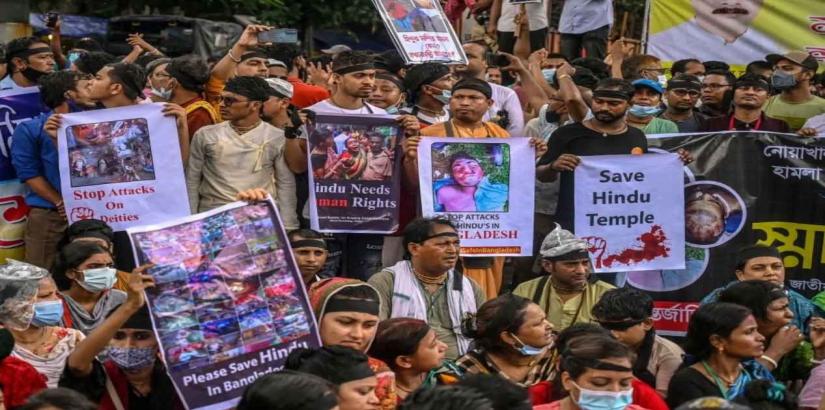
They were not militants. They were not criminals. They were workers, traders, shopkeepers - ordinary Hindu citizens of Bangladesh whose only “crime” was their faith. Beaten to death by mobs, burnt alive, stabbed, or shot at close range, at least six Hindus have been killed in less than a month, while global outrage remains conspicuously absent. No mass protests. No sustained media pressure. No urgency. Just funerals - and silence. In Bangladesh today, being Hindu has quietly become a life-threatening condition.
A nation does not collapse overnight; it erodes quietly, one ignored crime at a time. In Bangladesh today, that erosion is being written in blood - Hindu blood - spilled through lynchings, arson, stabbings, and executions, while the world watches in deliberate silence. When citizens are murdered for their faith and the state responds with denial, euphemisms, and indifference, the violence ceases to be random. It becomes a warning - and a pattern. What is unfolding in Bangladesh is not chaos; it is a slow-burning human rights catastrophe that too many are choosing not to name.
A Grim Pattern
Journalist Indrajit Kundu summed up this uncomfortable truth in a short but powerful post on X following the lynching of Dipu Chandra Das: “Dipu Chandra Das was not an Indian. He was a Bangladeshi citizen. Yet he was lynched and burnt. Because he is a Hindu”.
Dipu Chandra Das, a worker at a local readymade garment factory, was accused of making derogatory remarks about the Prophet of Islam - the familiar and deadly charge of “blasphemy”. In Bhaluka, an enraged mob beat him to death. Even that was not enough. His body was then set on fire, as if to erase not only his life but his very identity.
The US Department of State rightly described the killing as “horrific” and urged an “unequivocal stand against religious hatred”. But such statements lose all meaning when the Yunus regime in Dhaka, propped up by Islamists, jihadist networks, and Pakistan’s notorious Inter-Service Intelligence (ISI), treats them as background noise. There was no decisive action, no serious reckoning - only silence dressed up as governance.
What followed exposed a grim pattern. On Christmas Eve, Amrit Mandal, also known as Samrat, was killed in Rajbari’s Pangsha upazila. Instead of acknowledging the obvious communal dimension, the regime hurried to issue a press statement calling the incident “unfortunate”, while insisting it was “not at all communally motivated”. Such semantic acrobatics are not accidental. They are designed to shield extremists and dull public conscience.
Just days later, on December 29, 2025, Bajendra Biswas, a member of the Ansar force, was killed by his Muslim colleague in the Bhaluka area of Mymensingh. Once again, the authorities appeared more interested in damage control than justice.
Then came one of the most horrifying cases - Khokon Chandra Das, a Hindu businessman from Damudya upazila in Shariatpur district. He was stabbed multiple times in the lower abdomen and then set on fire. He later died at Dhaka’s National Institute of Burn and Plastic Surgery. This was not spontaneous rage. It was cruelty executed with intent.
On January 5, 2026, Rana Pratap Bairagi, a Hindu trader from Arua village in Jashore’s Keshabpur upazila, was shot in the head at point-blank range. There was no mob frenzy, no provocation story - just an execution. He died on the spot.
That same day, yet another Hindu life was extinguished. Sarat Chakraborty Mani (40) was running his small grocery shop at Charsindur Bazaar in Palash Upazila of Narsingdi district, on the outskirts of Dhaka. According to local residents, unidentified assailants armed with sharp weapons attacked him without warning. Gravely injured, Mani died on the way to hospital. Even witnesses were too afraid to speak publicly - a telling detail that rarely makes it into official narratives.
Triviliazing Violence
Possibly what is most disturbing is not only the violence itself, but the political effort to trivialize it. Bangladesh Nationalist Party (BNP) Secretary General Mirza Fakhrul Islam Alamgir ignited outrage when he described the killings of Hindus as “small incidents”. In an interview with CNN-News18, he dismissed concerns over targeted violence as a “media creation”, claiming only “a few small incidents” had occurred. Earlier, speaking to Press Trust of India (PTI), Alamgir went further still, calling reports of attacks on Hindu minorities “factually incorrect and misleading”. “There may be some instances”, he said, “but those are more political in nature and not communal”.
When lynchings, burnings, and executions are reduced to “small incidents”, the message to extremists is loud and clear: proceed without fear. And where, one must ask, is the global outrage?
Where are the emergency UN debates, the relentless media campaigns, the international delegations, and the sanctions that appear so swiftly in other conflicts? Why does violence against Hindus repeatedly fail to cross the threshold of global concern? Why does selective empathy remain the unspoken rule of international human rights discourse?
A Moral Crisis
This is not merely a domestic issue for Bangladesh. It is a moral crisis with international implications. The systematic marginalization and terrorization of Hindus is the result of years of appeasement, ideological denial, and the calculated use of religion as a political weapon - aided by external forces that benefit from instability. Bangladesh was founded in 1971 on the ideals of secularism and pluralism. Today, those ideals are being buried - quite literally - alongside its Hindu citizens.
History will not remember how carefully worded the statements were. It will remember who spoke when it mattered - and who chose silence for convenience.
Behind every statistic lies a shattered family, a silenced household, and a community living in fear. For Bangladesh’s Hindus, each funeral deepens the message that their lives are negotiable and their suffering invisible. If this trajectory continues unchecked, the country risks normalizing a culture of impunity that will ultimately consume more than one community. Violence ignored does not fade; it spreads. And the price of silence, as history repeatedly shows, is always paid in lives.
(The author is a journalist, writer, and editor-publisher of the Weekly Blitz. He specializes in counterterrorism and regional geopolitics. He can be contacted at salahuddinshoaibchoudhury@yahoo.com, follow him on X: @Salah_Shoaib )







Post a Comment