
US Secretary of State Marco Rubio with Prime Minister of Hungary Viktor Orban.

New Civilisational Thesis of Western Renewal Risks Reviving Spectres of Colonialism and Racism

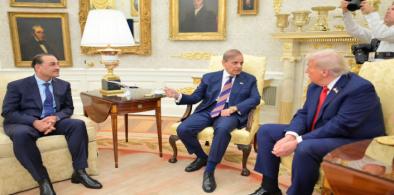
After Munich, Rubio travelled to Budapest and aligned himself warmly with Orbán’s government, praising Hungary’s trajectory. For European leaders committed to participatory democracy and the rule of law, the signal must have been disquieting. It suggested that Washington’s conception of Western solidarity may prioritise cultural homogeneity over liberal pluralism.

Trump’s Tariff Shock and India’s Export Reset: A Tech-Led Turn in the Making

The structural transformation of India’s export basket is no longer incremental—it is systemic. Technology-driven industries with higher value addition are steadily outpacing traditional sectors. If managed strategically, external tariff pressures could accelerate this transition. Rather than viewing tariff hikes solely as a threat, India can leverage them as a catalyst for deeper integration into global supply chains and stronger positioning in high-technology manufacturing. The reshaping of India’s export architecture is already underway. The tariff shock may simply fast-forward the process.

AI Encounters in Indian Higher Education: In Search of Humans in the Loop

Considering the potential of AI in solving complex questions and generating contents in individual writing styles, institutions need to ask a few fundamental questions - what is the role of academia in ensuring that the learners are not being slaves to AI, but masters who are aware of the potential bias and hallucinations that has a huge impact on knowledge acquisition and dissemination?  Should it be a social responsibility of higher educational institutions to ensure meaningful curriculum and assessment practices which make learners future ready in such a rapidly changing AI era?

Cryptocurrency and the Emergence of a Parallel Financial Architecture in South Asia

Recent global adoption indices confirms that South Asia has become one of the most dynamic regions for cryptocurrency engagement, with implications for remittance use. According to the 2025 crypto adoption index by Chainalysis, India secured the top position worldwide in overall crypto adoption across retail usage, reflecting pervasive grassroots digital activity. Pakistan and Bangladesh also feature prominently, with Pakistan ranking among top three in Asia and Bangladesh within top 20

More on Spotlight

We Cannot Veto Our Children's Future: How Our Collective Inaction On Climate Change Is The World's Most Devastating Veto

The war in Gaza demands a ceasefire. So does our war on nature. It demands Net Zero. IPCC has written the resolution for this ‘ceasefire’. This is not a metaphor. We are extracting, polluting, and emitting our way to collective suicide by adding fossil fuel on the spreading wildfire.

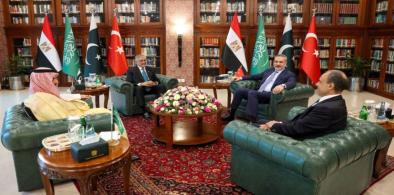
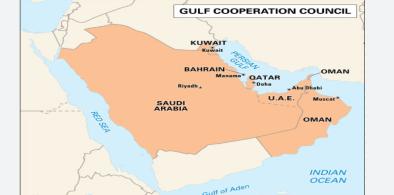
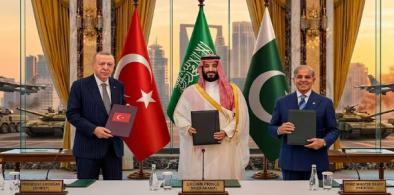
Saudi Arabia-Pakistan Security Pact Has Strategic And Economic Ramifications

By outsourcing its defence to Pakistan and, indirectly, to China, Riyadh has loosened its obligations. Freed from Washington’s security leash, the Saudis can theoretically price oil in whatever currency they choose. The fact is that any disruptions in the riyal-dollar relationship would risk global financial equilibrium and undermine investor trust in the greenback.

Saudi-Pakistan defense pact has profound implications for India, Middle East

In broader geostrategic terms, the defense pact is also an indicator of growing apprehensions in the Middle East about the United States as a reliable security guarantor any longer. It is also possible that Washington may have at least tacitly approved of the defense pact.

Nepal Needs Change: Protests Must Transition To Productivity And Renewal

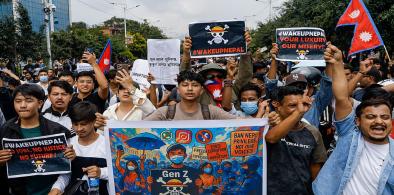
Nepal's dependence on remittances and decades of corruption, unemployment, and political stagnation came to a head during the Gen Z protests, which cost the lives of 72 people. Their sacrifice must lead to a ten-pillar change that turns vandalism into rebuilding, corruption into trust, and protest into the start of Nepal's renewal.

Trans-Border Rains: How Climate Change is Drowning India and Pakistan

Shared river systems, shared vulnerabilities, and shared futures mean that India and Pakistan must set aside hostility and cooperate on vital planetary issues. Equally, both must press the world’s richest polluting nations to deliver on promised climate finance. The deluge is already here.

Trade Wars Are Less About Tariffs, More About Power: India’s Strategic Autonomy in a Shifting World

Yet India’s response is neither impulsive nor reactionary—it is rooted in a long tradition of strategic autonomy. From Nehru’s Cold War non-alignment to today’s “multi-alignment,” successive governments have insisted on freedom of action, refusing to let outside powers dictate India’s role in the world. This ethos, born of colonial subjugation, now guides New Delhi’s diversified diplomacy

Is Digital Colonialism Changing South Asian Politics Through Youth?

Apart from these conspiracy theories, one fact is apparent: Digital platforms, particularly those owned by Facebook and Twitter (X), are playing a drastic role in launching, organizing and supporting socio-political movements and revolutions in South Asia where these developing countries, already marked by high-debt dependency, poverty, unemployment, poor governance, corruption, and illiteracy, are heavily reliant on international INGOs, NGOs, foreign aid, funds, and loans.

The Greenium Paradox: Can South Asia Align Climate Finance with Investor Demands?

In June 2025, Sri Lanka’s DFCC Bank broke new ground as the first foreign corporation to list a green bond on India’s NSE International Exchange in GIFT City. The $8 million bond financed solar energy projects aligned with Sri Lanka’s 2030 renewables target. By securing a dual listing in Luxembourg and aligning with ICMA’s Green Bond Principles, DFCC broadened its international investor appeal and demonstrated how green finance can support debt stressed economies.

Cricket Must Not Lose Its Soul: Competition Not At Cost Of The Game’s Spirit

The game must be allowed allowed to find a way to restore its dignity and balance on the ground.Not only is there a need to check the unregulated commercialization but there is a need for the introduction of regulations that give bowlers a fair chance, have sporting pitches, and fair future tour programs that preserve Test cricket’s relevance.

India-Pakistan: Breaking the Stalemate, Changing the Narrative

Changing this dynamic involves rebalancing domestic narratives. In India, presenting Pakistan less as an existential threat and more as a troubled neighbour could lessen the political costs of engagement. In Pakistan, reducing the military's dominance over India policy would open space for pragmatic dialogue.

From Dhaka to Kathmandu: An Islamist-globalist blueprint to destabilize South Asia?

The events in Nepal and Bangladesh serve as stark warnings: the US Deep State and its Islamist partners are actively destabilizing South Asia, targeting democracies and turning vulnerable nations into vassal states. Nepal narrowly avoided disaster thanks to the courage and foresight of its army, while Bangladesh remains trapped in a jihadist nightmare.

Why India and Pakistan Should Resume Cricket Ties

New Delhi should not view cricket ties as appeasement but as investment in peace. By embracing cricket diplomacy, India can show moral leadership, protect its strategic interests and give millions of fans across South Asia a reason to dream of friendship rather than enmity. The ongoing Asia Cup is a good start in that direction. A few handshakes could have made it an even better start. 

Nepal Crisis: Is India Being Boxed-In In A Destabilized South Asia?

For India, the situation will remain volatile, as it shares a thousand-mile open border with Nepal permitting free movement of people. The coup in Nepal came as a surprise to India and Indian intelligence agencies, just like the coups in Sri Lanka and Bangladesh

A Nation Adrift: Year After Hasina’s Ouster Bangladesh Remains In Political Limbo

Muhammad Yunus may bask in the applause of Western elites, but within Bangladesh his regime is a study in failure: illegitimate, incompetent, and dangerous. Nepal, with its army’s timely intervention and youth’s surprising maturity, showed that chaos need not consume a nation. Bangladesh, under Yunus, has shown the opposite: how a nation can betray its own future when it allows passion without perspective to rule the day.

World Ozone Day 2025: The Unfinished Lesson of Our Greatest Environmental Success

We are well on our way to sealing the ozone hole. But let us ensure that in doing so, we do not ignore the new fissures opening at our feet. The work of healing our planet is never complete—it simply evolves.Let our legacy be that we were wise enough to see the whole board, not just the move we just made. The ozone hole is being sealed, but the deal is not done. The lesson is not over. The action must continue—even in celebration.