

The Reality Behind Putin-Xi Ties: A No-Limits Relationship has its Limits
The Putin–Xi meeting, therefore, should not be interpreted as the birth of a fixed anti-American alliance. Rather, it reflects a flexible alignment whose cooperation is strongest where grievances overlap, but weakest where ambitions collide. Putin and Xi are united more by pressure than by trust. They are aligned in opposing American dominance, but not necessarily in supporting each other’s long-term rise.
 May 28, 2026
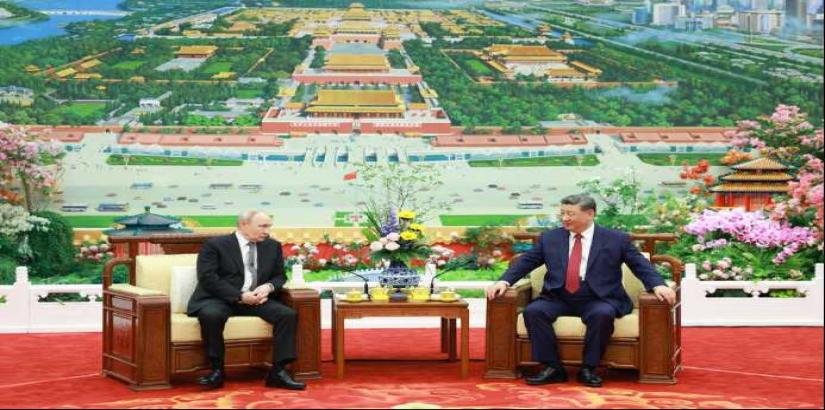
The Putin–Xi meeting in Beijing, held against the backdrop of Donald Trump’s recent China visit, was carefully choreographed geopolitical theatre. It sought to convey that China can engage Washington without yielding strategic ground, while projecting the image that the centre of global power is increasingly shifting eastward.
For President Vladimir Putin, the optics were equally important. Russia wanted to demonstrate that it remains strategically resilient despite sanctions, battlefield pressures and long-term economic isolation from the West. Together, both leaders attempted to reinforce the narrative of a growing partnership shaping a post-Western order.
Yet the deeper reality is far more complex. The relationship remains one of mutual necessity rather than enduring trust.
China needs Russia as a strategic counterweight against the United States, but it does not want to inherit the burdens and consequences of Moscow’s war in Ukraine. Russia, meanwhile, relies heavily on China as an economic lifeline, but fears becoming a subordinate raw-material appendage to Beijing. Their partnership may appear strong today, but it is neither naturally permanent nor free from deep structural mistrust rooted in history and competing ambitions.
Energy Dependence and Economic Imbalance
Energy remains the backbone of the relationship.
Since the Ukraine war, Russia has redirected much of its energy exports eastward, with China emerging as its most important buyer of oil and gas. Russian gas exports to China through the Power of Siberia pipeline reached 38.8 bcm in 2025, while Russia became China’s third-largest LNG supplier, providing nearly 9.8 million metric tons. China also accounted for around 20 percent of Russia’s oil exports.
However, China is not replacing Europe on equal terms. Beijing still imports far less Russian gas than Europe did before the war, exposing the limitations of Moscow’s much-publicised “pivot to Asia.” Russia has lost premium European markets and now faces a Chinese market that enjoys greater leverage and wider energy options.
The proposed Power of Siberia 2 pipeline illustrates this imbalance clearly. Moscow views the project as essential to replacing lost Western demand, but Beijing does not share the same urgency. China seeks favourable pricing and supply terms while simultaneously avoiding overdependence on Russian energy.
The broader economic relationship is also under strain. Bilateral trade fell to US$228.1 billion in 2025 after four consecutive years of growth. Chinese exports to Russia declined by 9.9 percent, while imports from Russia fell 3.4 percent. Sanctions, payment risks, weak Russian demand and growing Chinese caution have all created barriers to deeper integration.
At the same time, China continues to depend heavily on Western markets, technology, finance and capital. Beijing’s support for Moscow therefore remains carefully calibrated. China does not want Russia’s war to damage its own global economic position.
The so-called “no limits” partnership, therefore, clearly has limits.
While both countries oppose US-led pressure, their long-term priorities diverge sharply. Russia’s immediate concerns are regime survival, sanctions evasion and sustaining its war effort. China’s priorities revolve around national rejuvenation, regional primacy and long-term technological and military supremacy.
Their interests overlap, but they are not identical.
Historical Mistrust Beneath Strategic Alignment
The deeper challenge in Moscow–Beijing ties remains historical mistrust.
Despite warm public rhetoric, Russian strategic thinking has never fully forgotten the Sino-Soviet split or the demographic imbalance along the sparsely populated Russian Far East. Both countries share a border exceeding 4,000 kilometres, and historical anxieties continue to shape strategic calculations on both sides.
Russia’s growing stagnation has widened the asymmetry between the two powers, while Moscow’s military aggression in Ukraine has imposed reputational and economic costs on Beijing.
This creates a paradox: the partnership is strategically useful, but psychologically uneasy.
Russia seeks China’s market access, capital, technology and diplomatic cover, yet remains increasingly wary of Chinese economic penetration and long-term influence in regions traditionally viewed as within Moscow’s sphere of influence — particularly Central Asia, the Russian Far East and the Arctic.
The Arctic, East Asia and Southeast Asia Fault Lines
The Arctic is becoming an increasingly sensitive area of competition.
China now describes itself as a “near-Arctic state,” while Russia remains the dominant Arctic power with territorial control, military infrastructure and authority over the Northern Sea Route (NSR).
Moscow is uneasy about Beijing gradually normalising its Arctic presence through scientific research, the Polar Silk Road initiative, shipping access and long-term energy investments.
Western sanctions have constrained Russian Arctic energy development, forcing Moscow to rely more heavily on Chinese capital, technology and shipping demand. Yet Russia remains cautious about granting Beijing excessive access to Arctic routes and infrastructure.
For China, Arctic access offers strategic diversification away from vulnerable maritime chokepoints such as the Strait of Malacca and Hormuz. For Russia, however, there is growing concern that China could eventually become the dominant economic actor in Russia’s own northern frontier.
These tensions extend into East Asia and Southeast Asia.
Russia’s expanding engagement with North Korea, as well as its attempts to preserve channels with Japan, South Korea and ASEAN, do not always align comfortably with Beijing’s regional interests.
Moscow’s deepening military cooperation with Pyongyang has generated unease in Beijing, which has traditionally preferred to remain North Korea’s principal patron.
The North Korean connection has provided Russia with manpower, munitions and political solidarity while signalling that Moscow possesses strategic options beyond China.
This reflects Russia’s layered Asian strategy: China for economic and diplomatic weight, North Korea for military support, and broader regional openings where possible.
In Southeast Asia, divergence is also becoming more visible. China’s influence in the region is primarily economic and infrastructural, while Russia continues to leverage defence ties, arms sales and long-standing strategic relationships, particularly with Vietnam and Myanmar.
Moscow retains influence in selected defence partnerships, and Beijing may not necessarily welcome any Russian return to East or Southeast Asia that complicates China’s regional primacy.
Central Asia represents another long-term fault line. Russia sees the region as part of its traditional strategic backyard, while China has steadily expanded its influence there through trade, infrastructure projects and energy connectivity.
Alignment Under Pressure, Not Trust
Ukraine remains a sensitive issue for both countries.
China does not want to see a total Russian defeat, as such an outcome would strengthen Western unity and potentially allow the United States to redirect greater strategic focus toward the Indo-Pacific. Yet Beijing also does not want the Ukraine war to become China’s war.
As a result, Chinese support remains deliberately calibrated — providing economic backing and diplomatic cover while officially denying the supply of lethal military aid.
This reflects Beijing’s broader dilemma: it wants Russia strong enough to distract the West, but not at the cost of becoming a sanctioned co-belligerent.
Russia, meanwhile, is also keeping its strategic options open. A future thaw in ties with Washington, particularly under Trump, could potentially reduce sanctions pressure and create bargaining space over Ukraine and European security.
This demonstrates that, despite the rhetoric of “no limits,” Moscow will not ignore opportunities with the United States if they serve Russia’s long-term interests. Nor can China assume it will permanently remain Russia’s indispensable partner.
The Putin–Xi meeting, therefore, should not be interpreted as the birth of a fixed anti-American alliance. Rather, it reflects a flexible alignment whose cooperation is strongest where grievances overlap, but weakest where ambitions collide.
Putin and Xi are united more by pressure than by trust. They are aligned in opposing American dominance, but not necessarily in supporting each other’s long-term rise.
Their partnership is undoubtedly consequential and capable of challenging US influence across parts of Eurasia. However, it has yet to seriously rival the American-led global system, nor has it erased the deep structural suspicions between Moscow and Beijing.
History, asymmetry and the hard limits of mutual dependence continue to constrain the relationship.
(The author is a Kuala Lumpur-based strategic and security analyst. Views expressed are personal. He can be contacted at collins@um.edu.my.)







Post a Comment