

Rubio’s India Visit: Chinese Discourse Echoes Concerns About Quad and India's Growing Agency in Indo-Pacific
Chinese social media reactions to Rubio’s visit also reflected a degree of skepticism and criticism towards India. Several commentators focused on developmental and infrastructural contrasts between India and China. Discussions surrounding traffic congestion, pollution, aging infrastructure, and even the extreme summer temperatures in northern India were used by some online voices to project what they described as a “dismal” picture of India.
 May 29, 2026
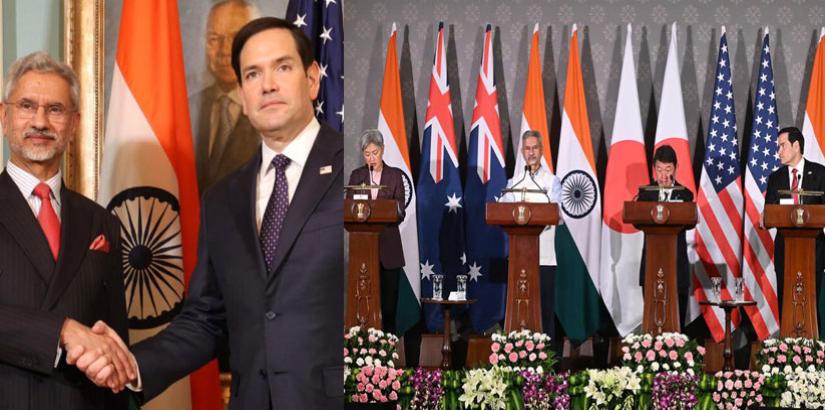
High-profile diplomatic visits between major powers invariably attract global attention, particularly in countries that believe such engagements may affect their own strategic interests. In that context, the May 23-26 visit of US Secretary of State (and officiating National Security Adviser) Marco Rubio to India was significant not merely for what was officially discussed, but for how it was interpreted across the region - especially in China.
While reactions in countries such as Pakistan or Bangladesh may not carry major strategic weight, Chinese discourse in the public domain surrounding the visit has been particularly revealing and focused on what the trip signaled strategically. Chinese analysts did not treat the visit as a routine diplomatic engagement. Instead, it was widely interpreted as part of a broader American effort to repair, deepen, and strategically recalibrate ties with India amid intensifying geopolitical competition in the Indo-Pacific.
A Visit Beyond Protocol
China appears to have viewed the visit as far more than a protocol interaction between India and the United States, especially coming immediately after President Donald Trump’s meeting with President Xi Jinping in China. Much of the discussion across Chinese digital media centered around a key question: why is Washington placing renewed emphasis on India at this particular moment?
The dominant interpretation was that the United States was attempting to repair and strengthen ties with India across sectors such as defence, trade, energy, and most importantly, the Quad framework.
The Kolkata Signal
Apart from the broader geopolitical messaging, considerable attention in Chinese discourse also focused on the itinerary itself and the strategic signaling behind the visit. Particular attention was paid to Rubio’s decision to begin his India visit in Kolkata rather than in New Delhi, which would normally have been the expected diplomatic starting point.
During his stay in Kolkata, Rubio visited the Missionaries of Charity, a gesture that some Chinese commentators interpreted as soft-power signaling - blending humanitarian imagery with diplomatic messaging.
More significantly, others viewed the Kolkata stop through a geopolitical and economic lens. Kolkata’s importance as an industrial centre and a major Bay of Bengal port hub in eastern India attracted attention within Chinese strategic discussions. Some analysts interpreted the visit in the context of global supply-chain restructuring and the broader “China Plus One” strategy aimed at reducing excessive dependence on Chinese manufacturing.
Linking Europe and Indo-Pacific
An even larger strategic message was read into Rubio’s participation in the NATO foreign ministers’ meeting in Sweden just days before attending the Quad foreign ministers’ meeting in New Delhi. Chinese commentators did not view these engagements in isolation. Rather, they interpreted them as part of a deliberate diplomatic arc linking European security coordination with emerging Indo-Pacific strategic alignments.
Within Chinese strategic circles, the visit was broadly seen as pursuing three major objectives.
The first, and perhaps the most obvious, was the effort to repair and stabilize US–India ties after periods of friction involving trade disputes, tariff disagreements, and occasional tensions during the Trump administration. The visit was also interpreted as an attempt by Washington to reassure New Delhi following Trump’s recent engagement with China and perceptions in some quarters of relatively cordial US–Pakistan interactions.
The second objective was linked directly to the Quad framework. Rubio’s participation in the Quad foreign ministers’ meeting on the final day of his India visit was widely seen as an effort to revitalize and reinforce the quadrilateral grouping at a time of growing strategic competition in the Indo-Pacific.
The third objective, according to Chinese analysis, was to draw India more firmly into the American economic and strategic orbit, particularly in view of India’s expanding long-term energy requirements.
Energy Diplomacy and Strategic Competition
Chinese commentary increasingly views energy diplomacy as central to future international relations, especially after recent tensions surrounding the Strait of Hormuz. Within this framework, part of the broader American objective is also perceived as encouraging India to gradually reduce dependence on Russian oil imports and diversify towards alternative energy partnerships aligned with Western strategic interests.
At the same time, Chinese academic voices also introduce limits to some of these narratives. For instance, a scholar identified as Chianfang from the Institute for National Strategic Studies at Shinoa University reportedly argued that American oil is unlikely to replace Middle Eastern energy sources in India’s import structure in the near future. At best, US energy supplies may serve as a diversification mechanism rather than a structural alternative to India’s long-term energy requirements.
Chinese View of Quad
The Quad continues to remain one of the most closely watched strategic arrangements from the Chinese perspective and is widely perceived there as an emerging anti-China coalition. However, Chinese commentary on the grouping is not entirely uniform.
Some analysts describe the Quad as an inherently uneven and somewhat awkward mechanism in which member states continue to pursue independent strategic calculations despite American attempts at coordination. A recurring assessment in Chinese discussions is that the effectiveness of the Quad depends substantially on India’s participation and strategic orientation. Any major Indian drift towards Russia — or even a limited rapprochement with China — could, according to this view, significantly weaken American regional positioning.
Another strand of Chinese commentary suggests that the Quad itself is becoming less ideologically coherent. In reality, however, the Quad was never fundamentally about ideology; it was primarily about converging strategic interests. Nevertheless, some Chinese analysts argue that the grouping is evolving into a more flexible and fluid framework rather than a rigid anti-China bloc. In their assessment, the Quad is increasingly shaped by shifting American priorities, changing geopolitical calculations, and the broader movement towards a multipolar world order.
India Through Chinese Lens
Chinese social media reactions to Rubio’s visit also reflected a degree of skepticism and criticism towards India. Several commentators focused on developmental and infrastructural contrasts between India and China. Discussions surrounding traffic congestion, pollution, aging infrastructure, and even the extreme summer temperatures in northern India were used by some online voices to project what they described as a “dismal” picture of India. Such commentary appeared intended to reinforce the Chinese perception that India remains far from emerging as a genuine alternative to China.
Yet beneath these dismissive observations lies a more serious strategic concern. A large section of Chinese discourse continues to believe that the United States is attempting to use India as a long-term counterweight to China. However, this perception is balanced by an equally important recognition that India is not merely a passive participant in American strategy. Chinese observers increasingly acknowledge that India possesses considerable strategic agency of its own.
Prime Minister Narendra Modi’s foreign policy is often described in Chinese strategic commentary as one based on strategic autonomy and multi-alignment. India is seen as engaging simultaneously with the United States, Russia, China, and other major powers without entering into rigid alliance structures or binding security commitments. From the Chinese perspective, this multi-alignment strategy allows India to preserve strategic space and maximize its geopolitical flexibility amid intensifying great-power competition.
The underlying concern
The final impression emerging from Chinese discourse is that Beijing remains deeply concerned about the Quad and the growing coordination among its four member states. Beneath the memes, criticism, and strategic commentary lies a recognition that the Indo-Pacific balance is gradually evolving.
Rubio’s India visit may officially have been presented as a diplomatic engagement, but in Chinese eyes it appeared to represent something larger - a visible signal of renewed American emphasis on India within the framework of long-term Indo-Pacific competition.
(The author is an Indian Army veteran and a contemporary affairs commentator. The views are personal. He can be reached at kl.viswanathan@gmail.com )







Post a Comment