
This moral dissonance is far from a Bangladeshi anomaly - it echoes across South Asia. From India to Pakistan to Sri Lanka, the lines between desire, dominance, and digital depravity are blurring faster than ever.
The NATO summit can indirectly transform India from a regional power into a West Asia stakeholder by integrating India into maritime security frameworks, supporting connectivity projects, strengthening intelligence ties, reinforcing India’s role as an alternative to China. The long-term outcome is that India could emerge as a pillar of stability linking Europe, the Gulf, and the Indo-Pacific
Japan has also proposed developing a Bay of Bengal–Northeast India Industrial Value Chain aimed at transforming the region into an integrated industrial zone. As part of the Free and Open Indo-Pacific vision, this includes strengthening cross-border connectivity with Bangladesh, Myanmar, Nepal and Bhutan.
China's expressed interest in modernising and upgrading both Chattogram and Mongla ports suggests the emergence of an interconnected infrastructure network linking the Bay of Bengal with southwestern China through Myanmar. If realised, such connectivity would enhance trade flows, improve regional logistics and deepen China's economic footprint across the Bay of Bengal littoral, while simultaneously increasing Bangladesh's importance as a regional transit and connectivity hub.
While Washington and New Delhi seek to strengthen bilateral ties with Colombo, Beijing has strategically engaged with the political forces that control the government. By engaging directly with actors at the core of Sri Lanka’s governance, Beijing appears to be signalling its strategic intent—projecting influence and reinforcing ideological ties.
This moral dissonance is far from a Bangladeshi anomaly - it echoes across South Asia. From India to Pakistan to Sri Lanka, the lines between desire, dominance, and digital depravity are blurring faster than ever.
Pakistan's transition from imminent default in 2023 to stability in 2025 exemplifies a remarkable macroeconomic reversal in South Asia. In contrast to Sri Lanka, which is mired in post-default restructuring, and Bangladesh, which is experiencing export stagnation, Pakistan's synchronized budgetary discipline and IMF-supported reforms have started to produce concrete outcomes
If there is a doctrine emerging from this moment, it is one of managed interdependence. India’s 25 percent import cap is not just a regulatory rule; it’s a political philosophy. It enshrines diversification as a matter of national security, insulating the economy from both volatility and coercion. No single country — whether Russia, Saudi Arabia, or the United States — should have the leverage to weaponize energy against India.
Yet, no matter how effectively India strengthens its regional partnerships, the enduring challenge of Pakistan and rising Chinese influence cannot be overlooked. Geopolitical churn may reshape alignments, but Islamabad’s propensity for misadventures continues to demand vigilance, alongside engaging in backchannel diplomacy.
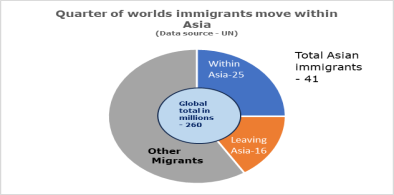
Demographic data show South Asia’s working-age population rose from 66.7% (2019) to 67.9% (2024), while the share in high-income countries fell from 65.6% to 64.7%. South Asia’s vast diaspora can further strengthen the region by leveraging knowledge networks, remittances, and investment flows.⁸
New Delhi recently received an official delegation from the Taliban government, led by Afghanistan’s Acting Foreign Minister — the first such visit since the formation of the Islamic Emirate in 2021
If trade tensions intensify, they could unravel years of progress in regional connectivity and energy integration. The same border that once symbolized shared progress could become a faultline of friction. Safeguarding these gains requires renewed dialogue, predictability, and partnership. Trade must be the foundation, not the faultline, of the Dhaka–Delhi relationship.
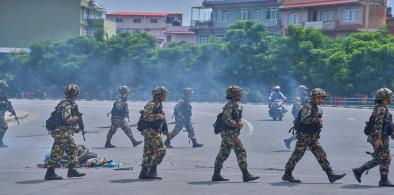
The movements in Sri Lanka, Bangladesh, and Nepal are a powerful reminder that South Asia's political landscape is being reshaped. A new generation, technologically savvy and politically aware, is unwilling to accept the status quo. The challenges are immense, but the opportunity for a more democratic, prosperous, and just future for the region is undeniable.
As Afghanistan struggles to rebuild, Bagram stands as both a scar and a lesson, a reminder of how intervention failed and how fragile independence can be. For India, backing the idea that no foreign power should return to that base is a way of saying the region must take responsibility for its own peace.
The time has come for New Delhi to consider formally recognizing the Taliban as Afghanistan’s legitimate government. The downsides are minimal; the strategic dividends substantial. Engagement would not mean endorsement of ideology but acknowledgment of geopolitical reality.
Taliban’s human rights record, particularly its regressive misogynistic policies are well known. No doubt developing relations with Taliban is a geostrategic requirement. But why did India have to ban women reporters from attending the joint press conference by the two foreign ministers?
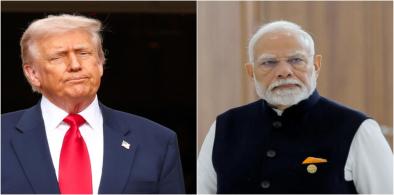
The Modi-Trump conversation may appear transactional, but its implications are strategic. If the trade agreement concludes by November, it could mark a turning point, redefining not just tariffs, but the trajectory of India’s global engagement.
The Yunus-led interim government appears, at present, to be leaning toward China. That makes sense in the short term: Beijing offers quick cash, infrastructure projects, and military hardware without raising questions about democracy or human rights. Yet the government’s near-total neglect of India is strategically reckless. Geography cannot be wished away
Far from isolating Russia, weakening China, or bending India and Brazil to Washington’s will, Trump's policies are uniting the Global South in ways unthinkable just a decade ago. They are creating new supply chains, strengthening regional blocs, and forcing nations to embrace economic self-determination.
For now, Washington still holds the advantage at sea. Its fleets and bases across the Indo-Pacific keep Malacca under watch, reminding Beijing that maritime power remains America’s strongest card. But on land, China is advancing incrementally, building assets and leverage that could at some point tilt the balance. The contest between the American thalassocracy and China’s continental reach has only just begun.