

India and Australia Enhance Strategic Relationship, Prioritise Maritime Domain Awareness to Secure Indo-Pacific
A significant factor that emerged after India launched Operation Sindoor against Pakistan in May 2025 was the strain in the India-US relationship under the Trump administration, driven by aggressive tariff disputes and policy friction. This indirectly accelerated India’s push to diversify partnerships, prompting New Delhi to lean more pragmatically into closer economic and strategic ties with middle powers such as Australia.
 Aug 10, 2026
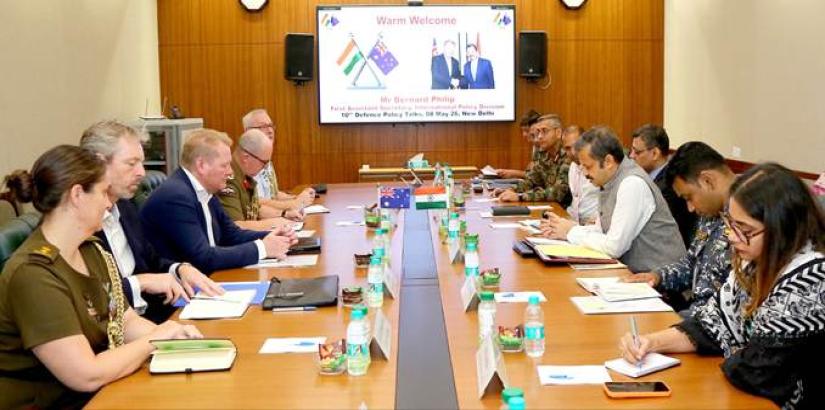
India’s Defence Minister Rajnath Singh and Australia’s Deputy Prime Minister and Minister for Defence Richard Marles co-chaired the second edition of the India-Australia Defence Ministers’ Dialogue at the Manekshaw Centre, New Delhi, on June 1, 2026.
The two ministers welcomed the significant progress in the bilateral relationship and reflected on the further development of consultation and cooperation since the inaugural edition of the dialogue on October 9, 2025, which marked five years since the elevation of ties to a Comprehensive Strategic Partnership in 2020.
Strengthening Maritime and Defence Cooperation
The two sides discussed advancements in bilateral maritime security cooperation and efforts to finalise the Joint Maritime Security Collaboration Roadmap. They agreed to progress collaborative maritime domain awareness activities through maritime patrol aircraft and explore opportunities to enhance undersea domain awareness. They also encouraged further cooperation between the Indian Coast Guard and Australia’s Maritime Border Command.
The ministers affirmed the importance of enhancing cooperation with regional partners to help maintain a free, open, peaceful, stable and prosperous Indo-Pacific. They underscored the importance of freedom of navigation and overflight, and their strong support for unimpeded trade in the region and other lawful uses of the sea consistent with international law, particularly the 1982 United Nations Convention on the Law of the Sea (UNCLOS).
India and Australia, as co-leads of the Indian Ocean Rim Association Working Group on Maritime Safety and Security, look forward to jointly hosting a Search and Rescue and tabletop exercise at the Maritime Rescue Coordination Centre, Chennai, in June 2026 to strengthen maritime safety and security cooperation in the Indian Ocean Region. The two sides undertook to explore arrangements to enhance procedural interoperability for exercises and operations, building on the 2020 Mutual Logistics Support Arrangement. They also agreed to continue aircraft deployments from each other’s territories to build operational familiarity.
The ministers announced that India and Australia would begin developing a Memorandum of Understanding regarding the Provision of Defence Articles and Defence Services as the next step in deepening defence industrial collaboration. They underscored the strategic importance of defence industrial collaboration and engagement, while welcoming Australia’s first defence trade mission to India and the Australia-India Defence Industry Roundtable, both held in October 2025, as a reflection of growth in the bilateral defence industry relationship. The two sides agreed to explore further exchanges, including through the Joint Working Group on Defence Industry, Research and Materiel.
Both ministers looked forward to exploring future defence science and technology research cooperation in new technology areas such as sensor technologies. The Australian Deputy Prime Minister invited India to participate in the 2026 Australian Defence Science, Technology and Research Summit.
Expanding Military Exercises and Interoperability
The ministers appreciated the growing engagement between their defence forces and looked forward to India’s enhanced participation in Exercise Talisman Sabre 2027. They welcomed Australia’s participation in India’s Exercise Milan in February 2026, and India’s participation in Australia’s Exercise Kakadu in March 2026. They looked forward to their countries’ participation in each other’s multinational air exercises in 2026, including operationalising the bilateral Implementing Arrangement on Air-to-Air Refuelling at Exercise Pitch Black.
The two sides noted with satisfaction the expansion of military cooperation into new areas. They welcomed the evolution of Exercise Austrahind and Exercise Ausindex, the two bilateral military engagements between India and Australia that have evolved significantly in scale, complexity and tactical scope since their inception.
Exercise Austrahind (Army) was started in 2022 as an annual alternating bilateral training event. It shifted from basic tactical-level exchanges to complex company-level joint operations in semi-desert, urban and semi-urban environments. The focus is on advanced sub-conventional warfare, counter-terrorism drills under UN mandates, drone integration and mutual equipment interoperability.
Exercise Ausindex (Navy) commenced in 2015 as a biennial maritime engagement and expanded from basic naval manoeuvres to highly sophisticated multi-dimensional warfare, focusing on complex anti-submarine warfare, integrated air operations, live-firing gunnery drills and coordinated surface combatant tracking.
Australia welcomed India’s inaugural participation in Operation Render Safe 2026. India welcomed Australia’s invitation for participation in the submarine rescue exercise Black Carillon.
The ministers welcomed the growing strategic convergence among Australia, India, Japan and the United States in the Indo-Pacific.
The two countries expressed strong support for the Quad Indo-Pacific Maritime Surveillance Collaboration initiative to be implemented initially in the Indian Ocean Region, as well as through subject-matter expert exchanges and tabletop exercises. The two sides welcomed India’s operationalisation of the Indian Ocean Region programme of the Quad Indo-Pacific Partnership for Maritime Domain Awareness through the Information Fusion Centre – Indian Ocean Region in Gurugram. They agreed to work to develop a Common Operational Picture across the Indo-Pacific by drawing upon the existing Indo-Pacific Partnership for Maritime Domain Awareness efforts.
In July 2025, India and Australia launched a three-year joint defence science and technology project, pairing India’s Naval Physical and Oceanographic Laboratory (NPOL) under the Defence Research and Development Organisation (DRDO) with Australia’s Defence Science and Technology Group (DSTG) to co-develop Towed Array Target Motion Analysis (TMA) algorithms for better undersea tracking and maritime security. This project’s goals and focus are to:
(a) Improve early detection and tracking of silent submarines and autonomous underwater vehicles (AUVs).
(b) Refine passive acoustic tracking using hydrophone arrays towed behind naval ships or submarines.
(c) Boost the reliability, efficiency and operational compatibility of joint surveillance tools.
In July 2026, India and Australia signed a new Joint Declaration on Defence and Security Cooperation, upgrading military interoperability, maritime security roadmaps and military industrial ties. Key milestones include Indian Rafale jets achieving first-time mid-air refuelling from an Australian KC-30A tanker during Exercise Pitch Black.
Underwater Domain Awareness: A Strategic Imperative
To counter China’s expanding naval footprint in the Indo-Pacific, secure vital sea lanes of communication and protect critical undersea infrastructure, India and Australia are prioritising Underwater Domain Awareness (UDA). China’s growing deployment of nuclear and conventional submarines, alongside ocean-mapping vessels in the Indian and Pacific Oceans, poses a direct security challenge to New Delhi and Canberra.
Vast amounts of global commerce and critical energy supplies transit through Indo-Pacific chokepoints, making undersea stability an economic necessity for both nations. Safeguarding vital subsea communication cables and data pipelines from espionage or physical sabotage has elevated the importance of deep-sea monitoring.
Australia’s advanced research in underwater acoustics combines with India’s vast operational reach in the Indian Ocean to build robust Underwater Domain Awareness (UDA). This union bridges the gap between high-end technological innovation and real-world deployment, creating a combined force that improves regional maritime security beyond what either nation could achieve alone.
Australia brings advanced research ecosystems, niche acoustic sensors and algorithm development, while India contributes expanding defence manufacturing and large-scale industrial capacity. Australian acoustic models and uncrewed underwater systems are tested and refined directly through India’s active, persistent presence across critical Indian Ocean chokepoints. Combining Australia’s signal-processing capabilities with India’s wide network of surface and air platforms upgrades real-time threat detection. There are also strategic and regional advantages, such as better tracking of subsurface movements in deep and shallow waters and securing critical undersea cables and maritime infrastructure.
Economic, Resource and People-to-People Ties
India and Australia are heavily promoting their bilateral ties due to shared geopolitical goals in the Indo-Pacific, growing economic complementarities and strong people-to-people connections. Bilateral trade exceeds AUD 50 billion, anchored by the Australia-India Economic Cooperation and Trade Agreement (ECTA), making the partnership a vital pillar of regional stability.
In terms of economic and resource partnerships, Australia holds vast reserves of lithium, cobalt and rare earths, which directly support India’s manufacturing, clean energy and technology ambitions. In terms of energy security, the operationalisation of civil nuclear arrangements allows Australia to supply uranium for India’s peaceful civilian energy programme.
A major move favouring India under the Economic Cooperation and Trade Agreement (ECTA), signed between India and Australia on April 2, 2022, and effective from December 29, 2022, is that Australia expanded to 100% duty-free access for all Indian tariff lines starting January 1, 2026. This means 100% of Indian goods now enter Australia completely tax-free. This final phase builds on the agreement signed in December 2022, deeply linking Indian manufacturing, textiles and gems with Australian raw materials such as coal and non-ferrous metals. Labour-intensive industries such as textiles, leather, jewellery and engineering stand to gain significantly. India also receives preferential access to vital Australian raw materials and minerals.
Australia a Top Draw for Indian Students
Progress in education and cultural bridges is also noteworthy. In higher education, Australia remains a top destination for more than 100,000 Indian students, backed by mutual qualification recognition.
A vibrant and fast-growing Indian community in Australia further strengthens social and political goodwill.
A significant factor that emerged after India launched Operation Sindoor against Pakistan in May 2025 was the strain in the India-US relationship under the Trump administration, driven by aggressive tariff disputes and policy friction. This indirectly accelerated India’s push to diversify partnerships, prompting New Delhi to lean more pragmatically into closer economic and strategic ties with middle powers such as Australia.
US protectionism and punitive tariffs made India eager to secure alternative markets and reliable supply chains, giving fresh momentum to bilateral trade frameworks with Canberra, such as the Australia-India ECTA. When friction rose with Washington, India relied on its time-tested strategy of multi-alignment, building robust bilateral military and critical mineral partnerships with Australia to offset unpredictable American trade and sanction pressures.
Anchored in permanent structural convergence and driven by shared geopolitical interests in the Indo-Pacific, expanding economic and critical mineral supply chains, and deep institutional frameworks rather than short-term political alignment, enhanced India-Australia relations are widely expected to be long-lasting and mutually beneficial.
(The author, a former spokesperson, Defence Ministry and Indian Army, is a strategic affairs analyst. The views expressed are personal. He can be contacted at wordsword02@gmail.com, LinkedIn: https://www.linkedin.com/in/anil-bhat-70b94766/, X: @ColAnilBhat8252, and YouTube: https://www.youtube.com/channel/UCPJKaZOcAt9K8fcDkb_onng.)





Post a Comment