
The EU therefore will need to depend on other regions to bridge the manpower gap and South Asia could be an important source, but global partnerships in skilling will need to happen in a big way.
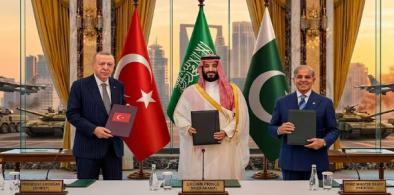
Taken together, these developments should ring alarm bells. The convergence of foreign military-industrial interests, Islamist political forces, and great-power rivalry risks turning Bangladesh into an epicenter of proxy competition and ideological confrontation. For a nation that has paid dearly for its independence and pluralistic identity, the cost of such entanglements may prove far higher than the short-term gains promised by arms deals and infrastructure projects.
Sri Lanka's case highlights the central weakness of the ICC’s complementarity principle. The Rome Statute grants jurisdiction only where states are unwilling or unable genuinely to carry out the investigation or prosecution. Sri Lanka maintains functioning judicial institutions, conducts some prosecutions, and has established reparations frameworks, thereby technically satisfying the ability threshold while systematically failing to deliver accountability for conflict-related crimes.
If Davos had a clear centre of gravity this year, it was technology—not geopolitics. The tech industry arrived in force, underscored by high-profile appearances from Elon Musk and Nvidia CEO Jensen Huang. The message was unmistakable: this is where attention, ambition, and capital are converging. With extraordinary sums being poured into artificial intelligence, unease among lenders and investors is understandable. Yet many executives were keen to reassure markets that fears of an AI bubble were overstated.
Strategically, these developments underscore the importance of regional counterterrorism cooperation and rigorous monitoring of cross-border arms flows. The proliferation of foreign-supplied weapons into Pakistan not only strengthens terrorist organizations but also threatens regional stability. Each attack executed with U.S.-origin rifles or advanced tactical gear reinforces the need for Pakistan’s zero-tolerance policy against militancy while exposing the organized external support networks that continue to embolden groups like the TTP.
The EU therefore will need to depend on other regions to bridge the manpower gap and South Asia could be an important source, but global partnerships in skilling will need to happen in a big way.
Women have to take risks at every step while walking down the streets. In the vast area of Bangladesh, there is hardly any place where a woman can breathe safely. Hatred towards women is being spread at every level of society.
The two major reforms in labor and land policies being politically sensitive will be a dampener if not implemented. These are political decisions much like the aborted advantageous farm reforms.
Building trust within our societies and institutions is paramount, as evidenced by the correlation between trust levels and resilience during crises such as the COVID-19 pandemic.
What is of significance and runs parallel in both the above verdicts is the Supreme Court's innate concern for upholding democratic values in the Indian polity.
The United States wants to keep the South Asian region stable, seeking to neutralize the overdependence of any nation on China. Bangladesh, because of its geostrategic position, is being lured to align Dhaka with Washington’s strategic objective for a free and open Indo-Pacific.
While the contentious Durand Line has become one of the main reasons for cross-border skirmishes between Afghanistan and Pakistan, the Taliban has turned from being seen as an ideological ally that can give Pakistan 'strategic depth' against India, to a troublesome neighbour that is now viewed with deep suspicion.
Since 2019, China has been building 628 dual-use military villages (termed ‘Xiaokang’ or ‘well-off’ villages) along the southern border of the Tibet Autonomous Region (TAR), including inside Bhutan and in Arunachal Pradesh, India.
Diplomatic efforts must be intensified to address the ongoing border situation with China and safeguard Bhutan's sovereignty. It is also imperative to address the unresolved Bhutanese refugee issue and protracted family separation among Bhutanese Americans.
The time has come to drastically curb the unchecked and ultra-constitutional powers of the army chief, subject the intelligence agencies to public scrutiny and accountability, and limit their influence over domestic and foreign policy.
Much more violence could be expected in Manipur, with Meitei radicals waging all-out war against the Kuki-Zo, with Nagas fearing they would be the next target since the Arambai Tenggol alone outnumbers the tribals of Manipur hugely.
The Maldives has undergone a radical transformation. To see this as playing the India or China card would be a miscalculation. Indeed, the strategic narrative of what is going on is very different.
While the NPP’s visit to India exemplifies changes in its political understanding, it has an important dimension in Sri Lanka's domestic politics. New Delhi appears to have judged that the NPP coalition has the potential to play a decisive role in the upcoming presidential election.
The Pakistani military went all out to deliver this vote. Its idea to have direct control of the political situation to what it comprehends will bring stability to Pakistan’s crisis may be a pipe dream with a fractured verdict leaving Pakistan open to elements that will only compound its instability.
Rakhine's lack of effective government structure and civil order will continue to be a significant source of worry for the region, particularly in terms of humanitarian, security, economic, and political issues.