

Bangladesh Drifting Into A Nexus Of Military Dependency And Proxy Competition? Ominous Consequences For India, South Asia
Taken together, these developments should ring alarm bells. The convergence of foreign military-industrial interests, Islamist political forces, and great-power rivalry risks turning Bangladesh into an epicenter of proxy competition and ideological confrontation. For a nation that has paid dearly for its independence and pluralistic identity, the cost of such entanglements may prove far higher than the short-term gains promised by arms deals and infrastructure projects.
 Jan 27, 2026
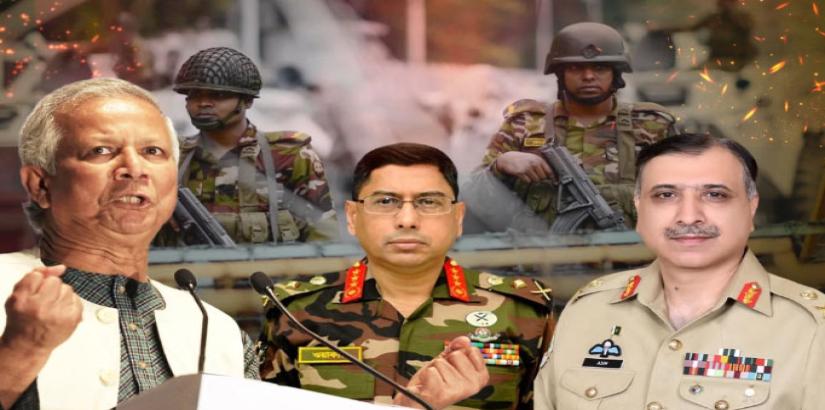
At a time when Bangladesh should be preparing for a democratic handover of power, the interim Yunus regime has instead unveiled a decision that could redraw the country’s strategic trajectory for decades. The announcement of a proposed military industrial zone near the India-Bangladesh border - potentially involving China, Pakistan, and Turkey - has triggered quiet alarm in regional capitals and raised urgent questions about Dhaka’s evolving security alignments.
The most striking of these decisions is the announcement of a large-scale defense industrial zone, informally dubbed a “Military Industrial Zone”, near the Indo-Bangladesh border. According to media reports, approximately 850 acres of land in Mirsarai, Chittagong district - previously earmarked for an “Indian Economic Zone” - have now been reallocated for defense manufacturing purposes. The timing alone is unusual. The geopolitical implications are far more serious.
Speaking to reporters, Chowdhury Ashik Mahmud Bin Harun, Executive Chairman of the Bangladesh Investment Development Authority (BIDA), justified the move by citing global trends. “In the current global context, demand for defense products is rising, and supply constraints have highlighted the importance of having domestic production capacity”, he said.
He further noted that while Bangladesh currently has only one state-run arms manufacturing facility, the proposed zone would be developed by the private sector with both local and foreign investment, and that defense equipment produced there would be exported abroad.
What Chowdhury declined to clarify - calling the matter “diplomatic and bilateral” - was which foreign partners were expected to participate. Yet multiple credible media reports have already pointed to Turkey, China, and Pakistan as keen contenders for establishing military hardware manufacturing facilities within this new zone.
Growing Presence Of Pakistan, China
This revelation has raised eyebrows not merely because of who the interested partners are, but because of when and where the project is being advanced. Announcing a defense-industrial mega-project weeks before a national election violates the spirit, if not the letter, of caretaker neutrality. Although Chowdhury Ashik insisted the initiative would continue regardless of political change, describing defense industrial capacity as a “non-partisan national priority”, defense manufacturing is never politically neutral - especially when foreign powers are involved.
Since the regime change of August 2024, Pakistan and China, in particular, have emerged as increasingly assertive actors in Bangladesh. Turkey has followed close behind. China is already deeply entrenched through infrastructure projects, most notably the long-discussed Teesta Barrage Project. On January 25, 2026, the Chinese Embassy in Dhaka formally announced its participation not only in the Teesta project but also in the construction of a Bangladesh–China Friendship Hospital.
These announcements came despite public warnings from newly arrived US Ambassador to Bangladesh, Brent Christensen, who cautioned against the long-term risks of deep Chinese military and strategic entanglement. Christensen’s remarks were not casual diplomatic boilerplate. They sounded more like an early alarm bell.
Indeed, Ambassador Christensen’s remarks were not merely a routine diplomatic caution. Bangladesh, once viewed in Washington and New Delhi as a country that carefully balanced competing global interests, now appears to be edging toward a far deeper embrace of Beijing – with Pakistan quietly positioning itself as a facilitating partner in that transition.
Christensen’s concern is not theoretical, nor is it rooted in speculation. Since Yunus assumed effective control, Bangladesh has revived and expanded discussions on acquiring advanced Chinese military hardware, including fourth-generation fighter jets such as the J-10C. These negotiations are reportedly being conducted not only directly with Beijing but also through Sino-Pakistani joint-venture channels – an arrangement that further complicates Bangladesh’s strategic posture.
Strategic Implications Of Defence Deals
The Armed Forces Division, under Principal Staff Officer Lieutenant General S.M. Kamrul Hasan, has engaged in multiple high-level defense consultations with Chinese counterparts. Delegations have visited China repeatedly in recent months to explore modernization options for the Bangladesh Air Force, particularly as aging aircraft near the end of their service lives.
In parallel, Dhaka has intensified talks with Pakistan over the JF-17 Thunder fighter jet, jointly developed by China and Pakistan and aggressively marketed by Islamabad as a cost-effective multirole platform. Pakistan has also offered fast-tracked delivery of Super Mushshak trainer aircraft, bundled with a full training, maintenance, and long-term support ecosystem. Islamabad has made little effort to conceal these engagements.
Official statements confirm that Pakistan Air Chief Marshal Zaheer Ahmed Baber Sidhu held detailed discussions with his Bangladeshi counterpart, Hasan Mahmood Khan, covering both JF-17 sales and accelerated delivery of trainer aircraft.
This is where the strategic implications deepen. Defense procurement is never a simple transaction. It binds the recipient country into decades-long dependency cycles involving spare parts, software updates, pilot training, and logistical support. By aligning itself so heavily with Chinese and Pakistani platforms, Bangladesh risks locking its military into a closed ecosystem dominated by Beijing and Islamabad, with limited flexibility to diversify or disengage in the future.
The defense dimension, however, is only one part of a much broader pattern. Yunus’s administration has also opened the door wide to Chinese infrastructure penetration across strategically sensitive regions. Syeda Rizwana Hasan, a key adviser to the regime, recently announced that China is eager to begin work on the Teesta River Master Plan “as soon as possible”.
The statement was made in the presence of Chinese Ambassador Yao Wen during his visit to Rangpur - uncomfortably close to India’s strategically vital Siliguri Corridor, often referred to as the “Chicken’s Neck”.
The symbolism of that visit was impossible to miss. When viewed alongside the Chinese-built submarine base at Pekua on Bangladesh’s southern coast, Beijing’s growing footprint suggests ambitions that extend well beyond development assistance. For New Delhi and Washington alike, the pattern is deeply unsettling.
China’s reaction to US concern has been unusually sharp. On January 22, the Chinese Embassy in Dhaka publicly rebuked Ambassador Christensen’s remarks, calling them “irresponsible”, “utterly unfounded”, and driven by “ulterior motives”. Such language is rare in diplomatic exchanges involving Bangladesh and betrays Beijing’s sensitivity to growing scrutiny of its expanding role.
During his confirmation hearing before the US Senate, Christensen acknowledged these risks openly. Responding to Senator Pete Ricketts’s warning that Chinese fighter jet sales would bind Bangladesh to Beijing’s defense industry for decades, Christensen agreed that the consequences would be long-lasting. He pledged to articulate the dangers of Chinese military dependency while highlighting the benefits of closer US–Bangladesh military cooperation.
Beijing’s unusually harsh rebuttal reveals urgency. China is not merely offering arms or infrastructure; it is seeking strategic alignment. Pakistan’s involvement reinforces this architecture, creating a Sino-Pak axis that offers Bangladesh military hardware, financing, training, and diplomatic cover—while steadily reducing Western leverage.
Jamaat Engagement Has Political Consequences
Compounding these concerns is Washington’s own increasingly controversial approach. On January 22, 2026, The Washington Post reported that the United States is quietly courting Bangladesh’s once-banned Islamist party, Jamaat-e-Islami, betting on engagement over isolation. Jamaat is an offshoot of the Muslim Brotherhood and openly advances an agenda aimed at reshaping Bangladesh’s democratic fabric under Sharia rule.
Historical records further complicate this outreach. A confidential intelligence report dated August 28, 1945, reveals that Sheikh Hassan al-Banna, founder of the Muslim Brotherhood, had links with Nazi intelligence during World War II and acted as a conduit for transmitting information to Berlin. According to the document, messages were sent using a German cipher machine loaded onto a fishing vessel anchored at Abu Qir port in Alexandria - a boat later intercepted by British intelligence in 1943.
The implications are jarring. At a moment when Bangladesh is drifting toward a defense-industrial partnership with China, Pakistan, and Turkey, Washington’s apparent willingness to engage Jamaat-e-Islami risks further destabilizing the country’s fragile political equilibrium.
Taken together, these developments should ring alarm bells. The convergence of foreign military-industrial interests, Islamist political forces, and great-power rivalry risks turning Bangladesh into an epicenter of proxy competition and ideological confrontation. For a nation that has paid dearly for its independence and pluralistic identity, the cost of such entanglements may prove far higher than the short-term gains promised by arms deals and infrastructure projects.
Bangladesh Repeating History?
Bangladesh’s history offers a clear lesson: external powers rarely bear the long-term costs of internal instability. Those costs are paid by the nation itself. The convergence of foreign military-industrial ambitions, Islamist political maneuvering, and strategic indecision threatens to erode the country’s sovereignty in slow but lasting ways.
South Asia has seen this pattern before: strategic ambiguity exploited by external powers, domestic actors emboldened by foreign backing, and institutions weakened in the name of expediency. Bangladesh now stands at risk of repeating that history.
If the country drifts into a nexus of military dependency, ideological experimentation, and proxy competition, the consequences will not remain confined within its borders. Stability in eastern South Asia depends on Bangladesh remaining sovereign, pluralistic, and strategically balanced. The window to preserve that balance is narrowing - and the decisions being made today will define the region’s security tomorrow.
(The author is a journalist, writer, and editor-publisher of the Weekly Blitz. He specializes in counterterrorism and regional geopolitics. He can be contacted at salahuddinshoaibchoudhury@yahoo.com, follow him on X: @Salah_Shoaib )







Post a Comment