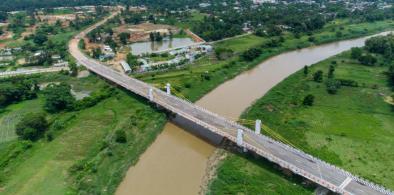


If India focuses on improving bilateral economic and connectivity initiatives with Bangladesh, the economic development of this region is inevitable.
The Ghost Murmur AI rescue of a U.S. pilot in Iran is an epochal event in the history of warfare. It shows how new technologies can be used to go around old restrictions and can allow carrying out operations that were not possible a decade ago.
India is managing intense US pressure about its involvement in the Chabahar port, with Washington providing only a six-month sanctions waiver set to expire in April 2026. While India has officially stated that exiting the project is "not an option" due to strategic interests in connecting with Afghanistan and Central Asia, it is actively negotiating for a long-term waiver to the sanctions.
The battlefield is no longer defined by geography alone. It extends into space, into networks, into supply chains, and into the human mind. Conflict today is as much about disruption as it is about destruction; as much about perception as it is about position. Lines are blurred, between soldier and system, between civilian and combatant, between war and peace.
The relationship between Resolution 80/23 and India’s 2026 CD statement illustrates a recurring challenge in contemporary arms control: how to build durable global norms in a world of divergent security contexts. Both documents share a foundational conviction — that human judgment must remain at the core of nuclear decision-making, and that AI introduces risks that demand urgent, coordinated attention.
If India focuses on improving bilateral economic and connectivity initiatives with Bangladesh, the economic development of this region is inevitable.
The manner in which bulldozers as tools of retaliatory State violence and punishment are being normalised now is akin to illegal 'encounter' (extra-judicial) killings which have now been normalised by police forces across the country.
I learned, too, that on average, the Gulf countries send half a dozen coffins a week to Nepal with the remains of somebody’s beloved family member. This didn’t just apply to Nepal — workers from India, Bangladesh, Pakistan, and African countries faced a similar fate.
The root causes behind the food insecurity status of Sri Lanka are two-fold. Short-sighted policies such as the chemical fertilizer ban imposed by the Rajapaksa government generated a domino effect on agricultural production. Additionally, foreign exchange constraints severely limited food imports.
As Mahatma Gandhi said we should be the change that we want to see or in other words we should practice what we preach. That is never the case. So we heard pontification on how we should reduce the carbon footprint to make this world sustainable by people who never practice sustainable living in their personal life.
If trade and cultural relations between Bangladesh and Northeast India improve, the picture of the entire region will change.
Writers of the three winning entries, one from Pakistan and two from India, read their works out online at the Spelt conference to a full auditorium. The meritorious list included four stories from Pakistan, three from India, two from Nepal and one from the Philippines.
The ranking process is a vicious circle wherein higher-ranking institutions can mobilize more resources and vice versa. Unfortunately, those institutions which are not part of this frenzy competition will eventually be excluded from the higher education space dominated by the current neoliberal discourse.
The space industry is keenly looking forward to the Indian government's new space policy and hoping for ease of doing business to take a practical shape.
What applies to India can also work for other nations. So one hopes that world leaders participating in COP27 will reach actionable decisions and obtain the funding already promised by the developed countries to make a serious start to creating a sustainable global environment and avoid further climate change within the next few decades.
There can be no doubt that the direction of the Ukraine conflict may cast a long shadow on India’s presidency.
Taking a cue from Africa, can South Asian countries conduct strategic and collective consultations to build a nest?
Following the crash of a Cheetah helicopter on 5 October 2022, the second such helicopter to crash this year (the earlier one was in March 2022), the Indian Army Wives Agitation Group (AWAG) wrote a letter to Prime Minister Narendra Modi expressing anguish over the continued use of the outdated Cheetah and Chetak Light Utility Helicopters (LUH), which have claimed many lives of experienced and young officers.
Today SEWA has some 2.1 million members making it the single largest trade union of its kind in India serving and representing self-employed women workers in 18 states
Interestingly CCI’s ruling was not the result of or in response to any complaint by a user, vendor, advertiser or customer. It came out of a summer project done by three student interns, who studied the EU case and its applicability to Indian conditions