

The Delhi Tightrope: Can India Lead BRICS without Triggering a Trumpian Trade War?
In 2026, the “strategic autonomy” that we so often discuss must evolve from a defensive crouch to a balanced offensive infrastructure play. India’s success will be measured by its ability to convince the Trump administration that a stable, digitally-sovereign BRICS is actually a better trade partner than a chaotic, bankrupt one.
 Mar 18, 2026
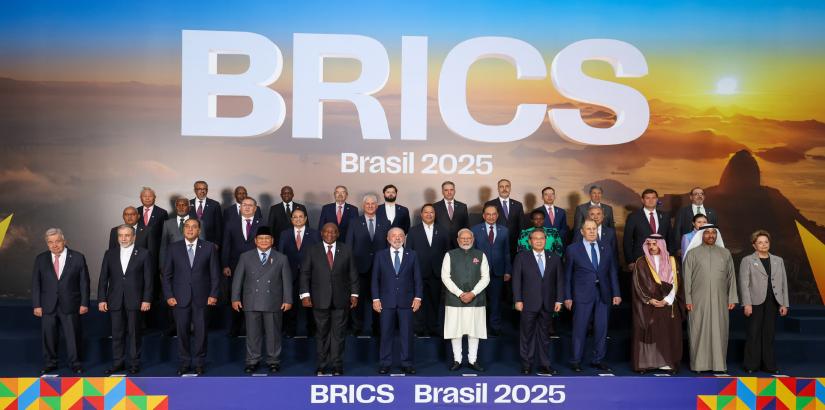
There is a specific kind of electricity in the air in New Delhi this year. On the surface, it’s the usual hum of hosting a global summit. But beneath the “Humanity First” banners, there is a palpable sense of high-stakes gambling. Geopolitics, in its purest form, is the art of navigating friction. But as we enter 2026, the friction has become a firestorm. India has officially assumed the chairship of BRICS in 2026, a year that was supposed to be about institutionalizing the expansion of the bloc has become a battle for the very soul of the global financial order.
When the 47th President of the United States took to Truth Social to demand a commitment that BRICS would neither create a new currency nor back alternatives to the dollar on pain of 100% tariffs, the diplomatic “polite era” ended. For India, the 2026 Summit isn’t just about “Building for Resilience”; instead, it’s about preventing a collision between the Global South's aspirations and an “America First” dogma. For India, the challenge is binary: lead the Global South toward autonomy, or keep the peace with its largest trading partner.
Local Currency Settlement
You cannot topple a hegemony with just a slogan, and India knows it. To understand the current tension, one must realise that in the current economy, the US dollar is not merely a medium of exchange; it is the ultimate psychological and geopolitical tether that significantly contributes to global hegemony of the United States of America. For decades, the world has operated under a form of “weaponized interdependence.” The greenback’s dominance, which accounts for nearly 90% of global foreign exchange transactions, clearly implies that the US doesn't just manage a currency; it manages the world’s “off-switch”. In such circumstances, Trumps’ “tariff first” diplomacy isn’t just a bluff, but a structural reality.
We’ve already seen the impact: early in 2025, even vocal de-dollarization advocates like Brazil’s Luiz Inácio Lula da Silva quietly retreated from common currency talk after 50% “witch-hunt” tariffs were slapped on Brazilian exports. Even Vladimir Putin, the man who once flaunted a prototype BRICS banknote, has had to publicly clarify that Russia isn't seeking to “abandon” the dollar, merely to survive without it. India’s strategy, therefore, must be one of “stealth erosion” rather than overt revolution.
The research is clear: the dollar’s share of global reserves has slipped by 12% over the last decade when gold is factored in (MDPI, 2025). But the dollar still facilitates nearly 90% of global FX transactions. Therefore, it is essential that India’s pivot toward local currency settlement via the New Development Bank (NDB), which aims to hit its target of 30% local currency lending by the end of 2022-2026 strategy must be framed not as an anti-dollar coup, but as “financial resilience.” We aren't trying to topple the king; we are just building a sturdier lifeboat for when the king’s interest rates become too expensive for the poor to breathe.
DPI: India’s Digital Third Way
While the West worries about “hegemony,” the Global South worries about “sovereignty.” Where trade and security pacts often trigger alarms in Washington, technology provides a safer ground for leadership and this is precisely where India’s true leverage lies. The 2026 theme of “Innovation” isn't just a placeholder; it’s the launchpad for the BRICS DPI Repository.
Think of it as the “Digital Non-Aligned Movement.” The US offers a “Big Tech” model that extracts data; China offers a “Great Firewall” model that exports surveillance. Amid such models, India’s “Digital Doctrines”, anchored by the population-scale success of UPI and Aadhaar offer a third path: open-source, interoperable, and sovereign. By institutionalizing the “India Stack” as a BRICS-wide standard, New Delhi isn't just exporting code; it is exporting a democratic alternative to digital colonization. This is the “Humanity First” vision that EAM S. Jaishankar articulated; it is hard-coded into the tech, making it a neutral tool that even a transactional Washington would find hard to sanction without appearing anti-innovation.
The Bridge Builder’s Success
History does not reward the indecisive, and 2026 will be the year of the hard choice. The transactional nature of modern power means that “sitting on the fence” is no longer a viable position and “strategic partnership” has become a term that is often handled with a butcher’s knife, not a surgeon’s scalpel. India is now being squeezed to choose sides.
But here is the twist: a fractured world actually needs a shock absorber. If India can successfully codify its green finance models and digital repositories into binding multilateral standards as was hinted in the 2025 Rio de Janeiro Declaration, it would create a world where the Global South is not just limited to being a victim of Northern “grave disruptions”.
In 2026, the “strategic autonomy” that we so often discuss must evolve from a defensive crouch to a balanced offensive infrastructure play. India’s success will be measured by its ability to convince the Trump administration that a stable, digitally-sovereign BRICS is actually a better trade partner than a chaotic, bankrupt one.
Geopolitics is ultimately a contest about who gets to write the rules of the future. If India treats the 2026 Summit as a routine diplomatic exercise, it will eventually find herself to be sidelined by the louder voices in the room. But if it leans into its role as the bridge between the “Humanity First” aspirations of the South and the “America First” realities of the North, it won't just survive the Trumpian era – it will define it. The tightrope is narrow, but for New Delhi, it is the only path to the top.
(The author is an undergraduate law student at Dr. B.R. Ambedkar National Law University. Her research interests revolve around the institutionalization of India’s foreign policy priorities, with a specific focus on the intersection of public policy and international law. Views expressed are personal. She can be reached at kaashvimalik27@gmail.com )





Post a Comment