

Bhutan Under China’s Doklam Shadow: Delhi Needs to Move Away From Protector-Protected Dynamic With Thimpu
A key consideration for Delhi is Bhutan’s occasional denial or downplay of any Chinese encroachment on its territory, even when satellite data suggests otherwise. This is coupled with a growing perception within Bhutan that India is preventing it from completing its border negotiations with China. Although Thimphu remains closely aligned with Delhi, there is growing interest in expanding its engagement with China.
 Mar 25, 2026
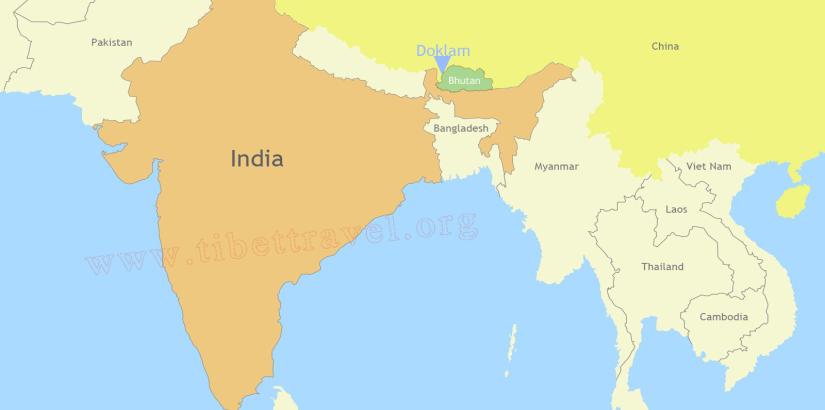
China’s gradual expansion of territorial claims, infrastructure development, and village construction in Bhutan represents a shift in the strategic geography of the Eastern Himalayas. The Doklam Plateau, located at the India-Bhutan-China trijunction, remains a critical geostrategic linchpin due to its proximity to the Siliguri Corridor, the only land-based link between mainland India and its Northeastern region.
The 2017 Doklam standoff ended in mutual disengagement. However, satellite imagery indicates that China has incrementally continued its territorial expansion in Bhutan over the past nine years. It has also engaged economically and culturally with Bhutan and has pushed for the settlement of border disputes in the past decade.
These developments, coupled with Bhutan’s growing desire for strategic autonomy and India’s predominantly reactive and episodic posture, risk altering the status quo and undermining India’s national security. India must shift to a more proactive approach in the eastern theatre. It needs to build up surveillance and connectivity capabilities, deepen diplomatic and economic engagement with Bhutan, without compromising trust and historical bilateral ties with the Kingdom of Bhutan. With China, India must build up mechanisms to monitor and deter Chinese salami-slicing tactics and prioritise standing firm on strategic redlines.
Buffer State and Chokepoint
The small Himalayan state of Bhutan has historically functioned as a buffer state between India and China. It occupies a strategically critical position as its western border lies adjacent to China’s Chumbi Valley, a high-altitude wedge of land between Bhutan and India’s Sikkim state. To its east, it borders the state of Arunachal Pradesh, where China claims around 90,000 square kilometers of land as part of Zangnan, or South Tibet.
The most crucial geographic factor for India is the Doklam Plateau’s proximity to the Siliguri Corridor, also known as the “Chicken neck” – a 60 km-long strip of land that is merely 22 km wide at its narrowest – which is the only connecting link between mainland India and the eight northeastern states. Siliguri is a vulnerable chokepoint for India, as it is surrounded by Nepal and Bangladesh, and lies very close to Bhutan and China. It is the main, often exclusive, route for transporting goods, trade, and troops to the Northeast. Therefore, if blocked, the entire region would be cut off from the rest of India.
Doklam became a focal point of this vulnerability in 2017 during the 73-day standoff between India and China over Chinese road construction on the plateau. The crisis ended with mutual disengagement and temporary stability, but the underlying territorial dispute remains unresolved. Since then, China has continued to pursue territorial claims in Bhutan — the most recent being in 2020 on the Sakteng Wildlife Sanctuary in Eastern Bhutan, which borders Arunachal Pradesh.
Salami-Slicing and Strategic Autonomy
Satellite imagery indicates that China has incrementally continued its territorial expansion in Bhutan. It has constructed roads, military facilities, dual-use infrastructure, and villages in Doklam. Tibetan grazers have also reportedly continued to encroach on Bhutanese land. These activities reflect the “salami-slicing” tactic adopted by China, where low-level incursions are made to alter borders and exert influence without triggering a conflict. Importantly, these developments have occurred after the 2017 military disengagement, indicating that the underlying strategic competition in the Eastern Himalayas remains unresolved.
A key consideration for Delhi is Bhutan’s occasional denial or downplay of any Chinese encroachment on its territory, even when satellite data suggests otherwise. This is coupled with a growing perception within Bhutan that India is preventing it from completing its border negotiations with China. Although Thimphu remains closely aligned with Delhi, there is growing interest in expanding its engagement with China.
While China and Bhutan do not maintain formal diplomatic relations, border negotiations have continued intermittently since the 1980s, including proposals for land swaps. Economic and cultural engagement between the two countries has also increased in recent years. These developments coincide with Bhutan’s efforts to diversify its relationships, reduce its dependence on India, and preserve its autonomy. Taken together, these points suggest that Bhutan prioritizes maintaining stable relations with China and avoiding escalation, even at the potential cost of territory.
For Delhi, the conclusion is not Bhutan’s strategic recalibration toward China, but rather a quest for increased diplomatic flexibility and strategic autonomy. It does reduce India’s ability to assume automatic alignment.
India’s response to developments in Bhutan and Doklam has been characterized by prolonged periods of inattention, followed by episodic, reactive mobilization. This approach creates a time asymmetry in which China can pursue its gradual territorial expansion in Bhutan much faster than India can respond. Periods of diplomatic thaw in Sino-Indian relations may further exacerbate complacency.
Proactive Strategising, Stricter Red Lines
India must adopt a more proactive and sustained strategy toward Bhutan, combining both internal and external balancing measures in order to preserve the status quo.
First, Delhi must treat the 2017 Doklam standoff as a persistent strategic variable, not a one-off isolated incident. It should move from episodic to continuous monitoring. ISR (Intelligence, Surveillance, Reconnaissance) and early-warning systems must be strengthened around the trijunction.
Second, India must focus on building up its own connectivity, infrastructure, and response time. Development of alternative routes connecting the mainland to the Northeast through Bangladesh and Myanmar should be prioritised and accelerated.
Toward Bhutan, India must ramp up its diplomatic, economic, and cultural engagement. India’s posture must reflect a more genuine partnership, and not merely an asymmetric protector-protected dynamic. Bhutanese autonomy must be respected while expanding collaboration in hydropower projects, trade, and education.
Finally, China’s preoccupation with the United States and Taiwan, as well as Delhi’s diplomatic thaw with Beijing, should not be interpreted as a window for strategic complacency. India must closely monitor and expose China’s salami-slicing tactics. It must prioritize clarity and assertiveness on its strategic redlines. India must also push for greater transparency in border negotiations and work toward increased trilateral confidence-building measures, where feasible.
(The author is pursuing her MSc in International Relations and is a student research assistant at the S. Rajaratnam School of International Studies at Nanyang Technological University, Singapore.Views expressed are personal. She can be reached at NAISHA001@e.ntu.edu.sg and https://www.linkedin.com/in/naisha-khan-a06b53217/ )





Post a Comment