

After the Begums: Battle For The Soul Of Bangladesh Has Just Begun
The optimistic view is that the “Twin Election” will force a compromise. The referendum provides a mandate for reform that even a BNP government cannot ignore. The “July Charter”, if ratified, creates checks on executive power that did not exist before. The students, even if they end up on the opposition benches, will form a moral pressure group that cannot be easily crushed. The cynical view is that Bangladesh is merely swapping a monopoly for a duopoly, or worse, a monopoly of a different colour.
 Feb 10, 2026
In the tea stalls of Bangladesh, where politics is consumed with the same sugary intensity as the cha, the mood is one of jittery anticipation. For 18 months the country has been a state in parenthesis. On 12 February that parenthesis would close. Voters will go to the polls in a unique double act: casting one ballot for a new parliament and another in a referendum on the “July Charter,” a package of constitutional reforms designed to prevent the rise of another autocrat.
The election is framed as the culmination of a “Second Liberation,” born of the student-led uprising that ousted the Awami League in August 2024 after 15 consecutive years in power. Observers from the Commonwealth, the EU and other nations are in place; the ballot boxes are ready.
Yet the papers will feature a glaring omission. Awami League, the party of independence that mutated into its leaders’ fief, is banned. Its leaders are in jail, in hiding or in Kolkata; its registration is suspended on grounds of “crimes against humanity” committed during the “Monsoon Revolution” of 2024.
The mechanics of the vote are novel. For the first time the diaspora, in particular, the hardworking remittance heroes whose blood and sweat keep the central bank afloat, have voted by post. Polling hours have been extended to accommodate the referendum. But as campaign posters promising a corruption-free, prosperous nation plastered over the faded graffiti of the revolution, the question is not just who will win, but whether Bangladesh is jumping towards democracy or merely swapping one form of illiberalism for another.
Restoration Of Old Order?
A synthesis of polling and analysis suggests a restoration of the old order, minus its recent empress. The Bangladesh Nationalist Party, battered for 15 years, stands on the cusp of power. With the League proscribed, the only organised opposition comes from a strange alliance: Jamaat-e-Islami and the student-led National Citizen Party (NCP). This coalition hopes to be the dark horse. The Jamaat, once a pariah for opposing independence in 1971, has reinvented itself with startling efficacy. The NCP, led by Nahid Islam, a revolutionary turned politician, provides the fire.
The longevity of the Jamaat is noteworthy. While the BNP and the Awami League spent decades in a bitter rivalry, the Jamaat played a long game, focusing on social welfare and cadre discipline. It has quietly entrenched itself within the bureaucracy and hospitals, transitioning leadership through party rule books rather than bloodlines. It has survived multiple bans, post-1971 owing to huge public demand following its overt anti-independence activities, and again in 2024, during the previous regime’s last-ditch attempt to cling to power. It has endured sustained campaigns against its activities, including the execution of senior leaders convicted for alleged war crimes.
Understanding that it lacks the mass appeal for an outright parliamentary victory, it has concentrated its efforts in selected regions, such as Chittagong and Rajshahi, and cultivated influence within social services, banks, hospitals and religious institutions. Like other cadre-based ideological parties, Jamaat has proven its ability to rejuvenate and to adapt, shelving its longstanding demands for ‘Sharia’ (Islamic) law to organise underground, and now fielding religious minority candidates and winning university student-council elections. Despite this, its role in 1971 hangs around its neck, a history the BNP alliance has exploited on the campaign trail.
The NCP rallies have been full of fervor, but their constituency is untested. Transforming street power into seats is an alchemy that has historically defeated young revolutionaries from Cairo to Khartoum. The party has suffered setbacks. Its decision to align with the Jamaat surprised many, including its own young supporters. Tasnim Jara, a prominent face of the 2024 uprising and the party’s first senior joint member-secretary, resigned to contest the election as an independent. Mahfuz Alam, a key student leader during the uprising, and a former adviser in the interim government, expressed real disappointment in an interview, “The younger generation, the real drivers of July, don’t control the administration, the military, big business, or the media. They don’t own conglomerates or institutions. They are voices of youth, yes, but with serious limitations.”
The fear is that even if the referendum secures reforms, the implementation of the precious “July Charter”, a package of sweeping constitutional reforms, will be left in the hands of an old guard.
The Women Factor
In a contest where the Awami League’s base is disenfranchised and the BNP alliance is seen as “politics as usual,” the Jamaat-NCP alliance might have offered a distinct, moralising alternative. So far its rise may be fuelled by a disillusioned electorate’s desire for change from the widespread corruption and high youth unemployment.
Yet the alliance’s chemistry is volatile, and it is difficult to see how their manifesto, especially those constraining women’s rights, will resonate with the electorate, particularly women in urban, outskirts and regional towns. According to the Bangladesh Election Commission’s finalised voter list of the 127.7 million eligible voters, 49.24% or 62,885,200 are women. Nonetheless, the alliance’s potential success, perhaps not a majority, but as the main opposition bloc, could fundamentally alter the texture of the Bangladeshi state.
Return Of The Prince, Hereditary Politics
If the opinion polls are to be believed, the BNP is the government-in-waiting. Tarique Rahman, a scion, who takes over from his mother (his father formed the party in 1978) the party’s chairmanship, has orchestrated the campaign, projecting an image of statesmanship. His party promises a “Rainbow Nation” and national reconciliation. Buoyed by sympathy over the recent death of his mother Khaleda Zia, the party chairperson and a former prime minister; his own incarceration and physical suffering at the hands of the “establishment” in 2007-08, and a 15-year absence from power, the BNP enjoys a commanding lead.
They campaigned on a platform of “restoration”, a return to the pre-Awami League status quo which, while democratic, was hardly the Garden of Eden. The BNP’s historical record on corruption and violence may seem preferable only by comparison to the Awami League’s recent excesses. As The Economist, the UK based newspaper, wrote “Leaked American diplomatic cables, written in 2008 and 2009, alleged that Mr Rahman “was widely considered one of the most corrupt individuals in Bangladesh”, and that he was “notorious for flagrantly and frequently demanding bribes. BNP and Mr Rahman dismissed these allegations as trumped up charges by the fallen Awami League regime.”, on 7 February 2026,
A likely BNP victory would test the thesis that the problem was not just the Awami League, but the winner-takes-all political culture that produced its reign.
Clouds of apprehension also overshadow the atmosphere: that perhaps the BNP views this election not as a mandate for reform, but as its turn on the throne. Reports of extortion (chadabazi) by local party cadres have proliferated in the press, notwithstanding the slaps on the wrists from its leaders, echoing the very practices the revolution sought to purge. Without a strong opposition, the risk of the BNP sliding into the vacuum left by the Awami League to become a new hegemon is real.
The Jamaat, having never secured a large number of seats, certainly has momentum in parts of the country. But given the first-past-the-post system and the untested nature of NCP candidates, not to mention some credible, strong independents, it is hard to imagine the alliance securing a parliamentary majority.
For the urban middle class, the calculation is cold but clear: better the devil you know. Conversations with white-collar professionals suggest that business prefers the BNP over ‘venturing into the unknown’ of a Jamaat-led administration — ‘stability over idealism’. While some Awami League loyalists may strategically defect to the BNP, there is weariness of the mainstream duopoly, with many viewing Jamaat as the option for those with ‘nothing to lose’.
This is consistent with how Bangladeshis have voted in the past. Between 1991 and 2001, following the overthrow of the military dictator H.M. Ershad, three successive elections overseen by caretaker administrations returned alternating the BNP and the Awami League governments. In other words, as in most established democracies, Bangladeshis have historically chosen to alternate between their two major parties.
Like much of South Asia, and elsewhere like the Philippines, Bangladesh has yet to exorcise the original sin of dynastic politics. Nationally, voters rally behind the descendants of independence heroes, much as a large number of Indians still cling to the Nehru-Gandhi bloodline.
The revolution of 2024 inspired hopes for a meritocratic reset, exceeding even the optimism of my generation in 1990, when the fall of H.M Ershad, promised a fair democracy. Yet, 18 months into the interim administration, the old order has reasserted itself. Election campaigns confirm that the dynasties are here to stay: witness the high-profile grooming of Rahman’s daughter, the latest heir apparent to take the stump.
A Referendum With Many Questions
The referendum questions painstakingly developed since August 2024 – by academics, constitution and legal experts in consultations with all political stakeholders – are inevitably complex.
Voters must cast a single ‘yes’ or ‘no’ on four key proposals enabling wide-ranging constitutional and institutional changes. These are knotty questions even for the politically engaged, let alone for ordinary citizens, many of whom are unlettered, pressed by the struggle to secure their next meal. It is unclear how voters will handle these constitutional abstractions in a national poll where they must also choose local MPs.
Furthermore, a clear distinction has emerged: the BNP is ambivalent about the referendum, while the Jamaat-NCP alliance promotes it heavily. Even in established democracies, reform referendums often flounder due to inertia or conflicting messaging; it is uncertain how rural and remote Bangladeshi voters will cast their choice. Many usually also follow family allegiance/orders to back parties.
A Mixed Legacy, A Looming Compromise?
Either way, the incoming administration faces a mammoth task. In a system plagued by cronyism, talk of progressive reform may seem distant. This is a moment of profound fragility. Muhammad Yunus, the Nobel laureate at the helm, successfully pulled the economy back from the precipice. Having secured an IMF lifeline, he stabilised the currency and cooled the worst of the inflation.
Yet his legacy is decidedly mixed. He succeeded in overseeing an orderly transition via a credible election and a constitutional referendum. A war-crimes tribunal, ironically, a tool forged by the ousted Awami League, satisfied public demand by convicting the fallen regime’s leaders in absentia. But the structural rot remains. The interim government failed to dismantle the suffocating web of patronage or clear the bureaucratic sclerosis that plagues private enterprise. Nor, crucially, could it fully restore law and order.
Also an average voter is less interested in foreign-exchange reserves than in the price of onions and eggs, which remain stubbornly high. There are hordes of unemployed people, especially youth, the International Labour Organization estimates about 31.1% youth were not in education, employment, or training in 2024. The garment sector, the engine of the economy, faces headwinds from tariffs, labour unrest and softening global demand. If the next government reverts to the old habits of fleecing state banks and politicising contracts, the economic stabilisers will fall off rapidly.
The optimistic view is that the “Twin Election” will force a compromise. The referendum provides a mandate for reform that even a BNP government cannot ignore. The “July Charter”, if ratified, creates checks on executive power that did not exist before. The students, even if they end up on the opposition benches, will form a moral pressure group that cannot be easily crushed. The cynical view is that Bangladesh is merely swapping a monopoly for a duopoly, or worse, a monopoly of a different colour.
A Post-Begum Future Or Unchartered Territory?
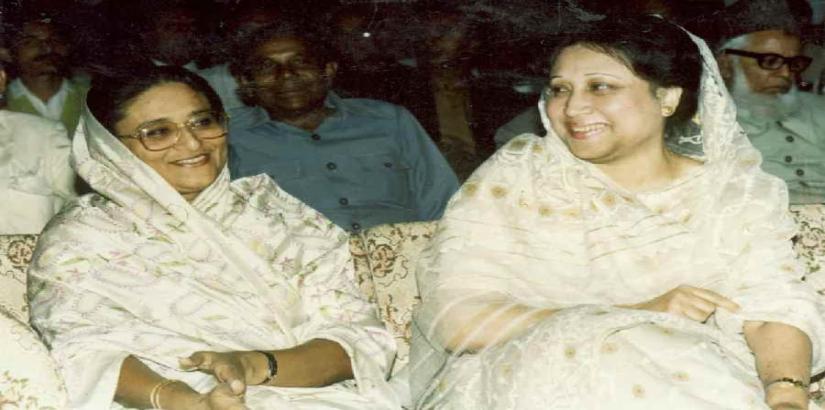
History has a grim sense of humour in Bengal. For three decades politics was a soap opera scripted by what The Economist called “The Battling Begums”: Sheikh Hasina, the daughter of the nation’s founder, and Khaleda Zia, the widow of an independence hero and popular ruler.
The stage has finally cleared. One Begum has passed; the other, sentenced to death in absentia, is a fugitive issuing statements from Delhi. Khalida Zia died on 30 December; Sheikh Hasina is in exile. But the systems of patronage they built, the 'mastans' (strongmen) who run the neighbourhoods, the syndicates that rig the markets, are alive and well. The path to a ‘fair’ system remains littered with potholes. But for a nation that has spent years fighting for a better future, the upcoming polls represent a hard-won milestone.
For the millions of ‘Gen Z’ voters heading to the booths, this is more than just an election; it is a long-overdue return to the ballot box, marking the first time in nearly two decades that their choice might actually count.
The battle of the Begums is over. The battle for the soul of Bangladesh, set to culminate at the ballot box on 12 February, is just beginning. And voters face difficult choices: a chastened old guard promising a rosy future yet again or is the country venturing into an unchartered territory?
(The author is a public-sector policy analyst and adviser from Bangladesh currently based in Australia. Views expressed are personal. By special arrangement with Sapan)





Post a Comment