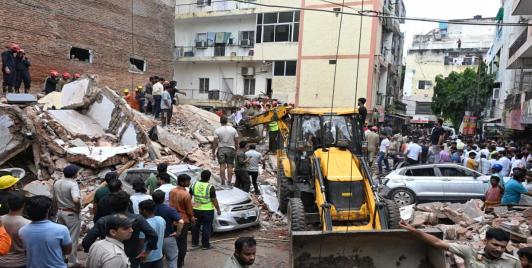

In some cases, politicians themselves are closely associated with land deals and builders, as Baba Siddique allegedly was, or politicians are builders themselves, like the BJP’s guardian minister for suburban Mumbai, Mangal Prabhat Lodha.
It may be argued that invoking the Bhutanese king’s principled stance as a reference point for a country as vast and diverse as India is deeply flawed—or, at best, a theoretical abstraction. Yet the fact remains: the ethos of good governance knows no geographical boundaries. If the highest leadership of a small, landlocked nation with limited resources could believe in, and strive towards, such ideals, why should our country fall short of visionary leadership, especially when it is far larger and endowed with greater capacities, opportunities, and strategic advantages?
In this backdrop, opening up India fully to Chinese, including inviting the Chinese delegations, is akin to arranging visits of KFC owners to poultry farms! The hubris that this was to familiarize two big political parties and two economic powers with each other must have amused Beijing endlessly. Finally, insecurity is palpable in India’s handling of China and the US. About time we get over this.
History is not a tool to divide society and perpetuate the injustices of the past. It is there to show us what wrongs have happened in the past which should not happen again. We need to march towards a just society where all live the life of dignity and respect, a society where all of us enjoy equal citizenship rights.
Public opposition towards the reforms escalated after a web link to a gay dating site was found in one of the lessons in the grade six English language module. This website was subsequently blocked by the regulator for internet users in Sri Lanka. The lesson was intended to teach ten-year-old kids how to make online friends.
In some cases, politicians themselves are closely associated with land deals and builders, as Baba Siddique allegedly was, or politicians are builders themselves, like the BJP’s guardian minister for suburban Mumbai, Mangal Prabhat Lodha.
Those who are welcoming external forces by promoting Yunus should re-examine history. Yunus is being seen by many as a Morsi figure for Bangladesh. When Mohamed Morsi came to power in Egypt following the Arab Spring with Western support, it led to deterioration of law and order, spike in the prices of essential goods, and extreme public suffering. Even after two months of Yunus' interim government, there has been no significant improvement in law and order, market stability or public well-being.
As cities grow and urbanise, they are becoming frontline battlegrounds in the fight against climate change. Incorporating green spaces, sustainable building practices, and raising public awareness are key to mitigating extreme heat. Indian metropolises are recognizing the need for comprehensive strategies, but climate action demands a coordinated, multisectoral approach at all levels of governance.
While tax-funded media can work under specific conditions, India's experience suggests that a model focused on subscriptions and private advertisements is more suitable for maintaining editorial independence, fostering innovation, and creating a more democratic and informed society
Governments should recognise the fact that unaddressed environmental concerns will transform into a radical form of action if not into eco-terrorism. The religious terrorism what Middle East nations have been experiencing these days may turn into environmental terrorism down the line due to progressive resource crunch and the steady degradation of natural resources.
Heat domes have severely impacted India, particularly during intense heat waves. In the 2022 North India heat wave, temperatures soared above 45°C across Delhi, Uttar Pradesh, Rajasthan, and Madhya Pradesh, with some areas nearing 50°C. A high-pressure system caused stagnant hot air and minimal cloud cover, intensifying the heat.
There is a saying revolution devours its children. Like the ousted regime who were the self-proclaimed legacy bearers of the revolution of 1971, the July revolution of 2024 could create a similar thermidorian reaction in the future if the torchbearers of this revolution play a similar political game of ‘Us’ and ‘Them’
If a true aristocrat is to be defined by courtesy and good manners, then the Mahatma was no less than the most refined princes and maharajas of India. His interactions were marked by legendary grace, respect and courtesy even in times of acrimony and division. He even addressed Mr. Jinnah, a political opponent, as the Quaid-I-Azam, the title given to Mr Jinnah by his supporters.
Balochistan remains a Pakistani faultline and it must be understood that it is a ‘political problem' even though the Pakistani state has been trying to deal with it all through as 'security problem'. The clear dissatisfaction of the people during accession to Pakistan is yet to be resolved. Forced disappearances and extrajudicial killings are now the trademark policy impulses of the oppressive Pakistani regime.
The recruitment of Nepali Gorkhas into the Indian Army being stopped after 77 years post-Independence is not only going to be a major loss to the Indian Army but also a serious and avoidable blow to cordial India-Nepal relations.
While there are uncertainties with regard to the possibilities and prospects of generating green hydrogen in a cost-effective manner it is surprising that green hydrogen is being hailed as the ultimate solution to overcome the emission issue and prevent climate disaster.
Many of us spend hours on social media doom scrolling, which then ceases to be just a source of recreation; it becomes an alternative world where algorithms and trends decode and shape individuals.
Peace and progress go hand in hand. To stabilize the economy, Pakistan needs a conducive political environment to focus on investment, education and health care. Whatever the economic challenges, the solutions would have to come from within. External funds, loans, debts are only temporary solutions
The very idea of Pakistan was based on the Two-Nation Theory which emphasized Muslims’ different way of life from that of the Hindus in the subcontinent. However, the mere religious identity of a nation without reconciling Pakistan’s diverse ethnic, linguistic, and cultural groups was not enough to hold it together.
Bangladesh is home to people of different religions and cultures, both in the hills and plains. The extreme polarization of thought and ideology between opposing ideological groups is impacting Bangladesh's social fabric.