

Bangladesh’s Lord Ram Statue

Bangladesh’s Lord Ram Statue Controversy fuels Renewed Debate over Religious Freedom and Social Cohesion

The controversy surrounding the proposed Lord Ram statue has emerged at a time when the BNP government has been in office for only 100 days. Some political observers believe that certain groups may be attempting to exploit the issue to deepen existing tensions between Bangladesh and India 

Foreign Funds, Civil Society Freedoms, National Security and India-US Friction

Every democracy permits foreign funding under regulated conditions. The question is whether democratic states possess adequate mechanisms to ensure transparency, accountability and protection against external influence operations, which could be against core national interests.

India's Push-In Policy on Suspected Illegal Immigrants: Need to Mitigate Human Suffering

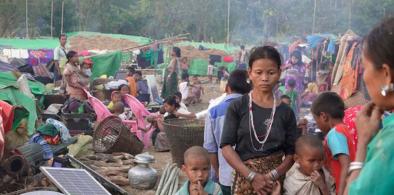
Over the past two months, a series of alleged push-in incidents along the Bangladesh-India border has reportedly left scores of people stranded in zero-line and no-man's-land areas under difficult conditions.

From Protectorates to Partners: The US Resets Security Expectations in Asia

The central message at the Shangri-La Dialogue is that America is staying, but on new terms. It will remain the core military balancer in the Indo-Pacific, but it expects allies and partners to become serious contributors. The era of strategic free-riding is ending. The new Indo-Pacific order will increasingly be defined by those willing and able to share the burden of preserving it.

More on Geopolitics and Strategic Affairs

Nepal-India relations must overcome the trust deficit

There is a clear sense that something is missing in the present relationship between the Indian and Nepali governments. Both should work to develop harmony and trust and mitigate the trust deficit, writes Gaurab Shumsher Thapa for South Asia Monitor

India should guard against terror, communal violence over Kashmir

Pakistan will try to enhance terrorist activities not only in J&K but in all of India. Pakistan’s Inter-Services Intelligence may activate and instruct its sleeper cells to carry out terrorist activities in communally sensitive places so that communal riots erupt in the country, writes J K Verma for South Asia Monitor

Some deft 'Modiplomacy' at G7, but Kashmir handling a challenge

The Kashmir issue may have been handled deftly at the global politico-diplomatic level, but the abiding challenge for India remains domestic, writes C Uday Bhaskar for South Asia Monitor

A strategic partnership at stake: UK needs to correct Kashmir policy

PM Modi has made it clear that it cannot be business as usual. The UK would need to carefully consider whether its pre-1947 agenda of promoting an autonomous Muslim state at the intersection of South and Central Asia is a desirable objective for the West, wrties Ambassador Bhaswati Mukherjee (retd) for South Asia Monitor

A nation deserted by ‘friends’: Pakistan’s anguish over Kashmir

Pakistan is unhappy that major players which could bail it out at the UN are all embroiled in their own affairs – the US trying to quit Afghanistan and China facing a trying time in Hong Kong, writes Mahendra Ved for South Asia Monitor

British stance on Kashmir can strain India ties

Boris Johnson has ended the British stance till now that Kashmir is a bilateral India-Pakistan issue, thereby delivering a lethal blow to India-Britain relations, writes Prakash Chand Katoch for South Asia Monitor

A CDS for India's armed forces must come with integrated theatre commands

CDS by itself without its essential adjunct of integrated theater commands would be of little avail. It may turn out to be just one more four star-general, without any enhancement in Indian military’s war fighting capabilities, writes  Lt-Gen Harwant Singh ( retd )  for South Asia Monitor

Kashmir developments triggered by Trump-Imran meet?

India has rudely shaken China, pushing back the bilateral Wuhan understanding with Beijing. It has hit not just China’s prime ally, but has moved close to Aksai Chin, the Kashmir territory Pakistan ceded to China, writes Mahendra Ved for South Asia Monitor

India should celebrate religious diversity, find spiritual common ground

Religious leaders should promote interfaith dialogue. They should bring together followers of different persuasions for meaningful conversations. They should promote a dialogue of understanding and a shared sense of community with other faiths, writes Frank Islam for South Asia Monitor

Jammu and Kashmir: Why revoking Art 370 was vital

The abolition of J&K’s special status will complete the ongoing process of annexation into the Indian Union, as it was a temporary provision, and will bring misguided and stone-pelting Kashmiri youth into mainstream politics, writes Sudhanshu Tripathi for South Asia Monitor

How sacrosanct is the 'Idea of India'?

Experts are divided about the legality and constitutional propriety of the August 5 decisions in relation to Article 3 and the reorganization of states. What is at stake is the sanctity of  constitutionalism  and for PM Narendra Modi the way the Kashmir issue unfolds  will  define his political legacy, writes C Uday Bhaskar for South Asia Monitor

Jammu & Kashmir: A landmark decision, but a work in progress

Internationally, the impact has been positive across the international community and, even China, although initially negatively disposed, has chosen not to be too vociferous in its protestations, writes  Lt Gen Syed Ata Hasnain (retd)  for South Asia Monitor

The pivotal role of Haj in transforming Saudi-India ties

Haj will continue to be the harbinger of cultural and economic cooperation between India and Saudi Arabia, writes Dr H A Nazmi for South Asia Monitor

Modi's ‘high-risk’ coup could yield rich dividends in Jammu & Kashmir

Those who have closely watched Modi believe that the prime minister wanted to give a clear signal that his government would be in a pro-active mode to handle long pending issues, writes Arun Anand for South Asia Monitor

Why Pakistan got trapped in its Kashmir plebiscite demand

The reason Pakistan was afraid of the plebiscite was that the raiders and troops it had sent in “had indulged in loot, arson, rape, and murder in the State. Scores of villages and towns were destroyed and hundreds of thousands of people uprooted, writes Arul Louis for South Asia Monitor