
Growing US-China Rivalry in Indian Ocean

Growing US-China Rivalry in Indian Ocean: A Test of Sri Lanka's Foreign Policy

China’s growing influence in Sri Lanka is an immediate concern for India as the resident power in the region, but it is also a global concern for the United States. 

Hasina's Return Proclamation Throws a Spanner in India-Bangladesh Ties

The Indian government is caught in a bind. Despite the BNP government’s outrage, for Delhi to hasten Hasina’s extradition is not an option.

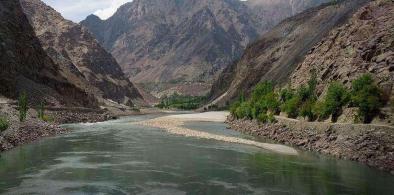
Why the Afghanistan-Pakistan Border Keeps Burning: Keys to Peace Lies With Group Whose Loyalties Answer to No One

The borderland TTP now exploits is the same terrain that Pakistan's own security establishment worked for decades to create as "strategic depth."  The world of proxy-war infrastructure seldom remains directed towards where its architects have aimed.

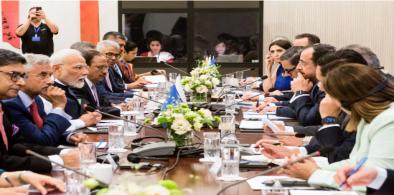
India and Australia Enhance Strategic Relationship, Prioritise Maritime Domain Awareness to Secure Indo-Pacific

A significant factor that emerged after India launched Operation Sindoor against Pakistan in May 2025 was the strain in the India-US relationship under the Trump administration, driven by aggressive tariff disputes and policy friction. This indirectly accelerated India’s push to diversify partnerships, prompting New Delhi to lean more pragmatically into closer economic and strategic ties with middle powers such as Australia.

More on Geopolitics, Security and Strategic Affairs

Anti-CAA protests in India mask Assam’s lonely struggle

The nature of protests and participation of people in anti-CAA rallies in Assam indicates that Assam rejects the communal agenda of the current BJP-led government and diversionary tactics of the mainstream media, write Minakshi Bujarbaruah & Rituparna Kaushik Bhattacharya for South Asia Monitor

What is drawing Iran and Taliban closer?

The Taliban has never been happy about Iran’s cultural influence in Afghanistan. When the Taliban ruled Afghanistan, they rejected any cultural links between Iran and Afghanistan and ignored Iran’s interests, writes Zahid Aria for South Asia Monitor

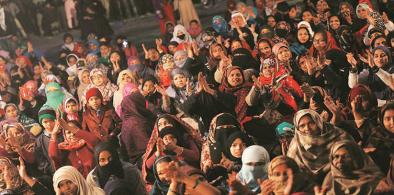
The profound symbolism of the Shaheen Bagh protests

The world must note the significance of the Shaheen Bagh phenomenon, as it highlights the power of Gandhian non-violent and secular protests in the face of the formidable State machinery, writes Brigadier Deepak Sethi (retd) for South Asia Monitor

Was India's controversial citizenship act modeled on US legislation?

External Affairs Minister S Jaishankar missed an opportunity at the news conference with Secretary of State Mike Pompeo and the two other participants at last month’s 2+2 strategic dialogue to clearly explain India’s goals behind the CAA in the rare opportunity he got to make the case in public before the US media, writes Arul Louis for South Asia Monitor 

Is India heading for a constitutional crisis over CAA?

Nearly all the non-BJP state governments have ruled out implementing the two measures, thereby preparing the battlefield for an unprecedented confrontation which will shake up the federal polity, writes Amulya Ganguli for South Asia Monitor

Cracking down on student protests augurs ill for Indian democracy

The dissent by young India is being cast as a diabolical anti-national act, even while many of the leaders in the BJP led government cut their teeth in politics during their student days, writes C Uday Bhaskar for South Asia Monitor 

On CAA, India has scored a self-goal with friendly neighbours

Can India challenge the sovereignty of other nations and think of living peacefully with them, asks Mahendra Ved for South Asia Monitor  

Soleimani’s killing and regional implications: Will the winners be China, Pakistan?

US Secretary of State Michael Pompeo spoke to Pakistani army chief Qamar J Bajwa on January 3, immediately after Soleimani’s killing, seeking Pakistani support, writes Lt Gen Prakash Katoch (retd) for South Asia Monitor

Assam: Betrayed by politicians, united strongly in anti-CAA protest

The issue of illegal immigrants, from Bangladesh to be precise, is, therefore, an old wound for the Assamese people. For someone familiar with the geography of the state, the changing demography is hard to miss, writes Azera Parveen Rahman for South Asia Monitor

Attack on Sikh shrine exposes Pakistan’s disdain for minorities

The 'deep state' and the Imran Khan government should care about the pitiable condition of minorities in their own country instead of worrying about Muslim and Sikh minorities in India, writes Jai Kumar Verma for South Asia Monitor

CAA has hurt India’s foreign policy and global image

The lack of homework by the Modi government on the adverse implications of the CAA is now clearly visible both domestically and internationally, writes Alakh Ranjan for South Asia Monitor

The Rajapaksas return in Sri Lanka: Should India be worried?

Sri Lanka is at the centre of the IOR and the country which will have greater stakes and leverage over this island nation will have an edge in the Indian Ocean, writes Alakh Ranjan for South Asia Monitor

Needed political will to solve Delhi's pollution crisis

There are enough existing solutions to alleviate air pollution which is a result of a waste-disposal problem.  However, there is a need to have political and administrative will to implement them, writes Anil Rajvanshi for South Asia Monitor

India and Bhutan explore new areas of engagement

India understands the needs of Bhutan and is equally willing to diversify the relationship beyond hydropower. During his last visit, Modi showed India’s intent towards the diversification of bilateral relations, writes Alakh Ranjan for South Asia Monitor

Policy lessons from Mahatma Gandhi: Decentralised development and sustainable living

Gandhi was an engineer at heart. He improvised and built equipment like better snake-catching tools, small cotton-spinning wheel (takli) and chappals (sandals) from used tires. In 1929, he even instituted an INR one lakh prize (INR 20 crores in today’s value; 2.6 times bigger than the Nobel Prize) for the design of a modern charkha (spinning wheel), writes  Anil K Rajvanshi for South Asia Monitor