

The Bay of Bengal: South Asia’s Emerging Maritime Security Challenge
The Palk Bay dispute illustrates a wider challenge for South Asian maritime governance. Coastal fishing communities frequently experience the consequences of strategic decisions without having equivalent opportunities to influence them.
 Nov 12, 2026
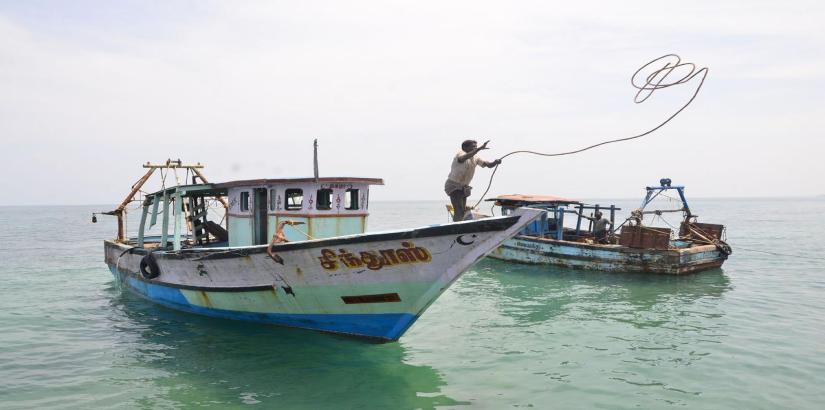
The Bay of Bengal is becoming steadily important to South Asia’s strategic landscape. Connecting India, Bangladesh, Myanmar, Sri Lanka and other regional economies, it supports commercial shipping, fishing livelihoods, and growing maritime cooperation. Yet the region’s security impediments are often approached primarily through naval competition, territorial disputes, and the protection of strategic interests. This perspective neglects a critical dimension: the coastal communities whose livelihoods and everyday activities are directly shaped by maritime governance.
The fishing communities of northern Sri Lanka, particularly those operating in Palk Bay, offer an important example of this challenge. Their experiences demonstrate that maritime security cannot be understood exclusively through the protection of national boundaries. It must also account for the relationship between security institutions, local livelihoods, and the people who depend on the sea.
India-Sri Lanka Fishing Dispute
Palk Bay, situated between India’s Tamil Nadu coast and northern Sri Lanka, has long been affected by a persistent fisheries dispute. Indian mechanized trawlers operating across the maritime boundary have contributed to tensions with Sri Lankan artisanal fishers, whose fishing equipment and livelihoods are affected by destructive fishing practices. The resulting dispute have involved arrests, maritime enforcement, and repeated diplomatic discussions.
The dispute is not simply a question of illegal fishing. Research by Ajit Menon and other scholars demonstrates that the conflict is shaped by economic inequalities, political interests, ethnic relations, and the historical development of fisheries in the region. Their work highlights how maritime boundaries intersect with local livelihoods and broader state interests.
For northern Sri Lankan fishers, maritime security is experienced through access to fishing grounds, protection from destructive fishing practices, and the ability to pursue livelihoods without persistent uncertainty. These concerns do not always correspond with the priorities of national security institutions, which generally emphasize territorial enforcement and sovereignty.
This difference reveals an important policy challenge. A maritime environment may be more closely monitored by security agencies while remaining economically insecure for the communities dependent on it.
Recognition of Fishing Communities
The relationship between fishing communities and maritime security is not entirely absent from existing scholarship. Researchers have examined fisher conflict, transboundary negotiations, and the difficulties of implementing community-led agreements in Palk Bay. Johny Stephen and his co-authors, for instance, demonstrate how national and regional political interests can undermine locally negotiated solutions.
The challenge, therefore, is not simply to recognize fishing communities as vulnerable populations. It is to determine how their participation can become a meaningful segment of maritime governance.
Fishing communities possess practical knowledge of local maritime conditions, fishing patterns, and changes in resource availability. Their experiences can help authorities identify emerging tensions and understand the consequences of enforcement policies. However, such participation should not turn civilians into informal security agents or transfer responsibilities for maritime enforcement onto vulnerable communities.
Instead, community participation should be understood as a governance mechanism that can improve communication, accountability, and the legitimacy of maritime policies.
Inclusive Maritime Framework
India and Sri Lanka have repeatedly explored bilateral approaches to the fisheries dispute. However, diplomatic discussions alone have struggled to produce a durable settlement. A more inclusive framework could strengthen existing mechanisms through three practical measures.
First, both countries could formalize consultations involving representatives of northern Sri Lankan artisanal fishers, Tamil Nadu fishing communities, fisheries authorities, and maritime officials. Such stakeholder dialogues should complement diplomatic negotiations and provide a structured opportunity to identify livelihood concerns and evaluate the effects of enforcement measures.
Second, authorities could establish transparent channels through which fishing communities communicate maritime safety concerns and report harmful fishing practices. These channels should be designed with safeguards against intimidation, misuse of information, and unnecessary surveillance. Their purpose should be to improve communication rather than make communities responsible for policing the sea.
Third, maritime governance should be assess through indicators beyond arrests and boundary violations. The condition of fishing livelihoods, the frequency of destructive fishing practices, and community confidence in governance arrangements could provide a more comprehensive understanding of maritime security outcomes.
These proposals would not eliminate competing interests or resolve every disagreement over fishing rights. They would, however, help ensure that maritime security policies are informed by the experiences of the people most directly affected.
Rethinking Bay of Bengal Security
The Palk Bay dispute illustrates a wider challenge for South Asian maritime governance. Coastal fishing communities frequently experience the consequences of strategic decisions without having equivalent opportunities to influence them. As regional maritime cooperation expands, governments must avoid treating security, environmental protection, and livelihoods as separate policy concerns.
The future of maritime security in the Bay of Bengal will depend on more than naval capabilities or the effectiveness of boundary enforcement. It will also depend on whether regional governments can develop governance arrangements that recognize the interests and knowledge of coastal communities.
A maritime boundary may define the limits of national jurisdiction, but it cannot independently guarantee security for those living and working around it. A more secure Bay of Bengal will require not only stronger maritime institutions, but also governance that places coastal communities at the center of regional security discussions.
References:
1. Menon, Ajit, et al. “The Political Ecology of Palk Bay Fisheries: Geographies of Capital, Fisher Conflict, Ethnicity and Nation-State.” Antipode.
https://onlinelibrary.wiley.com/doi/10.1111/anti.12181
2. Stephen, Johny, et al. “Transboundary Dialogues and the ‘Politics of Scale’ in Palk Bay Fisheries.”
https://journals.sagepub.com/doi/10.1177/0262728013487633
3. Stephen, Johny. “A Place to Live and Fish.”
https://www.sciencedirect.com/science/article/abs/pii/S0964569114002920
4. Vincent, S. “Palk Bay Fishing Problem Requires Indo-Sri Lankan Joint-Governance.” Maritime Affairs.
https://www.tandfonline.com/doi/10.1080/09733159.2020.1838717
5. Gamage, Rajni, and Isha Gupta. “Resolution of the India-Sri Lanka Maritime Border Conflict and Fisheries Dispute.” Institute of South Asian Studies, National University of Singapore.
https://www.isas.nus.edu.sg/papers/resolution-of-the-india-sri-lanka-maritime-border-conflict-and-fisheries-dispute/
6. “Beyond the Fishermen Arrests: The Absence of an Integrated Marine Spatial Framework in the Palk Strait.”
https://indospherefwa.org/publication-details.php?slug=beyond-the-fishermen-arrests-the-absence-of-an-integrated-marine-spatial-framework-in-the-palk-strait
(The author is a postgraduate researcher in International Relations and Geography and her research interests include maritime connectivity, coastal security, maritime intelligence and the evolving security dynamics of the Indo-Pacific and South Asia. The views expressed are personal. She can be contacted at muskanmehta5555@gmail.com)







Post a Comment