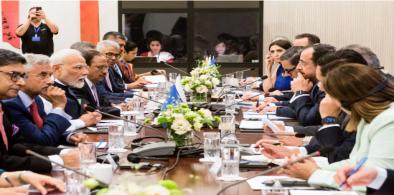

Japanese Prime Minister Sanae Takaichi arrived in New Delhi

India–Japan Summit: Strategic Convergence in a Changing Indo-Pacific Order

Japan has also proposed developing a Bay of Bengal–Northeast India Industrial Value Chain aimed at transforming the region into an integrated industrial zone. As part of the Free and Open Indo-Pacific vision, this includes strengthening cross-border connectivity with Bangladesh, Myanmar, Nepal and Bhutan. 

China and the Emerging Scenario in the Bay of Bengal

China's expressed interest in modernising and upgrading both Chattogram and Mongla ports suggests the emergence of an interconnected infrastructure network linking the Bay of Bengal with southwestern China through Myanmar. If realised, such connectivity would enhance trade flows, improve regional logistics and deepen China's economic footprint across the Bay of Bengal littoral, while simultaneously increasing Bangladesh's importance as a regional transit and connectivity hub.

Colombo to Kathmandu, China Seeks to Counteract US Moves Across South Asia

While Washington and New Delhi seek to strengthen bilateral ties with Colombo, Beijing has strategically engaged with the political forces that control the government. By engaging directly with actors at the core of Sri Lanka’s governance, Beijing appears to be signalling its strategic intent—projecting influence and reinforcing ideological ties. 

A Divided EU Faces Growing Scrutiny Over Taliban Contacts

Some analysts accuse the EU of double-standards arguing  that the EU has been condemning Taliban policies since they assumed power, but were now holding direct discussions with them. Such meetings undermine the EU's credibility as a defender of human rights and democratic values.

More on Geopolitics and Strategic Affairs

Will the Trump visit heal fissures in the Indo-US strategic relationship?

The US-India relationship has a number of contentious issues, trade being the most important of them, writes Pranay Kumar Shome for South Asia Monitor

Can Nepal’s domestic laws prevail over an IPR Compact with US corporation MCC?

The MCC, which has approved 37 compacts for 29 countries since its inception in 2004, could extend a claim on products originating or produced from Nepal, which would unfortunately lose its sovereign rights over certain products which have their origin in Nepal, write Jivesh Jha and Nil Prasad Paneru for South Asia Monitor

Is India’s populist surge a threat to liberal democracy?

The success of Modi’s populist campaigns in 2014 and 2019 Lok Sabha elections, followed by the majoritarian mobilizations and lurking use of repression, pose a serious threat to liberal democracy in India, writes L T Om Prakash for South Asia Monitor

A battle for India's soul

With Delhi assembly elections set for February 8, the battle lines are sharply drawn between two pitting ideologies that have polarised national discourse like at no time before, writes Tarun Basu for South Asia Monitor

Soleimani’s killing has only helped Islamic State, will threaten South Asian security

The re-emergence of IS would have a definite impact on the Af-Pak region, with its consequential fallout for India and regional peace and stability in South Asia, writes Brig Anil Gupta (retd) for South Asia Monitor

Shaheen Bagh protests: A unique civil society movement led by women

What makes the Shaheen Bagh rare in the history of Indian civil society movements is that this is the first-time Muslim women are leading a protest against a law passed by the state, writes Alakh Ranjan for South Asia Monitor

CAA will deepen perception of an India unfriendly to Muslims

It is widely believed that India’s decision on CAA would ‘question the principle of equality before the law’ and emotionally impact the Muslim community of both India and its neighbouring countries, writes Sukanya Bali for South Asia Monitor

Challenging times for Indian foreign policy as new foreign secretary takes charge

Shringla, who came in from Washington where he served as India’s ambassador, will have his work cut out, writes  Nilova Roy Chaudhury for South Asia Monitor 

Will China’s strategic embrace of Myanmar spell more trouble for Rohingyas?

The strategic gameplan of support to the Rohingya militancy is clearly visible. One, for China, making them into militants can be used to destabilize many countries, including India in South Asia, thus weakening its economic competitors, writes Swadesh Roy for South Asia Monitor

South Asian countries must formulate legal frameworks to control marine litter

In South Asia, the issue of marine litter management is not taken as a priority by any of the nations, write Harsh Mahaseth and Shubham Sharma for South Asia Monitor 

Religious extremism taking hold in Afghanistan as Taliban influence spreads

Salafist movements, such as Hizb ut-Tahrir and the Jamiat-E Eslah, while opposing Taliban methods, are generally the same, and these movements, consciously or unconsciously, pave the way for Taliban recruitment in Afghanistan, Writes Saleem Payenda for South Asia Monitor

Vulnerable communities in Bangladesh to be worst hit by climate crisis

Bangladesh and Maldives, amongst others, are the most afflicted and vulnerable victims of environmental pollution and climate change, Write Akmal Hossain for South Asia Monitor

Anti-CAA protests in India mask Assam’s lonely struggle

The nature of protests and participation of people in anti-CAA rallies in Assam indicates that Assam rejects the communal agenda of the current BJP-led government and diversionary tactics of the mainstream media, write Minakshi Bujarbaruah & Rituparna Kaushik Bhattacharya for South Asia Monitor

What is drawing Iran and Taliban closer?

The Taliban has never been happy about Iran’s cultural influence in Afghanistan. When the Taliban ruled Afghanistan, they rejected any cultural links between Iran and Afghanistan and ignored Iran’s interests, writes Zahid Aria for South Asia Monitor

The profound symbolism of the Shaheen Bagh protests

The world must note the significance of the Shaheen Bagh phenomenon, as it highlights the power of Gandhian non-violent and secular protests in the face of the formidable State machinery, writes Brigadier Deepak Sethi (retd) for South Asia Monitor