
Neither Bangladesh nor India — including West Bengal — is likely to fully concede its position. The future instead lies in pragmatic compromise, where domestic political constraints are balanced against the imperatives of regional cooperation. Ultimately, the trajectory of India–Bangladesh relations will depend less on identity politics and more on whether both sides can align economic necessity with political will.
The broader reality is that even if a political understanding emerges, restoring confidence in the Strait may take far longer than restoring a ceasefire. Shipping markets operate as much on perception of risk as on military realities. Tanker operators, insurers, charterers, and energy traders require predictability — and that predictability is currently absent.
New Delhi now occupies an awkward middle space: not fully trusted by the West, yet no longer fully aligned with the broader Global South consensus either. That ambiguity becomes riskier if Washington and Beijing move into even a temporary phase of strategic stabilisation.
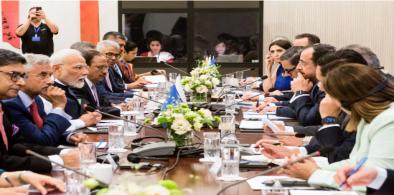
The major bilateral issue is border security and management. While India claims that millions of Bangladeshis enter India illegally, reside and work here, Bangladesh dismisses that contention outright, saying that as their per capita income was higher than India’s, there was no reason for economic migration from Bangladesh to India.
The lack of homework by the Modi government on the adverse implications of the CAA is now clearly visible both domestically and internationally, writes Alakh Ranjan for South Asia Monitor

Sri Lanka is at the centre of the IOR and the country which will have greater stakes and leverage over this island nation will have an edge in the Indian Ocean, writes Alakh Ranjan for South Asia Monitor

There are enough existing solutions to alleviate air pollution which is a result of a waste-disposal problem. However, there is a need to have political and administrative will to implement them, writes Anil Rajvanshi for South Asia Monitor

India understands the needs of Bhutan and is equally willing to diversify the relationship beyond hydropower. During his last visit, Modi showed India’s intent towards the diversification of bilateral relations, writes Alakh Ranjan for South Asia Monitor

Gandhi was an engineer at heart. He improvised and built equipment like better snake-catching tools, small cotton-spinning wheel (takli) and chappals (sandals) from used tires. In 1929, he even instituted an INR one lakh prize (INR 20 crores in today’s value; 2.6 times bigger than the Nobel Prize) for the design of a modern charkha (spinning wheel), writes Anil K Rajvanshi for South Asia Monitor

Trump realized that the draft deal, if signed, would be labeled a surrender to the Taliban, which would be politically damaging for him. Another reason could be that he never really wanted to meet the Taliban, but wanted to showcase the peace efforts made, and place indirect pressure on them through the subterfuge writes Lt Gen PC Katoch (retd) for South Asia Monitor

With India's growing political and strategic interest in the continent, and inclination to leverage its diaspora as an instrument of soft power, it’s natural for New Delhi to establish a beachhead in Somalia, that straddles the Horn of Africa, the source of the Nile and a gate to the Red Sea and the Gulf of Aden, through which tens of thousands of vessels pass through Somali waters every year in what is one of the world’s busiest sea-trading lanes, writes Tarun Basu for South Asia Monitor
Delhi has not yet made an official statement, but legitimizing the Taliban at a Camp David ceremony would have had an adverse impact on India’s strategic interests in the region, writes C Uday Bhaskar for South Asia Monitor