Trump and Iran president signing Islamabad Memorandum

The Islamabad Memorandum Has Stopped the War; It Has Not Settled It

The Islamabad Memorandum has bought time. But time is not neutral. It can be used to construct a more durable settlement, or by spoilers in Washington, Tehran and Tel Aviv to rebuild the case for war. The ceasefire will endure only if the difficult questions postponed in Islamabad are answered before those who opposed the truce succeed in answering them on the battlefield.

Energy Cooperation: A Quiet Success Story in South Asia

A big development happened in 2025. Nepal started exporting electricity to Bangladesh through India's transmission network. This was the first time Nepalese hydropower was commercially transmitted to Bangladesh via Indian territory. The initial export volume was 40 megawatts. The significance of the agreement is much bigger. It showed that regional energy cooperation can overcome political barriers.  

Lessons from Trump-Iran Deal: Strategic Autonomy is not a Luxury for India

India's rise as a major global power will depend not on the promises of allies or the intentions of adversaries but on its capacity to build economic strength, military capability, technological innovation, and strategic resilience. Partnerships will remain important. Cooperation will remain valuable. Engagement with the United States and other powers will continue to serve Indian interests. But the foundation of India's security cannot rest in Washington, Moscow, Beijing, or any other foreign capital.

Whither Disarmament? Nuclear Weapons Remain Deeply Embedded in National Security Doctrines

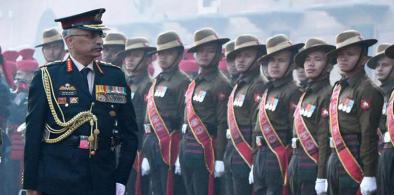
However, evolving regional dynamics, particularly China’s expansion and Pakistan’s tactical nuclear developments, continue to test the durability and interpretation of this doctrine. While India has officially reiterated its commitment to No First Use, debates persist within strategic circles about its future applicability under extreme scenarios.

More on Geopolitics and Strategic Affairs

Unorganised workers in India: The COVID-19 crisis has highlighted their utter neglect

The legislation enacted way back in 2008, known as The Unorganised Workers'Social Security Act (mentioned as the Act hereafter) which entered the statute book on December 31, 2008, if implemented seriously, could have come to the rescue of the unorganised workers, which stand to lose enormously both in terms of livelihood opportunities and social security at the present juncture due to the health pandemic, writes Partha Mitra for South Asia Monitor

Leaving Afghanistan's fate to the Taliban

It would not be surprising if American troops are also attacked after part withdrawal has taken place, with blame, apportioned to Islamic State, as was done in the case of the recent attack on Kabul gurdwara, while China and Pakistan laughed all the way home, writes  Lt Gen P. C. Katoch (retd) for South Asia Monitor

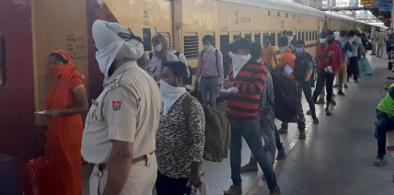
India needs to be fair to its own migrants, the city builders and sustainers

The census data of 2011 reflects that the four states - Uttar Pradesh (UP), Bihar, Rajasthan, and Madhya Pradesh -account for 50 percent of India's total inter-state migrants, write Suresh Kumar Patel, Abhishek Kumar & Noorul Quamer for South Asia Monitor

The Wuhan virus and China's biological warfare: Warnings the world ignored

Launch of China Virus/COVID-19  - which only India had guts to name biological weapon - had decades of preparation to deny/mitigate global response, writes  Lt Gen P. C. Katoch (retd) for South Asia Monitor

COVID 19: South Asian nations must take care of refugees, or we all are vulnerable

The Rohingya refugees staying inside and outside camps in Bangladesh and India are worth mentioning in the South Asian context. Their already slum-like dwellings, lack of fresh water and sanitation, densely-crowded living conditions and hunger puts them in a more perilous situation, writes Sariful Islam for South Asia Monitor

The final frontier: Women in combat roles must become the new normal

In the Indian context, the Indian Air Force and the Indian Navy have granted a permanent commission to women officers even as both have opened up some combat roles for women, write Subhranil Ghosh & Sayantan Bandyopadhyay for South Asia Monitor

Why Modi broke ranks from his nationalist 'friends' abroad

While Trump and Bolsonaro are worried about the virus' impact on their nation's markets, economies and, by extension, their political future, Modi was open enough to admit that the pandemic would have economic costs, but saving lives was more important for him and his government, writes Tarun Basu for South Asia Monitor

Rajapaksa’s Redux: Jingoism 1, Justice 0

The return of a Rajapaksa to the island’s highest office coincides with a potent form of majoritarianism in Sri Lanka, driven simultaneously by jingoism and fear among the electorate, writes Arman Sidhu for South Asia Monitor

The lockdown is India’s only hope

After independence, this is perhaps the first time India is being put to such a test, with every part of the country affected. Not confined to India alone, but the entire neighbourhood of South Asia is being engulfed by this pandemic, writes Brig Anil Gupta (retd) for South Asia Monitor 

Afghanistan a dangerous place for religious minorities, particularly Sikhs

Afghanistan has become an extremely dangerous country for its residents, especially religious minorities. After surviving there for hundreds of years, the Sikhs virtually don’t even have a right to exist anymore, writes Sanchita Bhattacharya for South Asia Monitor

Coronavirus pandemic should promote globalization, not reverse it

The disruption of supply chains coupled with an unprecedented economic disaster waiting for the world due to the pandemic, the pertinent question is - has the time come for the world to have a rethink for globalization, asks Pranay Kumar Shome for South Asia Monitor

Bangladesh: The corona pandemic has eclipsed Khaleda’s release from jail

Despite Khaleda Zia’s suspended sentence and release from jail, no news except about the coronavirus is attracting the people’s attention in Bangladesh, writes Swadesh Roy for South Asia Monitor

Modi’s outreach: SAARC can regain lost pedestal if its leaders fight Covid-19 together

If the habits of cooperation and mutual understanding developed while fighting together against COVID-19 allow the member countries to regain the lost pedestal of SAARC, it will augur well for peace and prosperity of the region, writes Monish Tourangbam for South Asia Monitor

COVID-19 fear grips densely populated South Asia

In the South Asian region, only Maldives and Sri Lanka fare relatively better in global rankings of quality of healthcare system. Pakistan, which spends the least on health, has only 0.6 beds per 1000 people compared to 8.5 beds per 1000 people in Germany, writes Kavita Bajeli Datt for South Asia Monitor

Coronavirus hits prospects for a revival in Kashmir this summer

For Kashmiris, who were hoping to come out of a long period of isolation after August 5, 2019 and subsequent government clampdown to ensure peace, the deadly virus has been a huge setback at a time when the thaw was beginning and restrictions easing, writes Brig Anil Gupta (retd) for South Asia Monitor