Trump and Iran president signing Islamabad Memorandum

The Islamabad Memorandum Has Stopped the War; It Has Not Settled It

The Islamabad Memorandum has bought time. But time is not neutral. It can be used to construct a more durable settlement, or by spoilers in Washington, Tehran and Tel Aviv to rebuild the case for war. The ceasefire will endure only if the difficult questions postponed in Islamabad are answered before those who opposed the truce succeed in answering them on the battlefield.

Energy Cooperation: A Quiet Success Story in South Asia

A big development happened in 2025. Nepal started exporting electricity to Bangladesh through India's transmission network. This was the first time Nepalese hydropower was commercially transmitted to Bangladesh via Indian territory. The initial export volume was 40 megawatts. The significance of the agreement is much bigger. It showed that regional energy cooperation can overcome political barriers.  

Lessons from Trump-Iran Deal: Strategic Autonomy is not a Luxury for India

India's rise as a major global power will depend not on the promises of allies or the intentions of adversaries but on its capacity to build economic strength, military capability, technological innovation, and strategic resilience. Partnerships will remain important. Cooperation will remain valuable. Engagement with the United States and other powers will continue to serve Indian interests. But the foundation of India's security cannot rest in Washington, Moscow, Beijing, or any other foreign capital.

Whither Disarmament? Nuclear Weapons Remain Deeply Embedded in National Security Doctrines

However, evolving regional dynamics, particularly China’s expansion and Pakistan’s tactical nuclear developments, continue to test the durability and interpretation of this doctrine. While India has officially reiterated its commitment to No First Use, debates persist within strategic circles about its future applicability under extreme scenarios.

More on Geopolitics and Strategic Affairs

Hindu-Muslim ties in the time of a pandemic

No one can predict what the trajectory of communal relations will be when it is clear that so much will change in the post-corona period not only with regard to Hindu-Muslim ties, but in every other field that the scene in India will be quite different from what it is today writes Amulya Ganguli for the South Asia Monitor

Right time to usher in reforms in India's Armed Forces

The armed forces, after decades of clamouring, have been accorded a historic opportunity to usher in change and reforms. It is imperative that this opening is utilized with sagacity and deliberate forethought writes  Admiral  Arun Prakash (retd) for the South Asia Monitor

US -Taliban peace deal: Peace for whom?

How much the talk of sharing power with the Taliban is realistic - that raises doubts, as it is impossible for the Taliban to be diverted from their ideology, writes Monira Nazmi Jahan for the South Asia Monitor

Nepal needs to show social solidarity in coronavirus lockdown

We, the people of Nepal should understand that if an unfortunate incident can befall one, it can befall others too. That’s why we all need to stand together, writes Jivesh Jha for the South Asia Monitor

India needs to brace for another lockdown

While the South Korean model of aggressive and maximum testing has proved successful; the world is also studying and appreciating the Indian model wherein a densely and an overpopulated nation with limited resources and a not very advanced health infrastructure has been able to control the exponential spread of the pandemic, writes Brig Anil Gupta for the South Asia Monitor

SAARC is back, but only to fight COVID-19

The question whether India’s initiative will develop into a SAARC minus Pakistan or lead to a revival of SAARC itself remains open,  writes Amb T P Sreenivasan (retd) for South Asia Monitor

Only a Biden presidency can strengthen Indo-US ties

This inability to get any meaningful trade agreement in place speaks volumes about India’s potential future relations with the US with Trump as president, writes Frank F Islam for South Asia Monitor

Time to review lockdown to stop economic shutdown

Lockdown cannot be an option to exercise indefinitely. We need to progressively lift it so that the economic costs will not overwhelm us, writes Mohan Guruswamy for the South Asia Monitor

55 years later, India returns favour to US, emerges as humanitarian force

It wasn't only a favour to the US, Brazil or Israel. India also decided to send HCQ  “to all our neighbouring countries who are dependent on our capabilities” and “some nations who have been particularly badly affected" by the pandemic, writes Arul Louis for South Asia Monitor

Is 'temporary' release of prisoners enough to halt spread of COVID-19?

In South Asia, India has, on the directives of its Supreme Court, constituted High Powered Committees in each state to define criteria for release of both sentenced and unsentenced prisoners, writes Madhurima Dhanuka for the South Asia Monitor

India could be staring at a human security catastrophe

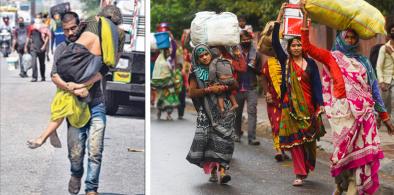
India has about 450 million workers in the informal sector and about a third of them are in the migrant cluster. Even if it is estimated that half of this workforce is grappling with hunger, the numbers are mind-boggling, writes C Uday Bhaskar for South Asia Monitor

Pakistan's fate in FATF once again hangs in balance

In order to save itself from being put under a blacklist, Pakistan has to work at least on papers with respect to various terror organisations to address ‘strategic deficiencies', writes Dr. Sanchita Bhattacharya for South Asia Monitor

Kashmiri youth being misled: Myth about 'demographic changes'

Who will benefit from the new rule? It would be the wards of West Pakistan refugees, Balmikis, Gorkhas, Punjabis and migrant labour in the newly created union territory, writes Brig Anil Gupta (retd) for South Asia Monitor

South Asian countries cannot make the same choices as developed nations

The biggest challenge for governments in South Asia is to fight this pandemic like a first-world country but with the limited resources of a third-world country, writes Dr. Jitender Bhandari for the South Asia Monitor

Post-COVID 19: Needed a brave new world, not chasing shadows

The world community reacted tardily and instead of shoring up the defenses, it is now dousing the fires. The world in the future would warrant systems that are more alert to impending pandemics and crises, better prepared and strong leadership writes R Adm Vineet Bakhshi (retd) for South Asia Monitor