

Muizzu’s Pakistan Visit: From Diplomatic Promises to Strategic Outcomes
The Maldives, like other small states, has an interest in diversifying its international partnerships, widening its economic choices and retaining room for diplomatic manoeuvre. Engagement with Pakistan does not necessarily come at India's expense
 Oct 27, 2026
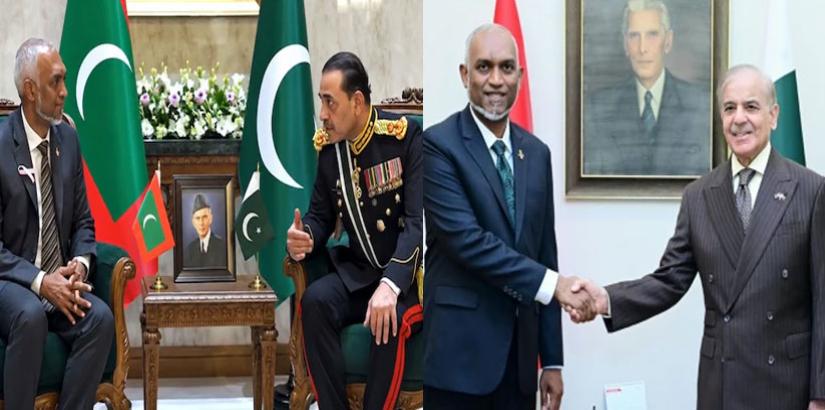
Maldivian President Mohamed Muizzu’s three-day visit to Pakistan in October 2026 marks an important development in the evolving diplomatic landscape of the Indian Ocean Region. The first visit by a Maldivian president to Pakistan in 11 years, it coincides with the 60th anniversary of diplomatic relations between the two countries, established in 1966. The signing of 20 memorandums of understanding (MoUs) covering defence, maritime security, trade, education, healthcare, technology and climate cooperation reflects a renewed desire to expand bilateral engagement. Yet, the significance of the visit will ultimately depend less on the number of agreements signed than on their implementation and their implications for regional relations.
Pakistan and the Maldives have maintained friendly relations for six decades, underpinned by shared religious and cultural links, educational exchanges and diplomatic cooperation. Pakistan has contributed to Maldivian development in several fields, including healthcare and education, while its assistance following the devastating Indian Ocean tsunami of 2004 demonstrated the humanitarian dimension of their relationship. The construction of the Maldivian Parliament building with Pakistani assistance and the establishment of medical education facilities with Pakistan’s support are further examples of this longstanding engagement. Muizzu’s visit seeks to build on this historical foundation and translate diplomatic goodwill into a more substantive partnership.
Defence and Security Cooperation
The most notable aspect of the visit is the intention to deepen defence and security cooperation, particularly in maritime affairs. Pakistan’s army chief, Field Marshal Asim Munir, met Muizzu during his stay in Islamabad, with discussions focusing on defence cooperation, institutional linkages, professional exchanges and the regional security environment. Agreements relating to defence and maritime security suggest that both sides want to move beyond traditional diplomatic engagement towards more structured cooperation.
For the Maldives, maritime security is a matter of fundamental national interest. Its geographical position across important Indian Ocean sea routes makes the security of its surrounding waters essential to trade, tourism, fisheries and economic stability. Illegal fishing, trafficking, human smuggling and other forms of transnational crime also pose persistent challenges to the island nation. Cooperation with Pakistan could offer additional opportunities for professional training, institutional development and law-enforcement capacity-building.
However, the precise nature and extent of this cooperation will matter. The signing of an MoU does not automatically imply the establishment of a substantial operational security partnership, nor does it establish that the Maldives is shifting its strategic alignment away from India. The practical significance will depend on whether the agreements lead to regular exchanges, training programmes, information-sharing arrangements or other concrete initiatives. It is therefore important to distinguish diplomatic signalling from an actual transformation of the regional security environment.
Ambitious Trade Target
The economic dimension of the visit is equally ambitious. Both countries have set a target of increasing bilateral trade from approximately $13.9 million to $200 million within two years. Achieving this nearly fifteen-fold expansion would require sustained efforts to identify commercially viable sectors, improve connectivity and encourage private-sector participation. The agreements cover agriculture, fisheries, pharmaceuticals, healthcare, information technology, tourism and investment. The proposed business engagement between the two countries could help identify opportunities and bring commercial actors into a relationship that has traditionally been driven largely by government-to-government contacts.
Yet, the trade target is demanding. The Maldives is a small island economy heavily dependent on tourism and imports, while Pakistan has a much larger and more diversified production base. This creates opportunities in food supplies, medicines, professional services and other products, but geographical distance, transport costs, payment arrangements and the limited scale of existing commerce could constrain expansion.
Better air and maritime connectivity, regular business exchanges and a functioning institutional mechanism for resolving trade-related difficulties will be essential. Without these supporting measures, the $200 million target risks remaining an expression of political ambition rather than an achievable commercial outcome.
Cooperation in education, healthcare and technology offers more immediate possibilities. Pakistani doctors and paramedical personnel already serve in the Maldives, while Maldivian students pursue higher education in Pakistani institutions. Additional scholarships and collaboration in artificial intelligence, digitisation, cybersecurity and technical training could expand these links.
Pakistan’s proposed assistance with data-centre development also points towards a broader agenda of digital cooperation. Such initiatives could deliver practical benefits without requiring either country to make major geopolitical commitments.
Climate change presents another important area for partnership. For the Maldives, rising sea levels, coastal erosion and environmental degradation are not distant concerns but direct threats to national security and long-term economic survival. Pakistan’s commitment to provide 100,000 olive cuttings and 100,000 seeds of other plant species in support of the Maldivian tree-planting initiative is a visible expression of environmental cooperation.
However, the value of such commitments will depend on the suitability of the species, local ecological conditions and the development of effective planting and maintenance programmes. Cooperation in renewable energy, waste management, coastal protection and climate-resilient infrastructure could ultimately prove more consequential.
Maldives' Strategic Position
For India, Muizzu’s visit deserves attention but not alarm. The Maldives occupies a strategically important position in the central Indian Ocean, close to maritime routes vital to India's trade and energy security. New Delhi has traditionally been a major partner of Malé in maritime surveillance, defence training, capacity-building, disaster relief and development assistance. The two countries’ security interests are closely connected, and stability in the Maldives is important for India's wider Indian Ocean strategy and its Neighbourhood First policy.
Pakistan’s renewed engagement introduces another dimension to the Maldives’ external relations. Islamabad may see opportunities to expand its diplomatic presence and develop security and economic links with an Indian Ocean country. Nevertheless, the 20 MoUs should not be interpreted as evidence of a strategic realignment. The Maldives, like other small states, has an interest in diversifying its international partnerships, widening its economic choices and retaining room for diplomatic manoeuvre. Engagement with Pakistan does not necessarily come at India's expense, provided that cooperation remains transparent, constructive and consistent with regional stability.
India's most effective response would be to strengthen its own partnership with the Maldives through reliable development assistance, mutually beneficial economic cooperation and sustained security engagement. A competitive approach based solely on counting agreements or viewing every external partnership as a strategic setback would be counterproductive. New Delhi should instead focus on delivering projects on time, expanding trade and tourism, supporting climate resilience and maintaining regular political dialogue. A confident and responsive Indian policy would offer the Maldives compelling reasons to continue treating India as a trusted partner.
The visit also highlights the wider limitations of regional cooperation in South Asia. Muizzu has reiterated the importance of reviving the South Asian Association for Regional Cooperation (SAARC), which has struggled to fulfil its potential because of political tensions among member states. Bilateral initiatives such as those between Pakistan and the Maldives can generate useful results, but they cannot substitute for broader regional mechanisms addressing trade, connectivity, climate change and transnational crime. Progress in these areas would benefit the entire region.
Ultimately, the success of Muizzu’s Pakistan visit will be measured by implementation rather than declarations. The two governments must establish clear timelines, identify responsible institutions, monitor progress and encourage businesses and educational organisations to participate. The proposed expansion of trade, stronger maritime cooperation, new educational opportunities and practical climate initiatives provide a promising agenda. Whether these commitments transform six decades of diplomatic friendship into a meaningful partnership remains to be seen.
For India, the appropriate course is clear: closely monitor the security implications, avoid premature conclusions and strengthen its own constructive engagement with the Maldives. In the Indian Ocean, lasting influence will depend not simply on diplomatic visibility, but on the ability to deliver tangible benefits and build enduring trust.
(The author is an Associate Fellow, Manohar Parrikar Institute for Defence Studies and Analyses (MP-IDSA), New Delhi. Views expressed are personal. He can be contacted at anand_rai@hotmail.com )








Post a Comment