

Trincomalee Energy Hub Development Will be a Strategic Milestone in India-Sri Lanka Ties
If one location matters most to India in Sri Lanka, it is Trincomalee. With one of the finest natural harbours in the world, Trincomalee has immense commercial, naval, and energy value. For decades, strategists in New Delhi have viewed it as critical to the security architecture of the Bay of Bengal.
 Apr 23, 2026
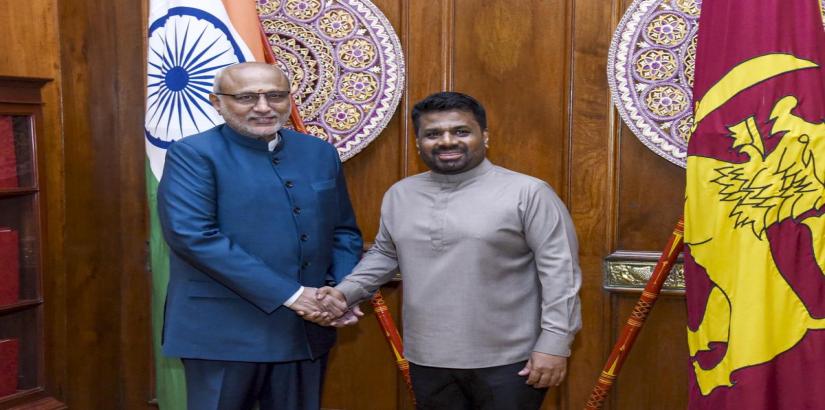
Indian Vice President C.P. Radhakrishnan visit to Sri Lanka earlier this week shot into prominence not because it was the first official visit by an Indian VP to the island-nation, but due to Foreign Secretary Vikram Misri’s announcement that New Delhi wants to implement the Trincomalee energy hub proposal in eastern Sri Lanka as early as possible.
In the first three decades since independence top level visits between India and Sri Lanka were very rare. First Indian Prime Minister Jawaharlal Nehru visited Sri Lanka in 1955 and the first Sri Lankan leader to go to New Delhi was then fourth Prime Minister S W R D Bandaranaike in 1956.
Surprisingly, none of the Vice Presidents of India paid an official visit to Sri Lanka, although V V Giri, who became Vice President in 1967 and two years later President of India, served as India’s first Ceylon Representative (High Commissioner) from 1947 to 1951.
Strategic Consolidation
However, in recent years a quiet but significant diplomatic pattern is emerging between India and Sri Lanka with top-level meetings, presidents, prime ministers and ministerial exchanges, and strategic visits now appear to take place almost every two to three months. What once depended on crises or ceremonial calendars is increasingly becoming an institutionalized cycle of engagement.
On the surface the visit of Indian Vice President Radhakrishnan was less about dramatic treaties and more about quiet strategic consolidation that include reassurance of goodwill, development aid visibility, and reaffirming India as Sri Lanka’s closest partner.
Foreign Secretary Vikram Misri held a media briefing in Colombo during the Vice President’s visit and said that India wanted to immediately implement the Trincomalee energy hub proposal signed last year when Prime Minister Modi visited Sri Lanka. Misri said both sides agreed there was “no further time to lose” on strategic projects like Trincomalee.
2025 trilateral Memorandum of Understanding (MoU) involving India, Sri Lanka, and the United Arab Emirates was to develop Trincomalee as a regional energy hub. The plan includes development of the Trincomalee 99 oil tank farm, a multi-product petroleum pipeline linking India and Sri Lanka, possible new refinery development, bunker fuel and storage facilities and regional energy security cooperation with UAE participation.
Political reading of Indian Vice President’s visit was to reiterate that India is consolidating influence in Sri Lanka after the economic crisis and focus on Trincomalee, ports, energy, Tamil outreach, and people-to-people ties. It also reflects India’s effort to stay ahead of Chinese strategic inroads.
Importance of Trincomalee
If one location matters most to India in Sri Lanka, it is Trincomalee. With one of the finest natural harbours in the world, Trincomalee has immense commercial, naval, and energy value. For decades, strategists in New Delhi have viewed it as critical to the security architecture of the Bay of Bengal.
India made this strategy into a bilateral agreement when it was included in the Indo-Sri Lanka Agreement of 1987 signed by President J R Jayewardene and Prime Minister Rajiv Gandhi. India’s long-term interest is to expand cooperation on the oil tank farm project, build an integrated energy hub, increase industrial and logistics presence and prevent rival powers from gaining strategic leverage in Trincomalee.
That is the reason why the Indian foreign secretary emphasized during the vice president’s visit that Trincomalee must move from promise to implementation. India knows infrastructure delays often become geopolitical openings for others.
India is well aware that whoever has influence over Sri Lankan ports gains relevance in the Indian Ocean. Hence, India’s concerns are to ensure stable access to Colombo Port, that is vital for Indian transshipment trade, deepen involvement in container terminals and logistics, strengthen maritime connectivity between southern India and Sri Lanka and reduce vulnerability to strategic surprises in nearby ports.
This visit signaled India’s presence and its engagement. The message between the lines was that while Sri Lanka has alternatives to enter into any economic partnership, political changes in Sri Lanka will not reduce Indian interest. India often responds to Chinese influence not through confrontation, but through persistence, proximity, and partnership.
As Foreign Secretary Misri has clearly outlined India’s priority of early implementation of the most strategic economic projects in the Indian Ocean, the proposed Trincomalee energy hub and oil storage development, Sri Lanka will have to respond in the near future. Although no new agreement was formally signed during the two-day visit, both governments used the occasion to accelerate implementation of previously negotiated understandings involving India, Sri Lanka and the United Arab Emirates. At a time when global fuel markets remain volatile due to Middle East tensions, Sri Lanka’s location has become even more valuable.
Potential for Sri Lanka
If professionally negotiated the terms and conditions, Sri Lanka could gain many benefits like foreign investment without sovereign debt burden, jobs and industrial development in the East, better fuel security and lower logistics costs, revival of underused national assets (99 oil tanks) and increased geopolitical relevance. However, Sri Lanka must ensure that national ownership, transparency and environmental safeguards are protected.
Vice President Radhakrishnan’s visit was ceremonial on the surface, but strategic underneath as it demonstrated that India now sees Sri Lanka not merely as a neighbour, but as a crucial partner in energy security and maritime stability. If implemented wisely, Trincomalee could become not just an oil tank farm, but the economic engine of Sri Lanka.
(The author, a former Sri Lankan diplomat, is a political and strategic affairs commentator. Views expressed are personal. He can be reached at sugeeswara@gmail.com.)





Post a Comment