

How Sri Lanka Balanced India and China Ties to Maximise Developmental Gains
The architecture of financial and infrastructural assistance deployed by India and China in Sri Lanka differs significantly. Their infrastructure profiles, however, are not fundamentally competitive and instead represent distinct advantages that Sri Lanka has leveraged for its development. India and China are essential pillars of Sri Lanka's development future and economic ambitions.
 Apr 29, 2026
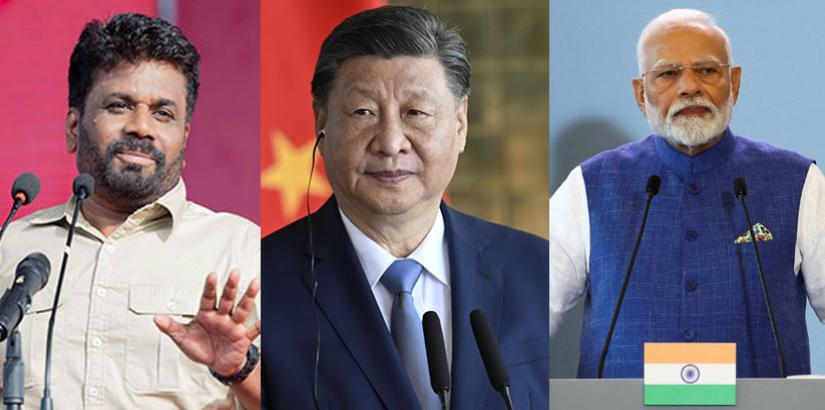
India and China’s economic engagement in Sri Lanka is better understood as complementary rather than purely competitive, shaped by their distinct strategic priorities and capabilities. While China has focused on large-scale, capital-intensive infrastructure projects aligned with long-term commercial and connectivity interests, India’s approach has emphasized smaller, regionally distributed initiatives and crisis-responsive financial support. Sri Lanka, driven by economic necessity and lessons from its financial crisis, has sought to balance both partners to diversify risk and maximize developmental gains. This dual engagement reflects a pragmatic strategy aimed at leveraging the strengths of each power to support stability, connectivity, and long-term growth.
In late March 2026, a delegation of Sri Lankan parliamentarians from the Sectoral Oversight Committee on Infrastructure and Strategic Development completed a week-long study tour of India. The delegation encouraged greater Indian investment in Sri Lanka's infrastructure sector, noting that such partnerships could contribute significantly to the country's foreign exchange earnings. Less than three months prior, Chinese Foreign Minister Wang Yi had stopped over in Colombo on his return from Africa. During the visit, Sri Lanka's Foreign Minister confirmed that the agreement related to the SINOPEC oil refinery in Hambantota would be finalized in the first quarter of 2026, significantly enhancing the financial prospects of the project.
The two episodes capture a dynamic that has long defined Sri Lanka's external relations for the better part of two decades. Positioned around one of the world's busiest east-west shipping corridors, Sri Lanka sits at the intersection of India's SAGAR vision which frames the Indian Ocean as a zone of its strategic stewardship, and China's Maritime Silk Road, for which Sri Lanka is a major country in the so-called String of Pearls. The conventional reading of this overlap is that it is competitive in nature, framing New Delhi's Neighborhood First policy as pushing back against China's growing footprint in South Asia.
President Anura Kumara Dissanayake, however, has been careful to balance ties with both India and China. Shortly after his visit to New Delhi, he travelled to Beijing in January 2025 with the intent of strengthening Sri Lanka’s position within China’s supply chain network, as well as securing greater access to financial aid to advance its ports as a naval service hub in the Indian Ocean region. This maintaining of balance emerges from structural necessity for small island and littoral states in the region, which must diversify economic partnerships to avoid overdependence on any single external actor. For Sri Lanka, this imperative has been sharpened by the vulnerabilities exposed during its recent economic crisis, making external engagement across multiple partners central to its economic stability. Across infrastructure and development financing, both India and China have offered demonstrably different capabilities, and Colombo has, with varying success, attempted to engage both powers on terms suited to its economic interests.
Differing Infrastructure Ambitions
The infrastructure footprints of India and China in Sri Lanka differ not merely in scale but even more so in strategic character, geographic distribution and the underlying logic of project selection. China's engagement, particularly after the end of the civil war in 2009, had emerged around a small number of large, capital-intensive projects concentrated in the south and the capital. The cumulative value of Chinese investment in infrastructure in Sri Lanka amounted to USD 12.1 billion between 2006 and 2019, spanning the Norochcholai power station, Hambantota port, Mattala International Airport, Port City Colombo, the Colombo International Container Terminal and the Lotus Tower. India's engagement has followed a different pattern with a focus on relatively smaller-scale projects, dispersed geographically and weighted toward both its socio-cultural connections as well as its greater regional vision. IRCON's railway reconstruction project from Maho to Omanthai, a USD 11 million grant-funded, hybrid renewable energy system across the Palk Bay islands, and the development of Kankesanthurai Port under a Line of Credit facility represent a model oriented toward connectivity and community-level needs. Notably, Chinese infrastructure has largely bypassed the north and east, the regions most scarred by the civil war and in dire need of sustained development investment. India's presence there, however modest in financial terms, has carried a different kind of significance.
India's most notable infrastructure move in recent years was the Adani Group's entry into the Colombo Port project. In 2021, Adani Group reportedly signed a USD700 million agreement to build the Colombo West International Container Terminal jointly with John Keells Holdings and the Sri Lankan Ports Authority under a build-operate-transfer arrangement for 35 years. This was the first-ever Indian port operator in Sri Lanka and the largest foreign investment in Sri Lanka's port industry. However, Adani’s investment initiatives have faced other roadblocks since it subsequently withdrew from a wind power project in the north after the Dissanayake government sought to renegotiate terms, and several other projects, including the Colombo Port West Container Terminal, also faced scrutiny and domestic criticism. Thus, while there is greater appetite for private Indian investments in Sri Lanka, its infrastructure presence, while strategically and commercially meaningful, has also proven vulnerable to domestic political shifts in Sri Lanka. The more recent India-Sri Lanka-UAE trilateral framework for Trincomalee, covering energy infrastructure, a potential pipeline and a new refinery, suggests New Delhi is attempting to address these vulnerabilities by anchoring projects within a broader multilateral structure less susceptible to bilateral friction. Whether that gambit succeeds will depend as much on the stability of Sri Lankan domestic politics as on Indian strategic coherence.
Varying Development Financing
In terms of bilateral lending, India and China’s patterns of financing have been determined by respective strategic interests, offering limited scope for comparability. However, they are broadly motivated by commercial self-interest, advancement of regional/global initiatives, and shifts in response to opportunities and changes in reputational costs. For instance, the spatial and temporal distribution of Chinese financing supports its broader energy security interests. Concentrated in the Southern provinces close to the East-West shipping lane and increasing around the time Sri Lanka joined the Belt and Road Initiative in 2013, Chinese financing for ports and logistics hubs has been designed to establish a presence in strategic locations along key sea lanes of communication (SLOC). On the other hand, India’s lending patterns have been largely driven by its national security interest in Northern Sri Lanka’s stability, due to the region’s geographic and cultural proximity to India’s Southern coast. The vastly differing strategic intent explains the patterns, emphasis, and underlying differences in the financing strategies pursued by both countries.
India and China’s lending to Sri Lanka have also shifted in response to different pressures and opportunities. China’s lending, which was initially concentrated in the infrastructure sector, shifted to the other sectors after the 2015 election, which highlighted China's role as a major bilateral creditor. The 2015 election marked the beginning of a highly tumultuous period in Sri Lankan politics, which saw a progressive reform agenda descend into political struggles and abrupt shifts in foreign policy, notably away from Chinese infrastructure investments. Responding to these dynamics, Beijing adjusted its financing strategy away from debt-heavy projects towards technical assistance and grants to mitigate reputational damage. India, which saw an improvement in its relations with Sri Lanka after the 2015 election, responded to the shift in political conditions by offering its own connectivity infrastructure projects. The recent exploration of cross-border electricity transmission and grid connectivity projects between India and Sri Lanka is an example of the new forays into connectivity infrastructure that New Delhi is willing to make.
Another point of difference has been the scale of financing and its significance for Sri Lanka. Sri Lanka’s outstanding debt to China stands at USD 4.974.1 billion, compared to India, which is USD 0.984 billion, as of December 2025. The variation reflects that China is a larger bilateral lender to Sri Lanka and has a relatively stronger commercial stake in the country. Beijing’s insistence on negotiating bilaterally during the external debt restructuring process that ended in June 2024 was underpinned primarily by such commercial considerations. Parallelly, India played the role of a lender of last resort, which was evident from the swift provision of assurances it provided for debt relief during Sri Lanka’s financial crisis in 2022. Moreover, emergency financing extended by India amounted to USD 4 billion following the debt crisis, and USD 450 million as disaster relief funds after the recent Cyclone Ditwah. In many ways, India’s role has been less about commercial gain, and more about ensuring stability and mitigating immediate crises in its periphery.
Positive Sum Maximization
The architecture of financial and infrastructural assistance deployed by India and China in Sri Lanka differs significantly. Their infrastructure profiles, however, are not fundamentally competitive and instead represent distinct advantages that Sri Lanka has leveraged for its development. India and China are essential pillars of Sri Lanka's development future and economic ambitions. New Delhi's engagement has evolved over decades and is characterized by stability, continuity and predictability that proved most consequential precisely when Sri Lanka's economy was most exposed.
Meanwhile, Beijing's engagement with Sri Lanka has injected fresh impetus into the island’s economic development. Beijing’s large-scale capital deployment and long-horizon infrastructure have been unmatched by any other bilateral partner in Sri Lanka's vicinity. Often, Global South regimes view Chinese loans and other bilateral financing instruments as complementary to their interests. Likewise, Sri Lanka's economic management of its relationships with India and China reflects this perspective, even though it has often been presented as zero-sum competition.
For Sri Lanka, connectivity and infrastructure have primarily carried an economic rationale. Several projects that were seen as signals of strategic alignment were, from Colombo's vantage point, decisions about costs, capacity and prosperity. Maximization of Sri Lanka’s autonomy has thus involved engaging both countries according to their respective strengths, and will continue to be so for the foreseeable future.
(The authors are the Senior Research Associates at the Organisation for Research on China and Asia (ORCA). This article was originally published at ORCA)





Post a Comment