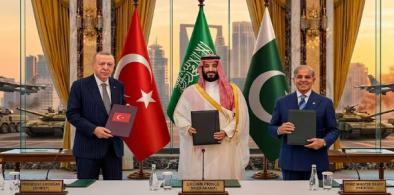
The salvation for Pakistan’s body politic, wherein democracy is aspired by those who are not democrats themselves, may remain unfortunately with the men in uniform.
The NATO summit can indirectly transform India from a regional power into a West Asia stakeholder by integrating India into maritime security frameworks, supporting connectivity projects, strengthening intelligence ties, reinforcing India’s role as an alternative to China. The long-term outcome is that India could emerge as a pillar of stability linking Europe, the Gulf, and the Indo-Pacific
Japan has also proposed developing a Bay of Bengal–Northeast India Industrial Value Chain aimed at transforming the region into an integrated industrial zone. As part of the Free and Open Indo-Pacific vision, this includes strengthening cross-border connectivity with Bangladesh, Myanmar, Nepal and Bhutan.
China's expressed interest in modernising and upgrading both Chattogram and Mongla ports suggests the emergence of an interconnected infrastructure network linking the Bay of Bengal with southwestern China through Myanmar. If realised, such connectivity would enhance trade flows, improve regional logistics and deepen China's economic footprint across the Bay of Bengal littoral, while simultaneously increasing Bangladesh's importance as a regional transit and connectivity hub.
While Washington and New Delhi seek to strengthen bilateral ties with Colombo, Beijing has strategically engaged with the political forces that control the government. By engaging directly with actors at the core of Sri Lanka’s governance, Beijing appears to be signalling its strategic intent—projecting influence and reinforcing ideological ties.
The salvation for Pakistan’s body politic, wherein democracy is aspired by those who are not democrats themselves, may remain unfortunately with the men in uniform.
There is no light at the end of the repatriation tunnel; one must look at other more viable and pragmatic scenarios rather than transporting almost a million people at gunpoint to Rakhine
From religious bigotry in India targeting Muslims, to Sri Lanka’s economic woes and food insecurity, to the plight of the Afghans, particularly women, discussions at the conference took up these and other issues like the impact of climate change, press freedom and creeping censorship, to transgender rights, enforced disappearances, and arbitrary detentions.
India annually celebrated major festival days of all faiths, but these festivities are largely confined to their believers. If those communities, however, were to become more open to secular participation on the principle that if faiths are for believers, associated festivities are for all to enjoy.
Indian and Pakistani politicians can leverage the sport to resolve many outstanding issues between the neighbouring countries, provided there is an honest will on either side and the intentions are well-meaning. And the bilateral series can resume only if a Vajpayee-Musharraf-like initiative is taken by those occupying the highest positions in the two countries.
South Asia must develop a common framework to hold politicians accountable and increase transparency in government dealings. Regional collaboration can reduce vulnerability.
If Myanmar acquires a nuclear capability, it would be a disaster for South and Southeast Asia. A nuclear Myanmar is not in India, China, or other neighbouring countries' interests. Recent border tensions between Myanmar and Bangladesh are the best example to understand the gravity of the situation.
Since Dawood moved to Karachi, the D Company syndicate has expanded incredulously. He is said to have invested over USD $28 billion in assets in Karachi alone and has diversified his businesses in several countries such as India, Morocco, the UK, UAE, Switzerland, Hong Kong, Thailand, Sri Lanka, Italy and France.
The demonstrable success of BBIN cooperation may draw Sri Lanka and Maldives also into its ambit in the near future. India's government and corporate sectors must work together to make BBIN cooperation a success to mutual advantage.
The question also arises – is Delhi losing focus and getting diverted from the AEP by QUAD, Chinese influence on RCEP, and so on. If so then Delhi must decentralise the AEP to make it effective
This doesn’t erase the irrefutable fact that a community that used to align with Kashmiri parties until now was shifting its preferences, the impact of which is bound to be felt in the electoral battle in the forthcoming assembly polls. If the BJP succeeds in reaping the electoral benefits in Jammu & Kashmir, it will have much more to tell the nation ahead of the 2024 polls in the country.
Activities of militant organizations have developed around the Rohingya camps in Cox's Bazar. A web of militancy is spreading in the camps with the money coming from six countries including the Middle East and Pakistan.
The Chinese presence in Pakistan, with or outside of the CPEC, and the TTP's defiance, although not directly related, do pose growing security challenges to Pakistan and China, especially when the two want to combine forces to extend the CPEC to Afghanistan.
Today the international image of India, courtesy the RSS-BJP, is a Hindu supremacist one where minorities are insecure, where identity issues are getting precedence over the issues of livelihood. RSS is the fountainhead of this politics; it needs introspection if it is serious about the process of dialogue and reconciliation.
India could reset its approach by engaging with Sri Lanka as a country in the Indo-Pacific region and not just as a neighbour.