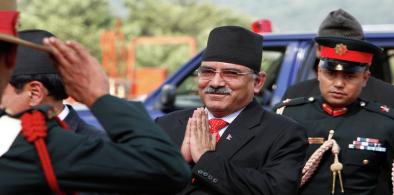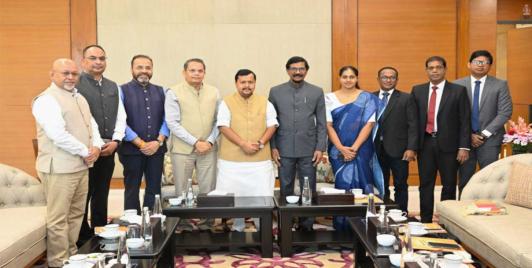


Sri Lanka's JVP delegation meet BJP national president

Sri Lanka’s Ruling Marxists-Leninists on Delhi, Beijing Visits: Embracing Diplomatic Pragmatism?

For Sri Lankan politics, this is more than diplomatic sightseeing. It raises a fundamental question whether the JVP is developing a sophisticated strategy of balancing relations with India and China or is it gradually adapting itself to the organisational models of powerful one-party or dominant-party systems in China and India respectively?

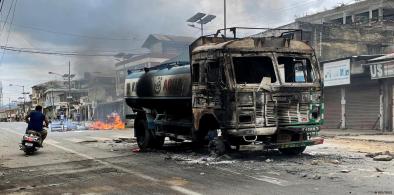
Continuing Kuki-Naga Conflict is a Threat to Northeast India's Security

The ongoing civil war in Myanmar has caused an influx of armed cadres (Meitei, Naga and Kuki) into Manipur's border tracts like Kamjong district, further squeezing finite land resources and aggravating historical territorial disputes. What began as a localized dispute under the state's newly elected government in February 2026 has escalated into intense, multi-district armed warfare. 

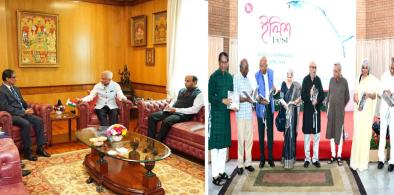
An Ilish Fest Becomes a Test of Diplomacy in Strained India-Bangladesh Ties

Hamidullah’s tenure has been marked by promotion of Bangladesh's soft power, with the envoy going around the country underlining the deep roots of people-to-people ties. 

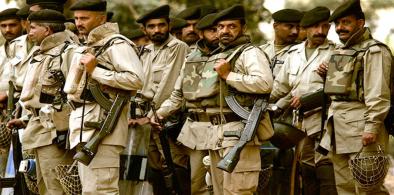
Mounting Instability in Pakistan: Consequences for Regional Security

India must also recognise that Pakistan's internal security crisis has wider regional implications. Escalating Pakistan–Afghanistan tensions could create additional uncertainty along the western frontier, while attacks on Chinese projects could affect regional connectivity and investment.

More on Geopolitics, Security and Strategic Affairs

Communal violence mustn't be employed as a weapon in Bangladesh's election

As Durga Puja approaches and the country's Hindu communities prepare themselves to embrace their beloved goddess, the leaders of the Bangladesh Hindu, Buddhist, and Christian Unity Council, a religious minority organisation, are concerned about a possible outbreak of communal strife in the nation.

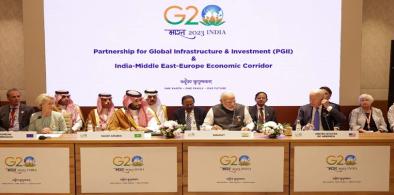
Will IMEC be a potential game-changer for India and South Asia?

For India, IMEC is a strategic move to lessen dependency on its traditional trading partners while opening up a horizon of opportunities in markets ranging from technology to energy. Also, India is poised to countervail growing Chinese influence in South Asia if successful implementation of IMEC becomes possible. 

Nepal's regional diplomatic balancing demonstrates its non-aligned foreign policy

Nepal’s participation in bilateral infrastructure projects with China exemplifies its aspiration for mutual economic growth. Yet its decision to distance itself from the GSI indicates its commitment to remain neutral, given its deep-rooted ties with India.

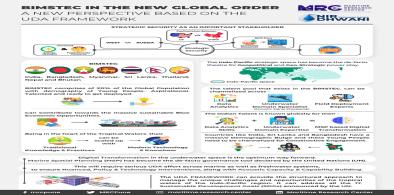
How Indian expertise and BIMSTEC's traditional knowledge can transform underwater domain awareness for regional benefit

The talent pool that exists in the BIMSTEC - in countries like Bangladesh, Sri Lanka, and Thailand - can be channelized across areas of data analytics, underwater domain (acoustic signal processing) and for field deployment.  Indian talent is known globally for its data analytics skills, and coupled with the underwater domain expertise, can work on the MSP-based digital transformation for the region.

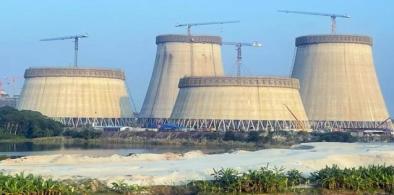
Bangladesh's march towards energy security - with a little Russian help

The successful operation of the  Rooppur plant will underscore the commitment of Bangladesh to responsible and secure nuclear energy utilization

Pakistan needs to reshape priorities: Trim high defence budget, build positive ties with India

History has shown that whenever Pakistan sought peaceful relations with India, India responded positively. This held true during democratic governments and even during dictatorships in Pakistan.

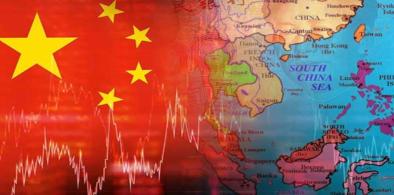
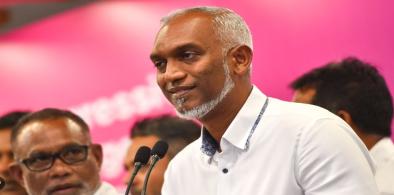
With China tightening hold on South Asia, Maldives a wake-up call for India

Muizzu’s regime in the Maldives in conjunction with Pakistan could be potentially sitting on China’s lap for decades, along with a pro-China government in Nepal, and Myanmar annyway drawn into China’s strategic sphere since the military coup in Nay Pyi Taw in February 2021.

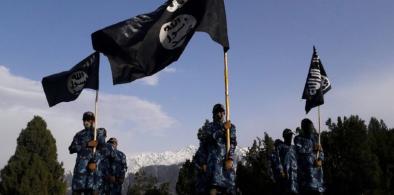
Islamic State's expanding footprints pose grave security threat to Pakistan and South Asia

While Pakistan continues to blame India for the bombings in Balochistan and Khyber Pakhtunkhwa,  it fails to introspect on its own internal crisis stemming from its policies against its citizens and the military/political support being given to certain radical outfits or groups.

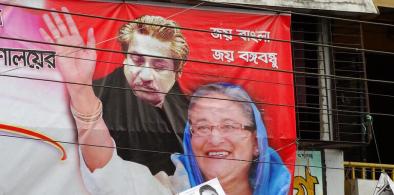
Why are the people of Bangladesh apprehensive about the upcoming elections?

Due to the lack of established regard for the democratic system, elections held after the 1990s have been marred by political turmoil and civic unrest. The absence of a solid democratic foundation has hindered the institutionalization of democracy in national life and politics.

Maldives election: India should not align its neighbourhood policy to individual leaders

The China-funded Sinamale Bridge connecting the capital Male and the airport island Hulhule, is a boon to the Maldivian people, who readily relate to the project, and hence to China as a development partner. But China is seen only as a developmental supplementary to long-term friendly neighbour India and not as an alternate in any way.  

Student suicides in India: Kota is a wake-up call

What we see in Kota today is deeply rooted in middle-class aspirations for social mobility, considering meritocracy a fair and promising system. But, the ‘merit ladder’ for upward mobility is not equally tangible and accessible to all. The material, social and psychological resources available for these students depend on their social location.

Continued ethnic strife in Manipur making region vulnerable to external exploitation

China has been supporting, training and arming northeast terrorists for the past several decades. The ongoing political experiment of ethnic cleansing and polarization in Manipur would naturally be exploited by China.

Shedding the misconceptions: Bangladesh's ties with China should not be a concern for India

The Sino–Bangladeshi partnership has not grown at the expense of the Indo–Bangladeshi partnership. Bangladesh does not constitute a part of the traditional Chinese sphere of influence. 

Empowering Bangladesh: The promise of solar-wind hybrid renewable energy systems

Bangladesh's energy woes demand innovative solutions, and the integration of solar and wind energies in a hybrid system represents a groundbreaking approach to meeting the nation's power needs. 

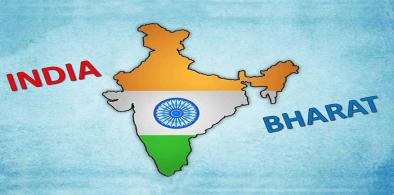
‘India’ or ‘Bharat’ debate reflects postcolonial insecurities, not in tune with modern nationhood

India holds together not by ignoring diversity but by granting constitutional and ideational recognition to different ethnic, religious and linguistic groups. The word ‘India’ evokes and symbolizes a “we feeling” in the people's collective consciousness, derived from long-held traditions and pluralist imaginations.