

India-UAE Defence Cooperation Is A Comprehensive Strategic Alliance With Wider Regional Ramifications
The India-UAE military equipment cooperation is a burgeoning strategic partnership focused on joint production, technology transfer, and industrial collaboration, moving beyond mere arms sales to build a self-reliant defence ecosystem, support India's 'Make in India' initiative, and establish the UAE as a gateway to African/Middle Eastern markets, creating a mutually beneficial, politically neutral defence bloc for regional stability and economic growth.
 Jan 23, 2026
Out of the seven sheikhdoms—Abu Dhabi, Dubai, Sharjah, Ajman, Umm Al Quwain, Fujairah, and Ras Al Khaimah, six became part of the United Arab Emirates (UAE) on December 2, 1971. Ras Al Khaimah, the seventh, joined the UAE on February 10, 1972. Also known as Trucial states, they were among the last territories relinquished by the British in the Gulf.
For thousands of years, India, the Sindhu (linguistically corrupted to Indus and later to India) valley civilisation traded by seafaring in dhows to exchange Indian spices, textiles, pearls, precious stones, gold, and porcelain for Arabian dates, horses, and pearls, using the Indian rupee as the trading currency before the oil era.
While official India-UAE relations began in 1972, the mid-1970s oil boom led to a rapid increase in the Indian workforce in the Gulf and India-UAE trade increased from $180 million in the 1970s to over $100 billion in the financial year 2025. There was an inexplicable 34-year gap between the visits by Indian prime ministers to the Gulf - Indira Gandhi (1981) and Narendra Modi (2015). Thereafter, PM Modi made at least seven visits leading to numerous agreements and deepened engagement. While relations were always good, the period after 2015 saw an exponential acceleration moving from traditional economic reliance to a multifaceted strategic alliance.
In 2017, the relationship was elevated to a Comprehensive Strategic Partnership. In February 2022, the Comprehensive Economic Partnership Agreement (CEPA) was signed targeting $100 billion in non-oil trade by 2030. As of 2025-26, the UAE is India's third-largest trading partner and second-largest export destination.
Counterterrorism Cooperation, Countering Radicalization
Since 2003, while military ties between India and UAE have grown steadily with regular joint military exercises, cooperation in counterterrorism has matured, characterized by high-level intelligence sharing, joint military exercises, and a mutual commitment to "zero tolerance" against terrorism. This alliance involves actionable measures to thwart threats, including disrupting terror financing, countering extremist ideologies, and strengthening maritime security with wider regional ramifications.
Cooperation expanded to regular naval exercises Desert Cyclone, Gulf Star-1, including a joint operation that thwarted a 2020 terror attack in Delhi. The second edition, Desert Cyclone-II concluded in December 2025 in Abu Dhabi, involving Indian Mechanised Infantry and the UAE’s 53 Mechanised Infantry Battalion. The exercise focused on urban operations, counterterrorism, and UN-mandated sub-conventional missions.
Under specialized training, exercises include joint training on room intervention, building clearance techniques, improvised explosive devices (IED) awareness, and casualty evacuation. Intelligence sharing/exchange has progressed with both nations sharing inputs about terrorist threats and the movement of foreign terrorists. The partnership includes robust mechanisms for the extradition of wanted individuals and mutual legal assistance. Action against financing of terrorism and money laundering progressed with the UAE committing to support India within the framework of the Financial Action Task Force (FATF).
Agreeing on countering ideology and radicalization, both sides have been focusing on targeting extremist ideology and the use of the internet for radicalization. For countering religious extremism, India and the UAE have been promoting values of tolerance and peace through interfaith dialogues.
Maritime Security, Inteoperability
For enhancing interoperability and learn each other’s best practices, India’s army, navy, air force and coast guard have been conducting regular bilateral and multilateral exercises with their UAE counterparts. These are:-
(a) Army. First bilateral Army Exercise Desert Cyclone was conducted from 02-15 January 2024 in India.
(b) Navy. India and UAE have been conducting bilateral maritime exercises regularly. Earlier known as Ex Zayed Talwar, the exercise has now been rechristened as Ex Gulf Waves. The previous edition was held in UAE in Oct 2024 along with the visit of the CNS, Indian Navy. In addition, UAE also participated as an observer in the multilateral maritime exercise Ex Milan in 2024. Apart from the exercises, the Indian Navy carries out frequent port calls in the region, especially Mina Rashid in Dubai and Mina Zayed at Abu Dhabi.
(c) Air Force. IAF has been regularly participating in Ex Desert Flag, the multilateral air exercises held in UAE. Similarly, UAE participated in the inaugural multilateral exercise Ex Tarang Shakti held in India in 2024.
(d) Coast Guard. In addition to the three services, Indian Coast Guard also engages with the UAE National Guards regularly in the form of table-top and maritime passage exercises during their port calls to UAE.
Further maritime security joint actions include anti-piracy efforts, joint training, and maritime exercises like Exercise Zayed Talwar.
Defence Manufacturing, Military Equipment Cooperation
A renewed focus on forging partnerships and joint ventures between the defence manufacturers from both sides led to the first-ever India UAE Defence Industry Cooperation Forum held under the aegis of Indian Defence Ministry’s Department of Defence Production in September 2024. Industry leaders and government officials from both countries converged to explore opportunities for collaboration in defence manufacturing and technology. There was active participation from government officials, industry leaders, and defence experts from both nations, with the aim of fostering innovation, technology transfer, and joint ventures in the defence sector. For enhancing defence manufacturing capabilities, key companies from the Indian defence industry, including private and public sector companies, engaged with their UAE counterparts, particularly EDGE Group, a leading Abu Dhabi-based advanced technology and defence conglomerate and other defence companies under the EDCC (Emirates Defence Companies Council), which plays a key role in the expanding India-UAE defence cooperation, particularly in fostering industrial partnerships, joint development, and technology transfer.
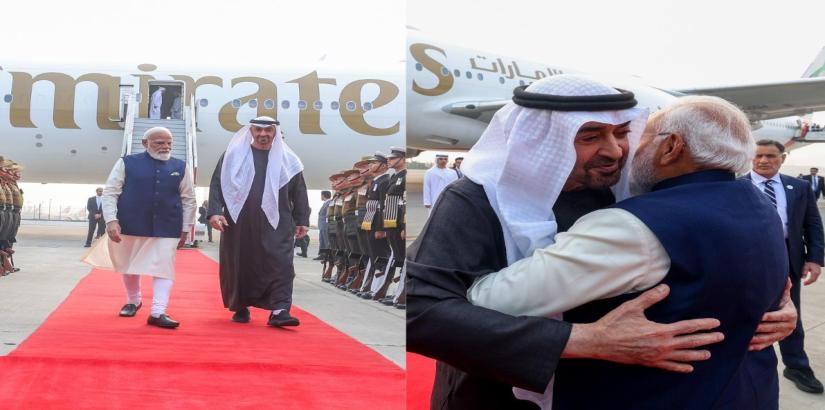
During the January 2026 visit of the UAE President Mohamed bin Zayed Al Nahyan to India - who was accompanied by a powerful delegation during his three-hour visit - both leaders reiterated their unequivocal condemnation of terrorism in all forms, including cross-border terrorism. Also in January 2026, both nations signed a Letter of Intent to enhance their strategic defence partnership, including cooperation in manufacturing, technology transfer, and cybersecurity.
A central aim is moving from buyer-seller to co-development and co-production of advanced military hardware, leveraging India's manufacturing base and UAE's investment. It is framed as a long-term, comprehensive strategic alliance, expanding beyond traditional military training to encompass deep defence industrial partnership and innovation.
The India-UAE military equipment cooperation is a burgeoning strategic partnership focused on joint production, technology transfer, and industrial collaboration, moving beyond mere arms sales to build a self-reliant defence ecosystem, support India's 'Make in India' initiative, and establish the UAE as a gateway to African/Middle Eastern markets, creating a mutually beneficial, politically neutral defence bloc for regional stability and economic growth. Key aspects of the cooperation are (a) joint manufacturing and co-production; (b) Focus on advanced technologies, R&D, space collaboration (IN-SPACe and UAE Space Agency), and integrating private sector participation; (c) Market access: the UAE serves as a potential launchpad for Indian defence exports into the Middle East and Africa, boosting India's global defence footprint; (d) Mutual benefit: UAE gains access to cost-effective, proven technology without political conditions, while India strengthens its 'Atmanirbhar Bharat' (self-reliant India) goals.
(The author is a strategic affairs analyst and former spokesperson, Defence Ministry and Indian Army. Views are personal. He can be contacted at wordsword02@gmail.com, https://www.linkedin.com/in/anil-bhat-70b94766/ and @ColAnilBhat8252, https://www.youtube.com/@SAM-SouthAsiaMonitor )







Post a Comment