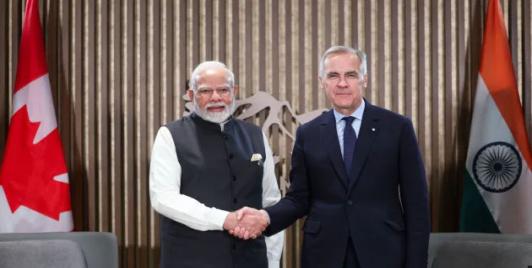
PM Modi and Canadian PM Mark Carney

Reimagining India-Canada Relations: Towards a Mutually Beneficial Relationship for Wider Public Good

Canada hosts close to 1.9 million persons of Indian Origin (PIOs) and 3% of Canada’s population, one of the largest ethnic groups in Canada’s multiethnic and multicultural society. Although immigration policy of Canada has tightened in recent years, yet a lot of students who study in Canada prefer to stay back and work in Canada acquiring permanent residency and citizenship.

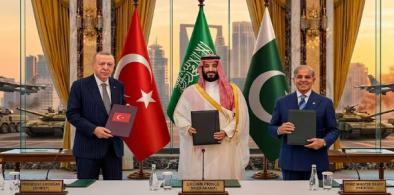
In Pakistan's and Turkiye's Military Commitment, the Mecca Pact Faces its First Litmus Test

It would also explain why Pakistan is trying to preserve a distinction between supporting Saudi Arabia and fighting the Houthis. Pakistan has every reason to avoid another open-ended conflict in the Middle East. Its military is heavily committed to its own security challenges. Its economy cannot easily absorb the political and financial consequences 

EU and India Should Cooperate Strategically on Middle East Stability

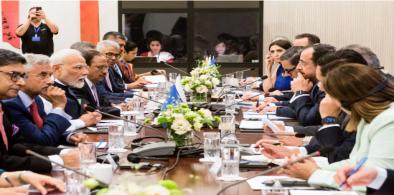
EU and India could establish a regular EU–India-Middle East Consultative Mechanism involving foreign-policy officials and experts. Its purpose would be to coordinate positions before major international gatherings and meetings. 

Sri Lanka’s Ruling Marxists-Leninists on Delhi, Beijing Visits: Embracing Diplomatic Pragmatism?

For Sri Lankan politics, this is more than diplomatic sightseeing. It raises a fundamental question whether the JVP is developing a sophisticated strategy of balancing relations with India and China or is it gradually adapting itself to the organisational models of powerful one-party or dominant-party systems in China and India respectively?

More on Geopolitics, Security and Strategic Affairs

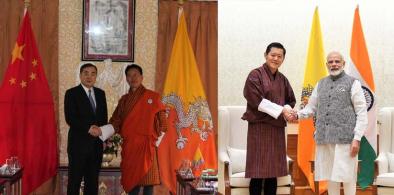
Diplomatic ties with China are not in Bhutan's national interest

The underlying reason for Bhutan to keep China at an arm’s length is not India’s strategic influence; rather it emanates from a firm belief that opening diplomatic ties with China is against its national interest, writes Thinley for South Asia Monitor

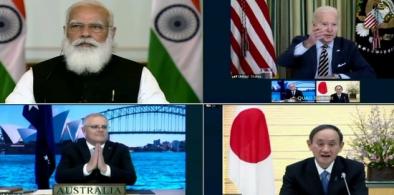
Despite uncertainties over Afghanistan, US-India ties will grow stronger under Biden

It is likely that under the Biden administration US-India relations will grow stronger and will have more routes to work on a range of issues -- free and open Indo-Pacific, restoring peace in Afghanistan, arms control, countering aggressive behavior of China and climate crisis with stress on multilateralism, writes Indu Saxena for South Asia Monitor

Chinese land-grab in Bhutan and India: Timid responses won't work with Beijing

There have also been reports that other areas of Western Bhutan have been gradually encroached by China to secure access to the border with India, writes Lt Gen Prakash Katoch (retd) for South Asia Monitor

Afghanistan: Challenges of peace through regional consensus

The region, overall, has gone through a major strategic realignment with the increasing influence of China, and its ties with Pakistan. Also, unlike the 90s,  there exists multi-dimensional international cooperation on the issue of Afghanistan today, writes Shraddha Nand Bhatnagar for South Asia Monitor

Dhaka's public admonition by Chinese envoy: Strategic fallout of an expanding profile in South Asia

The Chinese footprint in the South Asian region has been steadily increasing, while that of India is being diluted and all the SAARC (South Asian Association for Regional Cooperation) nations are  differently dependent on Beijing for a mix of political, economic, trade and military support, writes Cmde C Uday Bhaskar (retd) for South Asia Monitor

The pandemic: Bringing out the best, and the worst, in us

If it’s any solace, this dreadful time has given rise to an unnamed bond among strangers—call it humanity, altruism, empathy—but it’s helping many of us stay afloat, writes Azera Parveen Rahman for South Asia Monitor

Vaccination in South Asia: India still remains the best hope

While India must resume supplies to its neighbors, there is much that it can also learn from some of their best practices, including Bhutan, writes N Chandra Mohan for South Asia Monitor

Afghanistan can trigger multidimensional fallout on South Asian politics

Pakistan’s 'all-weather friend' China has intensified communication with the Taliban. Afghanistan is very significant for China for Its Belt and Road Initiative, writes Md. Ishtiak Hossain for South Asia Monitor

South Asia and COVID-19: Impact of school closures on children’s learning

South Asia - which had the longest period of school closure - could face a learning crisis which will set us back by a decade, writes Partha Pratim Mitra for South Asia Monitor

For India to be a global leader, it must deliver at home first

India's foreign policy mandarins know more than anyone else that altruism does not exist in international relations and diplomacy must be conducted on the basis of realpolitik acting only in pursuit of their self-interest, writes Lt Gen Yash Malhotra (retd) for the South Asia Monitor

Vaccination and vaccine purchase politics: Can India attain herd immunity?

But most experts agree that the country can reach ‘herd immunity’ if 70 to 80 percent of the population is fully immunised.  That comes to a population of 1.05 billion, for whom 2.10 billion doses are needed, writes Vinod Aggarwal for South Asia Monitor

Is the US set to repeat past mistakes in Afghanistan?

It would be interesting to know how American security experts view the threat perceptions from the numerous affiliates of the bodies in the Afghanistan-Pakistan region, some of whom target India, writes Mahendra Ved for South Asia Monitor

Is the tide running out for Modi?

But for the waning of his appeal, it is difficult to explain why the BJP came a cropper in West Bengal even after the enormous effort which both Modi and his powerful Home Minister Amit Shah put into their campaigns in the state with scores of public rallies and roadshows, writes Amulya Ganguli for South Asia Monitor 

Vaccine diplomacy and Chinese moves in South Asia: Can Beijing live up to its promises?

Pakistan, Afghanistan, Sri Lanka and Nepal have joined the Beijing-led Platform along with Bangladesh. India, the largest country in South Asia, has stayed away, writes Swadesh Roy for South Asia Monitor

Bengal elections and the future of Bengali regionalism

The future of regional politics in India depends on not just exploiting local tradition and pride for elections, but in beefing up governance, economy, public delivery of benefits and taking on Delhi when the interest of the state is at stake, writes Subir Bhaumik for South Asia Monitor