

In Pakistan's and Turkiye's Military Commitment, the Mecca Pact Faces its First Litmus Test
It would also explain why Pakistan is trying to preserve a distinction between supporting Saudi Arabia and fighting the Houthis. Pakistan has every reason to avoid another open-ended conflict in the Middle East. Its military is heavily committed to its own security challenges. Its economy cannot easily absorb the political and financial consequences
 Oct 07, 2026
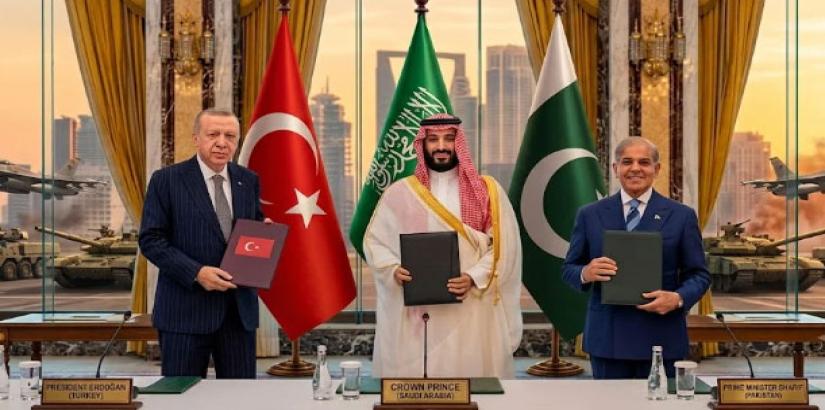
Pakistan’s Deputy Prime Minister and Foreign Minister Ishaq Dar abruptly terminated a media interaction following sharp questioning over whether parliamentary approval would be sought before committing Pakistani forces to kinetic operations against Houthi rebels in Yemen. His departure was more revealing than any carefully drafted diplomatic statement could have been. It exposed the uncertainty surrounding Pakistan’s military role at precisely the moment when the Mecca Pact was being tested in circumstances that its architects may not have fully anticipated.
The question is no longer whether Pakistan stands with Saudi Arabia. It has already said that it does. The real question is how far that commitment extends when the distinction between defending Saudi territory and participating in a war against the Houthis begins to disappear.
The timing could hardly be more difficult. The Mecca Joint Defence Agreement, signed in August by Saudi Arabia, Pakistan and Türkiye, treats an armed attack against one member as an attack against all. On October 5, its members moved from broad strategic language towards practical implementation. They agreed to provide military forces and capabilities for rapid deployment in Saudi Arabia. The stated purpose is collective deterrence and the protection of the Kingdom's security and territorial integrity.
But deterrence becomes meaningful only when an adversary believes that the threatened response will actually follow. That is where the Houthis have created an awkward dilemma for Islamabad. They have continued launching missiles and drones against Saudi targets even as the Pact has been activated. Attacks have targeted airports in Jazan and Najran, causing damage and injuries, while the Houthis have also claimed attacks on other strategic locations. Saudi Arabia, meanwhile, has intensified its military campaign in Yemen.
Keeping Things Deliberately Ambiguous
The Pact therefore finds itself caught between two interpretations. Under the first, Pakistan's role is essentially defensive. Pakistani personnel can protect Saudi airspace, strategic installations, airports, oil infrastructure and the holy cities. They can provide reconnaissance, intelligence, air defence, logistics, training and other military support.
Under the second interpretation, a sustained Houthi campaign against Saudi Arabia could eventually require Pakistani forces to support offensive operations designed to destroy the threat at its source. That distinction is critical.
Pakistan's Defence Minister Khawaja Asif has indicated that Pakistani and Turkish forces are playing a supporting role and that reconnaissance is already part of the effort, while Saudi forces are conducting the actual combat operations. Islamabad has also deliberately kept the precise composition and operational mandate of its deployment confidential.
This ambiguity may be useful in the short term. It gives Pakistan room to honour its commitment without immediately becoming a combatant in Yemen. But ambiguity becomes dangerous when the war expands. If Saudi Arabia's campaign remains limited to protecting its borders and recovering strategic territory around the Bab al-Mandab Strait, Pakistan can plausibly maintain that it is defending an ally. If Riyadh and the Yemeni government decide to pursue the Houthis into their strongholds, seize Sana'a, or attempt to destroy the organisation as a fighting force, the nature of the mission changes dramatically.
Need for Parliamentary Approval
The difference between the two objectives is enormous. Securing Saudi territory is one thing. Helping to defeat the Houthis inside Yemen is another. Analysts have already pointed out that a campaign aimed at recovering limited territory could remain relatively contained, whereas an attempt to defeat the Houthis decisively or retake Sana'a could become a prolonged war.
This is precisely where Ishaq Dar's aborted press conference becomes significant. The issue of parliamentary approval cannot simply be brushed aside as political theatre. It goes to the heart of Pakistan's democratic and constitutional process. Islamabad has a long military relationship with Saudi Arabia and Pakistani troops have served in the Kingdom for decades. Pakistan also sent forces to Saudi Arabia during the 1990-91 Gulf War, largely for defensive purposes.
Yet the present situation is different. This is not merely a question of stationing troops to protect Saudi borders. Saudi-backed Yemeni forces are already engaged in a major counteroffensive against the Houthis. Saudi aircraft are supporting that campaign, while the Houthis are retaliating against Saudi cities and infrastructure. The boundary between defence and participation in an offensive war is therefore becoming increasingly thin.
Distinction Between Defence and Offense
Pakistan's military capability is not the principal question. Its capacity is considerable. The three countries together possess a substantial military establishment, with Pakistan contributing a large and experienced land force, a sizeable air force and naval capabilities. The Pakistani military also has long experience of operating in difficult environments and has an established presence in Saudi Arabia.
More importantly, Pakistan has already demonstrated that it can move meaningful military assets into the Kingdom. Earlier this year, it reportedly deployed thousands of troops, a fighter squadron, drone squadrons and an HQ-9 air-defence system to Saudi Arabia during the wider regional crisis.
So, the issue is not whether Pakistan possesses the military instruments. It does. The more difficult question is whether those instruments are suited to the particular war that Saudi Arabia may now be preparing to fight.
The Houthis are not a conventional army waiting to be defeated by conventional superiority. They have demonstrated an ability to combine ballistic missiles, cruise missiles, drones, dispersed launch sites and asymmetric tactics. They can attack critical infrastructure from considerable distances and impose disproportionate economic and psychological costs without having to defeat a conventional army in open battle.
This makes air defence particularly important. Saudi Arabia needs to protect airports, oil installations, military bases, cities, shipping and critical infrastructure. Pakistani air-defence systems, aircraft, surveillance capabilities and trained personnel could therefore be extremely valuable without Pakistani soldiers ever crossing into Yemen. That may be Islamabad's preferred formula.
It would also explain why Pakistan is trying to preserve a distinction between supporting Saudi Arabia and fighting the Houthis. Pakistan has every reason to avoid another open-ended conflict in the Middle East. Its military is heavily committed to its own security challenges. Its economy cannot easily absorb the political and financial consequences of a prolonged foreign intervention. And a direct role in Yemen would expose Pakistan to risks far beyond the battlefield.
The Sectarian and Regional Dimension
There is also the sectarian dimension. Pakistan has historically been extremely cautious about becoming militarily entangled in conflicts that could aggravate Sunni-Shia tensions at home. The Yemen war carries precisely such dangers. A Pakistani combat role against the Houthis could be interpreted by sections of Pakistani society as participation in a wider confrontation involving Iran and its regional allies. That could make the domestic political consequences more serious than the government currently anticipates.
There is another complication. The Mecca Pact is not simply a Saudi-Pakistani arrangement. Türkiye is part of it, and Ankara brings a major military establishment and its own regional ambitions. Yet Türkiye too faces constraints over the deployment of troops abroad. Its parliament has a role in authorising such deployments, and the exact extent of Turkish military participation remains less clear.
The result is a curious three-way equation. Saudi Arabia wants credible military backing. Pakistan wants to honour its commitment without being dragged into an offensive war. Türkiye wants strategic influence but must also manage its own legal and political constraints. The Pact is therefore stronger on paper than it may prove to be in the field.
Yet the Pact cannot afford to look hollow. If the Houthis continue attacking Saudi territory after the alliance has been activated, questions about its credibility will grow. An alliance that promises collective defence but hesitates when an ally is actually attacked risks losing its deterrent value. Conversely, an alliance that responds with an open-ended military campaign risks transforming a defensive arrangement into another regional war. That is the central contradiction confronting the Mecca Pact.
Saudi Arabia also faces a strategic choice. Its present offensive appears aimed at reversing recent Houthi gains around the Bab al-Mandab Strait and the Red Sea coast. Saudi-backed Yemeni forces have reported gains around key areas, while Saudi air power has supported the counteroffensive.
But military success on the coast does not automatically translate into victory over the Houthis. The further the campaign moves into Yemen, the greater the likelihood of retaliation against Saudi Arabia. Every additional Houthi missile or drone attack will increase pressure on Riyadh to strike harder. Every stronger Saudi strike will provide the Houthis with another justification for retaliation. That is how wars acquire their own momentum.
The greatest danger for Pakistan is therefore not an immediate large-scale deployment. It is mission creep. Pakistani forces could initially arrive to protect Saudi installations. Then they could be asked to provide reconnaissance. From there could come air-defence missions, intelligence support, logistics and targeting assistance. The next request might involve maritime surveillance around the Red Sea. Eventually, the question could arise whether Pakistani aircraft should strike Houthi launch sites.
Each step could be presented as a logical extension of the previous one. Together, however, they would amount to participation in the war. That is the point at which parliamentary approval and domestic legitimacy become unavoidable questions.
Pakistan cannot afford a situation in which its government says one thing publicly while its military is doing something substantially different on the ground. Such a gap would damage democratic accountability and could also undermine the credibility of the Pact itself. Islamabad therefore needs to define the rules of engagement clearly. It needs to tell its own Parliament, its public and its allies what Pakistan has undertaken to do and, equally importantly, what it has not undertaken to do.
There is also a larger regional implication. The Houthis have shown that geography no longer provides Saudi Arabia with the protection it once did. A relatively lightly equipped non-state actor operating from Yemen can threaten airports, oil installations and other strategic assets deep inside the Kingdom. The Red Sea and Bab al-Mandab are equally vulnerable. Any prolonged disruption there could affect global shipping, insurance costs, energy markets and supply chains far beyond the Middle East. The present conflict has already acquired an international economic dimension.
For India and other Asian economies, this matters greatly. Any prolonged disruption of the Red Sea route would increase the cost and duration of shipping between Asia and Europe. Energy prices could rise further. Insurance premiums could climb. Supply chains could face fresh delays. What begins as a dispute between Saudi Arabia and the Houthis could therefore become an economic problem for countries with no direct role in the conflict.
The most likely immediate scenario is neither full Pakistani participation nor complete withdrawal. Islamabad is likely to pursue a carefully calibrated middle course. Pakistani personnel will help protect Saudi territory, provide intelligence and reconnaissance, operate or support air-defence systems and contribute to logistical and training requirements. Pakistan will probably resist direct offensive operations inside Yemen unless the security of Saudi Arabia itself is judged to be under sustained and exceptional threat. That arrangement, however, will survive only if Saudi Arabia is prepared to accept it.
If Riyadh seeks a larger Pakistani role, the pressure on Islamabad will increase. If the Houthis intensify attacks on Saudi cities, the argument for deeper Pakistani involvement will become harder to resist. If Saudi forces begin suffering serious losses or the offensive stalls, the demand for additional allied capabilities could become stronger.
The decisive test may therefore come not from the text of the Mecca Pact but from the battlefield. The Pact has been activated. That much is clear. But activation is not the same as a declaration of war. The immediate task for its members is to establish precisely what collective defence means in a conflict where the aggressor is a non-state actor, the battlefield lies outside the territory of two of the three members, and the ally being defended is simultaneously conducting an offensive across the border.
The Test of the Mecca Pact
Pakistan now has to walk an exceptionally narrow path. It cannot afford to appear indifferent to Saudi Arabia's security. Nor can it afford to stumble into a war whose objectives, duration and consequences remain uncertain. Its military may possess the capability to contribute substantially. Its political leadership, however, must decide how much of that capability it is willing to commit. The future of the Mecca Pact will ultimately depend on that distinction.
If the alliance succeeds in protecting Saudi Arabia while compelling the Houthis to moderate their attacks and return to negotiations, it could emerge as a significant new pillar of regional security. If it becomes an instrument for expanding the Yemen war, it could instead draw Pakistan and Türkiye deeper into a conflict that neither may have intended to fight.
The irony is difficult to miss. The Pact was created to strengthen deterrence and prevent instability from spreading. Its first real test could determine whether it becomes a shield against regional escalation or one more mechanism through which the escalation gathers momentum.
(The writer is an Indian editor of four-plus decades and a commentator on regional, international, social, cultural and science-related matters. The views expressed are personal. He may be contacted at krajuster@gmail.com)





Post a Comment