

Nepal’s Gen Z Government Faces a High-Stakes Test
Nepal’s Gen Z government is not just an experiment in youth-led politics—it is a high-stakes test of whether disruption can evolve into governance. The same streets that once roared with revolutionary energy can just as easily erupt again in frustration. If this new leadership fails to translate momentum into meaningful change, the cycle of instability will repeat itself
 Apr 11, 2026
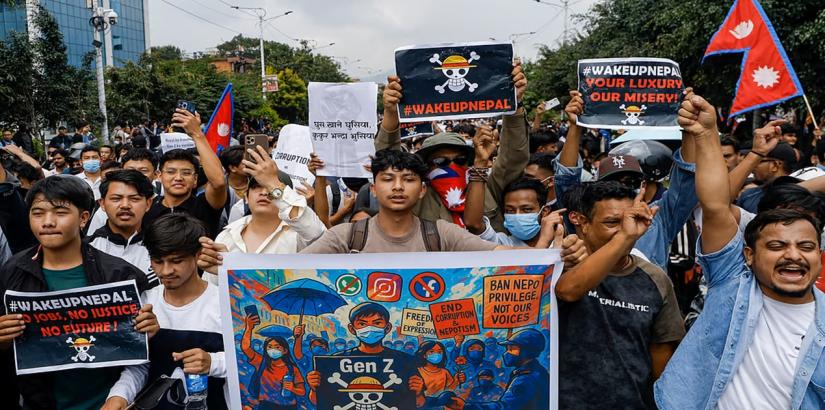
Nepal stands at a volatile crossroads. The dramatic rise of a Gen Z-driven political order—born out of rage, digital mobilization, and institutional collapse—has not only upended the country’s traditional power structure but also exposed the fragility of its democratic foundations. What unfolded in Kathmandu was not merely a protest movement; it was a political earthquake whose aftershocks may define Nepal’s future for years to come.
The events leading to the fall of the previous government were as swift as they were destructive. What began as youth-led demonstrations against corruption and economic stagnation spiraled into one of the most violent episodes in Nepal’s recent history. Public anger, long simmering beneath the surface, erupted with unprecedented intensity—targeting political institutions, party offices, and symbols of state authority.
In a matter of days, key government buildings were reduced to ashes, administrative systems were paralyzed, and the legitimacy of the ruling establishment collapsed. The scale of destruction reflected not just political dissatisfaction, but a deeper societal breakdown fueled by unemployment, inequality, and disillusionment with entrenched elites.
Similarity With Bangladesh
At the center of this upheaval was a demographic reality that Nepal’s political class had long underestimated: a young, digitally connected population unwilling to tolerate stagnation. With over half of the population under the age of thirty, platforms such as TikTok, Instagram, and online forums became powerful tools for mobilization—far beyond the reach of traditional political control.
This digital ecosystem played a decisive role in transforming localized grievances into a nationwide movement. Unlike earlier waves of protest, this was decentralized, rapid, and emotionally charged—making it far more difficult for authorities to anticipate or contain.
This pattern is not without precedent in the region. In 2018, Bangladesh witnessed a similar eruption of protests following the deaths of two students in a road accident. Public anger rapidly escalated into mass demonstrations, particularly among the youth, highlighting how a single incident can trigger a broader movement when underlying frustrations already exist. At the time, the protests spread across Dhaka and beyond, creating significant pressure on the government of Sheikh Hasina. However, the situation was ultimately brought under control through firm administrative and security measures. The episode demonstrated how quickly public sentiment can escalate—and how decisive responses can prevent a full-scale political crisis.
Bangladesh’s political trajectory since then also offers an important correction to common misperceptions. Following the ouster of Sheikh Hasina on August 5, 2024, the country returned to a democratic path through a credible general election held on February 12, 2026—underscoring the resilience of institutional processes when effectively managed.
People Have High Expectations
Nepal’s history offers a sobering reminder. Since the restoration of democracy in 1990, the country has witnessed frequent changes in leadership, with governments often failing to complete their terms. Political instability has been a recurring feature, eroding public trust and weakening institutions.
The new Gen Z leadership now faces the same structural challenges—but with far higher expectations. Public patience is thin, and the same forces that propelled them to power could quickly turn against them if tangible improvements are not delivered.
The economic realities are particularly daunting. Growth remains modest, unemployment among youth is significantly high, and a large portion of the population depends on remittances. Thousands of young Nepalese leave the country every day in search of better opportunities abroad, underscoring the lack of domestic prospects.
Tourism, a critical pillar of Nepal’s economy, has also struggled to regain stability. Restoring confidence among international visitors will require not only improved security but also political predictability—something the country has struggled to maintain.
Another critical dimension is governance maturity. While youthful leadership brings energy and new perspectives, it also demands administrative competence, strategic thinking, and discipline—qualities that cannot be improvised in moments of crisis.
During the recent years, despite the wave of Gen Z protests that have swept through Asia in recent years and carried over to other parts of the globe (from Togo to Madagascar to the Caribbean), in the past year most of the youth protests led to minimal results at the ballot box, at least in Asia—in Nepal there was exception with Gen Z winning the election, which did not happen in Bangladesh despite Gen Z protesters succeeding in toppling Sheikh Hasina’s government which remained in power for over 17 years.
Real Battle has Begun
Indeed, this victory of Gen Z in Nepal should not be taken by country’s current prime minister Balendra Shah who rose into political prominence from a rapper as a matter of eternal celebration. Shah needs to remember that people of Nepal quickly became frustrated with their governments in the past, and it may repeat this time too if Gen Z government fails to feel the pulls of the masses.
The role of external influence in political transitions is often debated in South Asia, but regardless of interpretation, the sustainability of any government ultimately depends on domestic legitimacy. In Nepal’s case, legitimacy will hinge on performance—on the ability to deliver jobs, stability, and a functioning state.
Nepal’s Gen Z government is not just an experiment in youth-led politics—it is a high-stakes test of whether disruption can evolve into governance. The same streets that once roared with revolutionary energy can just as easily erupt again in frustration. If this new leadership fails to translate momentum into meaningful change, the cycle of instability will repeat itself—perhaps with even greater intensity. In Nepal today, power has shifted, but the real battle has only just begun.
(The author is a journalist, writer, and editor-publisher of the Weekly Blitz. He specializes in counterterrorism and regional geopolitics. He can be contacted at salahuddinshoaibchoudhury@yahoo.com, follow him on X: @Salah_Shoaib )







Post a Comment