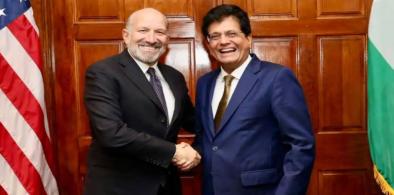

US Secretary of State Marco Rubio with Prime Minister of Hungary Viktor Orban.

New Civilisational Thesis of Western Renewal Risks Reviving Spectres of Colonialism and Racism

After Munich, Rubio travelled to Budapest and aligned himself warmly with Orbán’s government, praising Hungary’s trajectory. For European leaders committed to participatory democracy and the rule of law, the signal must have been disquieting. It suggested that Washington’s conception of Western solidarity may prioritise cultural homogeneity over liberal pluralism.

Trump’s Tariff Shock and India’s Export Reset: A Tech-Led Turn in the Making

The structural transformation of India’s export basket is no longer incremental—it is systemic. Technology-driven industries with higher value addition are steadily outpacing traditional sectors. If managed strategically, external tariff pressures could accelerate this transition. Rather than viewing tariff hikes solely as a threat, India can leverage them as a catalyst for deeper integration into global supply chains and stronger positioning in high-technology manufacturing. The reshaping of India’s export architecture is already underway. The tariff shock may simply fast-forward the process.

AI Encounters in Indian Higher Education: In Search of Humans in the Loop

Considering the potential of AI in solving complex questions and generating contents in individual writing styles, institutions need to ask a few fundamental questions - what is the role of academia in ensuring that the learners are not being slaves to AI, but masters who are aware of the potential bias and hallucinations that has a huge impact on knowledge acquisition and dissemination?  Should it be a social responsibility of higher educational institutions to ensure meaningful curriculum and assessment practices which make learners future ready in such a rapidly changing AI era?

Cryptocurrency and the Emergence of a Parallel Financial Architecture in South Asia

Recent global adoption indices confirms that South Asia has become one of the most dynamic regions for cryptocurrency engagement, with implications for remittance use. According to the 2025 crypto adoption index by Chainalysis, India secured the top position worldwide in overall crypto adoption across retail usage, reflecting pervasive grassroots digital activity. Pakistan and Bangladesh also feature prominently, with Pakistan ranking among top three in Asia and Bangladesh within top 20

More on Spotlight

Democracy on Deadline: How Electoral Bureaucracy Disenfranchises The Marginalised in Bihar

Bihar's 2025 electoral revision controversy is not only a national alarm bell but reveals how easily democratic process can be exclusionary under the guise of order; how silence can mask erasure. To preserve democracy, India must reimagine governance not as a gatekeeper of rights but as a facilitator of justice; it must transition from exclusionary governance to one rooted in dignity, justice, and participation, as voting is not just a right but recognition.

Trump’s Tariffs, India, And The Misreading Of America

A hug, even an awkward or forced one, between Modi and any world leader, particularly Trump will have no bearing on his policy however much he continues to refer to both India and the prime minister as his friend. At best, it is a lip-deep expression that so many Indians, both here in America and in India, have treated as an article of faith. It is anything but that.

Why Pakistan Remains Relevant For International Community

This client-state relationship is critical for the illusionary perseverance of Pakistani relevance. Pakistan becomes indispensable not because it is reliable, but because it's situationally useful. The US, China, and Gulf states don’t expect consistency, they expect deliverables. As long as Pakistan delivers (or threatens to disrupt), it retains leverage.

India’s Strong Economic Fundamentals Shield It from Trump’s Tariff Threat — and Challenge Vietnam

Trump’s renewed tariff war may upend the global trade landscape once again, but India is well-positioned to weather the storm. Its strong domestic economic fundamentals, relatively low dependence on merchandise exports for GDP growth, and diversified export base put it at a strategic advantage—particularly over export-heavy rivals like Vietnam and China.

Taliban's Rejection of the ICC Warrants Undermines Global Justice

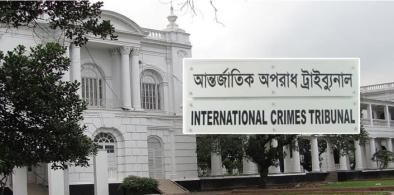
The repressive nature of the Taliban government along with the absence of a credible international enforcement mechanism for human rights have left Afghan women in despair. Publicly rejecting the ICC ruling and lack of enforcement mechanism of such organizations might set an example to other ideologically resistant countries that global norms can be discarded without consequences.

India remains central to Sri Lanka’s economic stability, strategic objectives

India has extended a $1 billion credit line for Sri Lanka by one year. Given these realities, Sri Lanka’s path to stability must be built in close collaboration with India. This is more than an economic necessity; it is a strategic recalibration. Working with India also brings Sri Lanka closer to meeting U.S. expectations while balancing regional interests.

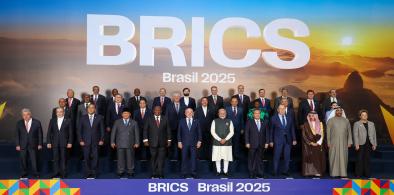
BRICS: Pitching for Multilateralism in a Changing Global Order

The recent India-Pakistan conflict, China’s support for the latter, and China’s growing footprints in South Asia – clearly aimed at undercutting India and keeping New Delhi tied down in its immediate neighbourhood -- cannot be overlooked. Recently, China has proposed an alternative to the defunct SAARC organisation Beijing is also trying to build up a China-Bangladesh-Pakistan trilateral.

As Nepal's Democracy Falters, People Romanticise The Past

If Nepal’s political parties cannot provide a functioning and trustworthy alternative, the longing for the past—however problematic—will continue to grow. For democracy to survive and thrive in Nepal, it must deliver not just procedures and elections, but stability, accountability, and a renewed social contract with the people.

Establishing Narrative and Perception Dominance in Modern Conflict: A National Security Imperative for India

A nation's power today is judged not just by its military or economy but also by the credibility, speed, and resonance of its narrative. As adversaries evolve their hybrid warfare strategies to target public opinion, social trust, and international perception, India must develop a narrative response architecture that is anticipatory rather than reactive

From Dhaka to Balochistan: Pakistan's Recurring Tragedies That It Draws No Lessons From

Flashforward from 1971 to 2025 to a Pakistan facing almost the same kind of problems that it was facing in 1971: same intrusions of military in public affairs, same hopelessness, same corruption, same or more inflation and, most importantly, the same threat of rebellion.

Is India Chasing A Mirage? Theatrical Diplomacy No Substitute For Strategic Power

The warm reception given to Pakistan's Army Chief in Washington is more than symbolic. It indicates Washington's strategic calculation—that India, despite its rhetoric, is becoming a more problematic partner.  Washington, while not forsaking India, is hedging its bets. Its embrace of Pakistan is a backup plan.

India’s Fiscal Scorecard 2.0: Can It Turn Potential Into Performance In Decade's Second Innings?

India’s states play an outsized role in public spending accounting for nearly +/- 60% of total government expenditure. However, their fiscal health varies greatly across pan India. As someone closely observing both macroeconomic trends and grassroots governance models, I notice a growing divide between states that follow prudent fiscal practices and those still trapped in populist spending cycles.

Guns, Governments and Greed: The Global Nexus of War and Power

When democracies embrace the traits of war economies and view peace as a sign of weakness, we need to question not about those who benefit from war, but rather about those who continue to engage in it. Not only does it include safety, but it also includes power, contracts, careers, and control. 

Op Sindoor: Did India Win Militarily But Lose The Narrative War?

The age of overt, high-visibility strikes is diminishing in returns. Covert operations, cyber infiltration, and disrupting terror logistics silently deliver greater impact at a lower political cost. India needs to establish a dedicated Psychological and Information Warfare Command, rather than relying solely on MEA press briefings or tweets from leaders.

Can BRICS Build to Break the Climate Blockade?

BRICS has the potential—and perhaps the will. Ahead of COP30, it should convene a high-level “Redefining Climate Summit” with other like-minded nations invited to the BRICS table. Let the world know: BRICS can indeed build the force to break the climate blockade. The clock is not ticking anymore. It’s screaming.