

One Wounded Indian Pilot Was the Last Line of Defense; That Is the Problem
An Emirati airline, an Indian captain, Israeli passengers, and Saudi authorities all played a part. India, re-elected to the ICAO Council last year, is well placed to push these standards into global aviation rules. The best tribute to Captain Machchhar is making sure the next crew never needs a hero.
 Oct 10, 2026
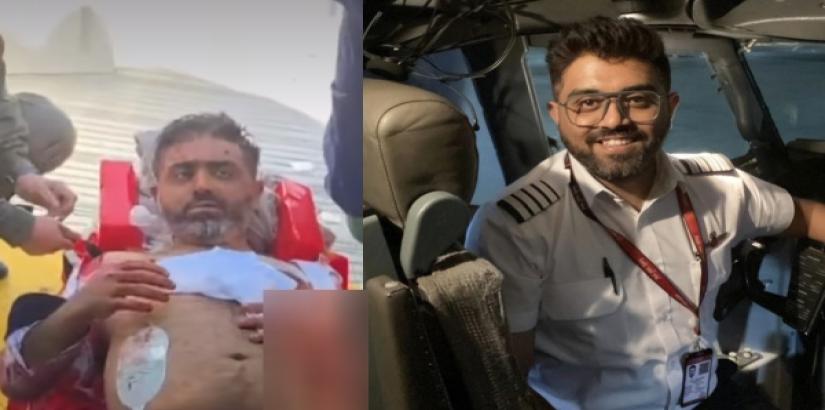
When flydubai flight FZ1073 began plunging toward the Arabian desert on September 30, the person standing between 174 people and the catastrophe was an Indian captain lying on the cockpit floor, bleeding. Captain Smit Machchhar, a Mumbai-born Boeing 737 veteran, had been attacked by his own first officer, and Israeli officials said the jet dropped nearly 14,000 feet in under 30 seconds. Somehow the wounded captain reached the cockpit door release. Crew and passengers overpowered the attacker, and two off-duty flydubai pilots riding in the cabin landed safely in Tabuk, Saudi Arabia.
Prime Minister Narendra Modi called Machchhar in an Abu Dhabi hospital to thank him, and India is rightly proud. UAE prosecutors say the co-pilot attempted a terrorist attack with the cockpit's own crash axe, and the investigation continues. But as someone who spent a career building products that were not allowed to fail, I see a security system whose final safeguard was one injured man's consciousness. That is not a safety system. That is luck wearing a uniform.
Why India has Most at Stake
For India, this is not a distant Gulf story. About 4.3 million Indians live in the UAE, roughly a third of its population, and Indian pilots fly for airlines across the region. At home, Indian airlines have more than 1,700 aircraft on order, and the government expects to need about 30,000 more pilots over the next two decades. The standards India sets now will shape tens of thousands of careers and the safety of millions of travelers.
The Standard Must be Zero
Six Sigma, the manufacturing benchmark, allows about 3.4 defects per million. That is superb for television. Where one failure kills hundreds, I have argued for a Thirteen-Sigma standard that designs failure out rather than making it rare. The reinforced cockpit door shows why. Built after September 11 to keep attackers out, it protected the attacker in Germanwings Flight 9525, when a co-pilot locked out his captain and killed all 150 aboard. On FZ1073, rescue hinged on one bleeding man reaching one switch.
Screening no one Needs to Hide From
UAE officials reportedly described the co-pilot as suicidal and radically indoctrinated, yet he passed screening. Pilots everywhere conceal mental-health problems for fear of losing their licenses, and a system that punishes honesty guarantees concealment. India's DGCA (Directorate General of Civil Aviation) saw this early: in 2023 it directed airlines to run non-punitive peer-support programs and add mental-health checks to medical exams. The task now is to make those checks continuous and trusted, and to expect the same of the foreign airlines that employ Indian pilots. And since the weapon was already on board, emergency tools should be stowed so that removing them alerts the crew and the ground.
A Cockpit That Watches Itself
Small private planes already carry Garmin's Emergency Autoland which can land on its own. Yet a jet carrying 174 people has nothing that notices two pilots fighting. Sensors, seat-side panic buttons, and software that flags violently conflicting control inputs could alert the cabin within seconds. In the R&D world I came from, this is a first-generation engineering problem. Pilot unions have long opposed cockpit cameras over privacy, but a system that stores nothing unless triggered is a smoke detector, not surveillance.
Training for the Unthinkable
Machchhar told PM Modi he was fighting for his life but told himself to get up and act. Under attack, adrenaline floods the body and the amygdala pushes toward freezing or fighting; whether the brain can still direct one purposeful act depends on what was rehearsed.
Europe already requires startle and surprise training, but for stalls and engine failures, not a violent colleague. Pilots should drill for the threat in the next seat.
An Emirati airline, an Indian captain, Israeli passengers, and Saudi authorities all played a part. India, re-elected to the ICAO Council last year, is well placed to push these standards into global aviation rules. The best tribute to Captain Machchhar is making sure the next crew never needs a hero.
(The author is the Director of the Reddy Center for Critical and Integrated Thinking. A former R&D executive holding 30 U.S. patents, he specializes in interdisciplinary research and public policy analysis. The views expressed are personal. He can be reached at mpreddy54@yahoo.com, https://lnkd.in/gn2zQJbs, website mpreddyinsights.com )







Post a Comment