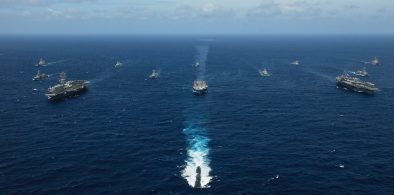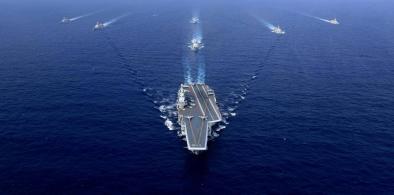

Regardless of future leadership transitions in Washington, the pivot to the Indo-Pacific will be here to stay in safeguarding America’s status quo and primacy, writes Collins Chong Yew Keat for South Asia Monitor
It also demonstrated that the EU increasingly sees India as a strategic alternative to excessive dependence on China and India increasingly sees the EU as an important technology and investment partner amid a more fragmented global trading system.
India's energy profile has changed significantly over the past decade. Crude imports from Russia, increased purchases from the United States, Brazil, Angola and other suppliers, together with expanding strategic petroleum reserves, have reduced dependence on any single source. India's energy vulnerability has not disappeared, but it has become more diversified.
As South Asia seeks to become one of the principal engines of global growth in the twenty-first century, velocity may emerge as one of the most important indicators of economic vitality. The countries that prosper most will not necessarily be those that create the most money, but those that use it most effectively.
If the twentieth century was shaped by the Atlantic and the early twenty-first century witnessed the rise of the Pacific, the coming decades may well belong to the Bay of Bengal. The foundations of that future will not be built solely through trade agreements or infrastructure projects. They will emerge from a shared commitment to connectivity, cooperation and civilisational understanding.
Regardless of future leadership transitions in Washington, the pivot to the Indo-Pacific will be here to stay in safeguarding America’s status quo and primacy, writes Collins Chong Yew Keat for South Asia Monitor
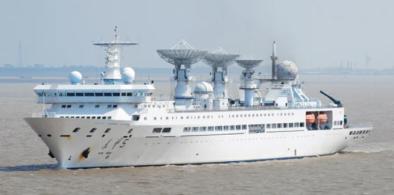
Interestingly, despite gaining significant influence and footprint in Sri Lanka, China’s failure to assist the crisis-hit country has left analysts baffled about Beijing’s thought process. The restructuring of loans, which Colombo sought repeatedly, was ignored by China
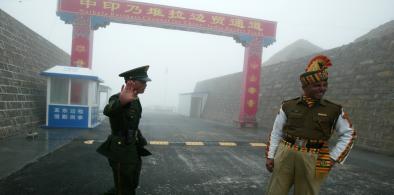
During the military commanders' meeting, the Indian side asked for the PLA to move back from all the “friction points”, which is a euphemism for "intrusions" used by India to avoid acknowledging it has lost control of some 1,000 sq km of territory during the 2020 Chinese aggression. For the same reason, India keeps asking of more military-to-military talks, with each round continuing 12-13 hours without any progress, writes Lt Gen P.C. Katoch (retd) for South Asia Monitor
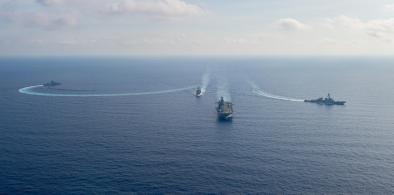
The I2U2 is an attempt to replicate in a different environment the Indo-Pacific Quad of India, the US, Japan and Australia, the goal of which is developing a bulwark of democracies against China
The punitive mood against Chinese firms is not reflected in a diminishing dependence on Chinese goods on the trade front or telecom technology. The dragon remains one of our largest trade partners, writes N. Chandra Mohan for South Asia Monitor
Apart from engaging in projects for upgrading India highways that go all the way till the Bangladesh border, Japan could also collaborate with India in the constantly deferred Agartala (India)-Akhaura (Bangladesh) rail link, something that provides scope for Indo-Japan collaboration under India’s Act East Policy and Japan’s Free and Open Indo-Pacific Strategy, writes Prarthana Sen for South Asia Monitor
Abe was among the first to envision with then-Prime Minister Manmohan the group of democracies as a potential counterweight to China in the Indo-Pacific taking forward the cooperation of the four countries in providing relief during 2004 tsunami
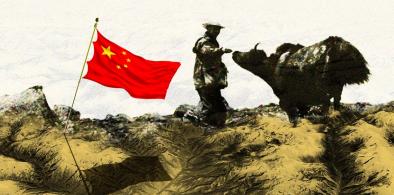
China has harmed Tibet, massacred innocent Tibetans and is occupying Tibet for the last several decades with a vice-like grip and suppressing freedom of the Tibetans
There are several ways whereby the IPEF will outbid China in the Indo-Pacific region and outweigh India’s China dependency, writes S. Majumder for South Asia Monitor
The short game might be Beijing’s to lose for now, but the long game is certainly Washington’s to squander away, writes Collins Chong Yew Keat for South Asia Monitor
Vietnam, an important country of the ASEAN (Association of Southeast Asian Nations), has territorial disputes with China in the South China Sea region. India has oil exploration projects in the Vietnamese waters in the South China Sea. India and Vietnam have been boosting their maritime security cooperation in the last few years to protect common interests.
Since the US is not a member of RCEP, the collaborative approach of the US and India will pose a big challenge to RCEP, which falls under Chinese influence, writes S. Majumder for South Asia Monitor
Michael Kugelman, a senior fellow at the Washington-based Wilson Centre, noted in a Foreign Policy Brief that the Biden administration’s growing engagement with countries like Sri Lanka, Nepal, and the Maldives, “marks a shift for Washington, which in recent decades has expended most of its diplomatic capital in the region on India, Pakistan, and Afghanistan.”
Beijing also seems nervous as its earlier run, largely on the back of support of the now-discredited Rajapaksa brothers, appears to have come to an end. Unlike earlier, a crisis-hit Sri Lanka in need of assistance is more eager than any time before in recent years to embrace India, the West, and the United States.
Kim Jong-un's new strategy shifts the region's counter-reaction to a new level of risk that will invite changes in the dynamics of the military spectrum, writes Collins Chong Yew Keat for South Asia Monitor