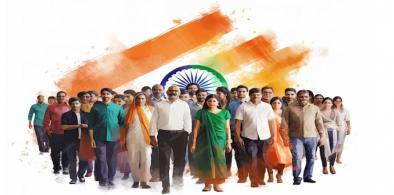



The opposition to the INDIA alliance is also rooted in the thesis which sees a ‘clash of civilizations’ (Samuel Huntington), in contrast to what the UN report emphasizes on Alliance of Civilizations, well articulated in Nehru’s belief system.
India is managing intense US pressure about its involvement in the Chabahar port, with the Washington providing only a six-month sanctions waiver set to expire in April 2026. While India has officially stated that exiting the project is "not an option" due to strategic interests in connecting with Afghanistan and Central Asia, it is actively negotiating for a long-term waiver to the sanctions.
The battlefield is no longer defined by geography alone. It extends into space, into networks, into supply chains, and into the human mind. Conflict today is as much about disruption as it is about destruction; as much about perception as it is about position. Lines are blurred, between soldier and system, between civilian and combatant, between war and peace.
The relationship between Resolution 80/23 and India’s 2026 CD statement illustrates a recurring challenge in contemporary arms control: how to build durable global norms in a world of divergent security contexts. Both documents share a foundational conviction — that human judgment must remain at the core of nuclear decision-making, and that AI introduces risks that demand urgent, coordinated attention.
Across all these traditions, a small minority of extremists sometimes distort religious teachings to justify violence. This is not unique to any one faith. In recent decades, for example, some fringe groups have invoked highly selective interpretations of jihad to justify suicide attacks, claiming spiritual reward. Mainstream Islamic scholars overwhelmingly reject these interpretations. Similar distortions have appeared in other traditions as well
The opposition to the INDIA alliance is also rooted in the thesis which sees a ‘clash of civilizations’ (Samuel Huntington), in contrast to what the UN report emphasizes on Alliance of Civilizations, well articulated in Nehru’s belief system.
But wild, in-your-face violence of the kind seen in some of the crimes that continue to happen, particularly against women, indicates that the nation isn’t really progressing, never mind what the GDP numbers may say.
The Pakistan-US-UK ties remain strong. Pakistan’s removal from the FATF’s ‘grey list’ and recent $3 billion IMF loan to Pakistan had an obvious nod from the US.
Myanmar, Bangladesh, and India need mutual friendship in their national interest. Bangladesh's improved road and rail connectivity with India will open up new doors of trade and commerce.
The politics being pursued by the BJP and its related organizations have a multipronged strategy to win over indigenous communituies electorally by emotive symbolic actions, to Hinduise them on the one hand, and to maintain the upper-caste hegemony on the other.
Modi's singular aversion to media engagement starkly contrasts with the active media engagement of leaders like Australian Prime Minister Anthony Albanese's one year in office. A notable analysis of his public relations strategy (Sydney Morning Herald, 20 June) reveals his tireless efforts to engage the public.
Gita Press is the intellectual and cultural base on which conservative Hindu values, mainly Brahmanical values, are promoted, and it provides the base for Hindu nationalist politics by promoting and propagating a narrow, exclusive version of Hinduism. Gandhi’s Hinduism was, on the other hand, humane and inclusive and he evolved with time to live the humanistic aspects of religion.
The US has continued to support Pakistan for short-term geopolitical considerations. On the other hand, the US has been unfair to Bangladesh by alleging that the democratic process there had been disrupted.
The relationship has grown with extraordinary speed. India and Australia are strategic partners – unthinkable a few years ago! An extraordinary bipartisan friendship reflects the way in which both countries have now come to see each other.
This approximately two-and-a-half-hour operation between Wadi Sayyidna and Jeddah, Saudi Arabia will go down in the annals of IAF history for its sheer audacity and flawless execution - akin to that carried out in Kabul, in which almost 400 Indians were brought back by the IAF in August 2021 in very challenging conditions following the Taliban takeover of Afghanistan.
The rise and fall of FTX’s co-founder Sam Bankman-Fried, a poster boy of the crypto world and seen as a genius, tells a story that has important learnings for all of us. A key learning is that, though talent or ingenuity can erect an empire of fame and riches in a short time, yet devoid of moral and ethical moorings, it can wreak havoc in the long run.
Since the late 1970s, the Indian Army has been paying a heavy price of losing good soldiers in asymmetric warfare waged by Pakistan, which involves having large bodies of regular troops committed on the ground for dealing with a 'handful' of the enemy.
Analysts see the rice-potato trade between the two countries as an extension of their stepped-up bilateral diplomacy. Their expectation is that this incipient commercial relationship can play a major role in resolving the Rohingya humanitarian crisis
India can assist Bangladesh in achieving the goal of Bangladesh’s military plan “Forces Goal 2030,” a modernization programme that aims to transform Bangladesh's army into a technologically advanced, multi-domain force by 2030.
Military spending calculated as a share of the Gross Domestic Product (GDP) was 2.4 per cent for India, an estimated 1.6 per cent for China, 2.6 per cent for Pakistan.