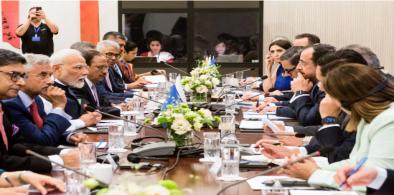

NATO Headquarters in Brussels (NATO photo)

Why the NATO summit in Ankara matters for South Asia

The NATO summit can indirectly transform India from a regional power into a West Asia stakeholder by integrating India into maritime security frameworks, supporting connectivity projects, strengthening intelligence ties, reinforcing India’s role as an alternative to China. The long-term outcome is that India could emerge as a pillar of stability linking Europe, the Gulf, and the Indo-Pacific

India–Japan Summit: Strategic Convergence in a Changing Indo-Pacific Order

Japan has also proposed developing a Bay of Bengal–Northeast India Industrial Value Chain aimed at transforming the region into an integrated industrial zone. As part of the Free and Open Indo-Pacific vision, this includes strengthening cross-border connectivity with Bangladesh, Myanmar, Nepal and Bhutan. 

China and the Emerging Scenario in the Bay of Bengal

China's expressed interest in modernising and upgrading both Chattogram and Mongla ports suggests the emergence of an interconnected infrastructure network linking the Bay of Bengal with southwestern China through Myanmar. If realised, such connectivity would enhance trade flows, improve regional logistics and deepen China's economic footprint across the Bay of Bengal littoral, while simultaneously increasing Bangladesh's importance as a regional transit and connectivity hub.

Colombo to Kathmandu, China Seeks to Counteract US Moves Across South Asia

While Washington and New Delhi seek to strengthen bilateral ties with Colombo, Beijing has strategically engaged with the political forces that control the government. By engaging directly with actors at the core of Sri Lanka’s governance, Beijing appears to be signalling its strategic intent—projecting influence and reinforcing ideological ties. 

More on Geopolitics and Strategic Affairs

Sri Lanka's geopolitical and regional importance: Talks with India, China, France and Japan in one week

Wickremesinghe’s visit to New Delhi, and the subsequent visits of the senior Chinese party functionary, the French president, and the Japanese foreign minister signal a renewed thrust by the global and regional powers to reinvigorate their influence in the Indian Ocean Region where Sri Lanka's strategic geographical location makes it a pivotal player.

Bangladesh-US fraught ties scarred by Washington's cultural misperceptions

Strong-arming Bangladesh into toeing its prescribed policy positions is part of the Biden Administration’s wider external agenda of promoting the liberal values of democracy and human rights as the centerpiece of its foreign policy. But the real problem doesn’t lie in policy postures, but rather in the way these policies are being executed.

Electoral battle begins in the Maldives: Outcome will impact on regional geopolitics

On matters of foreign policy too, Nasheed is critical of China and favors the ‘India first’ policy, while Yameen has had positive relations with China and his party has recently protested against the Indian military presence in Maldives under the slogan ‘India Out’.

South Asia in the Asian perspective: external and internal macro-economic imbalances and the rise of China (Part II of a two-part analysis)

There has been discussion of alternate supply chains being created in India, Indonesia and Vietnam but supply chain issues originating from China are not going to go away in a hurry.

South Asia in the Asian perspective: Macroeconomic policies and the triple crisis (Part I of a two-part analysis)

South Asia has no strong trade ties within the region, unlike many parts of Asia, and more particularly the developed parts of Asia, namely Southeast Asia and East Asia. South Asia, therefore, has to formulate its own macroeconomic policies to sustain growth keeping in mind global economic trends.

Caste, class and cricket: How a colonial sport became a religion in South Asia

The Hindus entered cricket due to their long-standing social and business rivalry with the Parsis. The first Hindu club, the Bombay Union, was formed in 1866. Muslim cricket began with the Luxmani and Tyebjee families, who helped establish a Muslim cricket club in 1883.

Bangladesh in the time of cyclones: When gender-based violence peaks

Wife battering is universal in Bangladesh in almost all homes. However, this increases manifold during and after cyclones. There is a breakdown of social and familial infrastructure and livelihood patterns and violence increases with economic stress and anxiety.

The challenge of Artificial Intelligence to higher education: Policymakers need to answer critical questions

Higher Educational Institutions (HEIs) need to have policy responses to ensure checks and balances against generative AIs. The top-down policy approach may focus on banning the use of generative AIs. But participatory and adaptive approaches focus on developing policies that could accept the use of generative AIs in varying degrees, with the realisation that generative AIs are here to stay.

Violence must not be allowed to continue in Manipur; implement confidence-building measures

What is painful is the inability of civil society groups in the state to intervene during this critical time since the contending groups are not ready to negotiate with each other. However, one must not lose faith in the civil society which is based in Manipur's immediate neighbouring states like Nagaland, Mizoram, and Assam.

Uniform Civil Code should not be pushed through in haste; first make all personal laws gender-just

The Muslim Personal Law Board is committing the same mistake by opposing the UCC as it did during the discourse on the abhorrent Muslim practice of instantaneous triple talaq without realising its far-reaching consequences.

Modi meets Macron: World needs transformational diplomacy, not transactional diplomacy

Macron and Modi should shun transactional diplomacy that engages in multi-billion dollar agreements for military fighter jets and machinery, nuclear reactors and pharmaceutical products. Instead, they should embrace some transformational diplomacy to make the planet sustainable again.

Russian nuclear diplomacy in Sri Lanka will have wider strategic and security implications for region

Russia’s proposal to establish Sri Lanka’s first nuclear power plant comes on the heels of the completion of a similar nuclear power plant in Bangladesh, which has paved the path for Russia to play a larger role in South Asian geopolitics.

India-Nepal-Bangladesh power diplomacy is a big step for regional cooperation in South Asia

In recent years India has been prioritising regional integration among South Asian countries, excepting Pakistan. As per the joint vision statement between Nepal and India in April last year, the two countries agreed to expand sub-regional cooperation in the power sector among Bangladesh, Bhutan, India and Nepal (BBIN)

2022 floods in Pakistan: Violence and vulnerabilities of women increase during climate disasters

Climate crisis is a lesser word to describe the transformative shifts that are taking place in weather conditions across the Global South affecting mostly countries like Pakistan in South Asia. Attitudes of society need to change towards women. Societal attitudes, traditional norms and cultural practices create entrenched gender disparities that hinder women’s participation in development plans and in survival strategies devised to save them in the post-disaster period.

Modi's state visit to the US: A visit rich in style and substance

From Modi's standpoint, the visit unfolded precisely as he desired. The exceptional reception he received from the leader of the free world, less than a year before facing the billion-strong Indian electorate, serves as a significant boost for him.