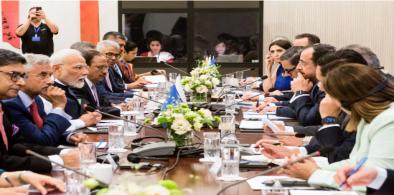
Growing US-China Rivalry in Indian Ocean

Growing US-China Rivalry in Indian Ocean: A Test of Sri Lanka's Foreign Policy

China’s growing influence in Sri Lanka is an immediate concern for India as the resident power in the region, but it is also a global concern for the United States. 

Hasina's Return Proclamation Throws a Spanner in India-Bangladesh Ties

The Indian government is caught in a bind. Despite the BNP government’s outrage, for Delhi to hasten Hasina’s extradition is not an option.

Why the Afghanistan-Pakistan Border Keeps Burning: Keys to Peace Lies With Group Whose Loyalties Answer to No One

The borderland TTP now exploits is the same terrain that Pakistan's own security establishment worked for decades to create as "strategic depth."  The world of proxy-war infrastructure seldom remains directed towards where its architects have aimed.

India and Australia Enhance Strategic Relationship, Prioritise Maritime Domain Awareness to Secure Indo-Pacific

A significant factor that emerged after India launched Operation Sindoor against Pakistan in May 2025 was the strain in the India-US relationship under the Trump administration, driven by aggressive tariff disputes and policy friction. This indirectly accelerated India’s push to diversify partnerships, prompting New Delhi to lean more pragmatically into closer economic and strategic ties with middle powers such as Australia.

More on Geopolitics, Security and Strategic Affairs

Knowledge diplomacy: India’s missing soft power tool

India’s superpower ambitions require a comprehensive strategy to use the Indian education sector, both private and government, towards advancing India's strategic aims and objectives. A starting point to experiment such knowledge/education diplomacy lies in its neighbourhood.

National anthems and identity crises continue to haunt South Asia

However, religion, domestic compulsions and failure to improve political conditions, with or without national elections, have embroiled Afghanistan, Pakistan and Bangladesh, all compounded by economic woes, in issues that impinge on their national identity.

Sri Lanka's new president: Can he deliver on economic stability and regional security?

In a way, Sri Lanka's economic crisis has served as a blessing in disguise, bringing India and Sri Lanka closer as South Asian neighbors. However, India remains concerned about security in the Indian Ocean, where China has been actively expanding its influence. 

Isolating the Taliban is not helping Afghanistan's people: International diplomats must return to Kabul

For Afghans to find their own solutions they need an engaged international community inside Afghanistan.  The more isolated they become the more possible it is for the most regressive among the Taliban – which it must be said is not a monolith – to impose tighter and tighter controls, which is what is currently happening.

Cross-border militancy, Taliban intransigence intensifies Pakistan's security dilemma

Then there is the thorny issue of "Lar o Bar," a nationalist idea that has long existed on the fringes of Pashtun politics. The phrase, literally meaning "here and there," reflects the dream of uniting Pashtuns on both sides of the Durand Line, the border drawn between Pakistan and Afghanistan during British rule. While the notion might resonate with cultural pride, it’s a direct threat to Pakistan’s territorial integrity.

Dismantling barriers to empower persons with disabilities: India must unlock potential of a largely untapped talent pool

India has made strides in creating a legal framework that supports the rights of individuals with disabilities, but their full inclusion is still a distant goal. The integration of sensory and speech-impaired individuals into the workforce requires a multi-faceted approach beyond vocational training that includes accessible infrastructure, employer sensitization, and use of assistive technologies.

Summit of the Future: From past lessons to present chaos to a future we want

The hope for a better and more sustainable future now lies, first with the youth in the ages of 18-25, studying in the universities and higher education institutes. These youth would be the young decision-makers by 2030. That year would see the end of SDGs and expected to halve the GHGs emissions. By 2050, the youth of today would be at the helm of the affairs in business and government.

As world abandons Afghanistan, Taliban, IS and ISK-P feed on each other to export terror

The region and the world should reconsider their policies toward Afghanistan and the Taliban. They must assist the Afghanistan people in forming a legitimate government and establish professional security forces. The Taliban are not a trustworthy partner in the fight against terrorism.

Pakistan seeks climate justice as its people battle climate change

In the bustling city of Karachi, solar panels are becoming a common sight. Pakistan is investing heavily in renewable energy, aiming to generate 30% of its electricity from renewable sources by 2030

Pakistan needs to address foundational causes of its persistent violence and social instability

It is a fact that Pakistan's obsession with military power without attending to the roots of political exclusion and economic disparity has left its vulnerable masses base to the extremes. 

Sri Lanka's presidential election: Voter faced with choice of status quo, mild tinkering or radical change

Most analysts agree that there is no clear-cut winner and the race to the presidency is a multiple-horse race

Kolkata's protests: Will it herald a new era of youth-propelled social awakening in India?

What sets these protests apart was their apolitical nature, illustrating that regardless of how firmly a government may seem entrenched in power, movements grounded in just causes can expose the vulnerability of even the most resilient regimes, as recent events have clearly shown.

Manipur’s civil unrest: A growing threat to India’s national security

Cross-border arms and drug trafficking has always been there in the region, with recent reports suggesting large quantities of guns being shipped to Manipur from an illicit market located close to the border between China and Myanmar. Drugs are being used by the insurgent group to finance their procurement of arms and fund other illicit activities.

Twenty years of EU-India 'strategic partnership': Substance needs to match rhetoric

The Brussels-based think tank Egmont Institute, in a policy brief in April, said individual EU member States attach a lot of importance to their bilateral relationship with New Delhi and are interacting with the Indian government at the highest level. “However, visits of the leaders of the EU institutions to India are rare. One fails to see a real political interest in India from the Commission President and from the President of the European Council.”

Revival of nuclear posturing: Isnt it time for India to review its no-first-use policy?

China, Pakistan and Russia have clearly and unequivocally declared that they will exercise ‘FIRST USE OF NUKES’ option under certain circumstances. For China and Pakistan, India is the target. Yet our Chief of Defence Staff and premier think tank viz Centre for Air Power Studies, IDSA, USI and many others continue to ‘sing’ the outdated NFU policy.