Pakistani cinema industry, even as it fears being swamped by Bollywood, realises the need for films from India that, given the common culture, resonate well with the cinegoers, writes Mahendra Ved for South Asia Monitor


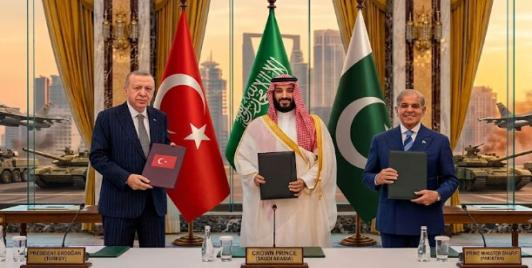
It would also explain why Pakistan is trying to preserve a distinction between supporting Saudi Arabia and fighting the Houthis. Pakistan has every reason to avoid another open-ended conflict in the Middle East. Its military is heavily committed to its own security challenges. Its economy cannot easily absorb the political and financial consequences
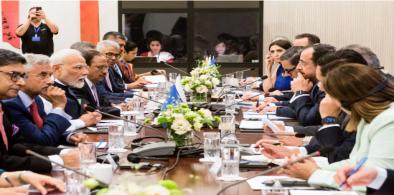
EU and India could establish a regular EU–India-Middle East Consultative Mechanism involving foreign-policy officials and experts. Its purpose would be to coordinate positions before major international gatherings and meetings.

For Sri Lankan politics, this is more than diplomatic sightseeing. It raises a fundamental question whether the JVP is developing a sophisticated strategy of balancing relations with India and China or is it gradually adapting itself to the organisational models of powerful one-party or dominant-party systems in China and India respectively?

The ongoing civil war in Myanmar has caused an influx of armed cadres (Meitei, Naga and Kuki) into Manipur's border tracts like Kamjong district, further squeezing finite land resources and aggravating historical territorial disputes. What began as a localized dispute under the state's newly elected government in February 2026 has escalated into intense, multi-district armed warfare.

Pakistani cinema industry, even as it fears being swamped by Bollywood, realises the need for films from India that, given the common culture, resonate well with the cinegoers, writes Mahendra Ved for South Asia Monitor
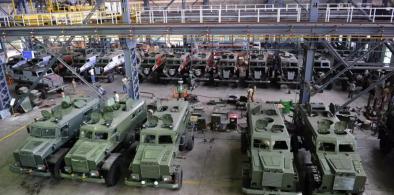
In view of the unprecedented tension between the Indian Army and the Chinese Peoples’ Liberation Army on the Line of Actual Control since early May 2020, it is vitally important for ordnance factories to be able to meet large requirements of arms, ammunition, vehicles, and various equipment, writes Col Anil Bhat (retd) for South Asia Monitor

The scourge of the COVID pandemic has radically altered the nature of the challenge cum dangers lurking in the maritime sector for South Asia as related to the Indian Ocean and the surrounding seas, writes C Uday Bhaskar for South Asia Monitor

Although madrasas educate only between 2-4% of Muslim children and youth, they need to modernize their curriculum and move away from Islamic centric or Islamic-only education to a holistic approach that enables these students to integrate fully into Indian society, writes Frank Islam for South Asia Monitor

The global healthcare has benefited hugely from the Indian pharmaceutical industry, and from generic drugs that the Indian pharmaceutical industry produces for the world, writes Sunil Prasad for South Asia Monitor

Now it became possible for young and talented cricketers with abilities to shoot into the top rung via the IPL. With cricket now being played increasingly across South Asia, one sees rising stars from Afghanistan and Nepal also in the IPL mix, writes Col Ravi Rajan (retd) for South Asia Monitor
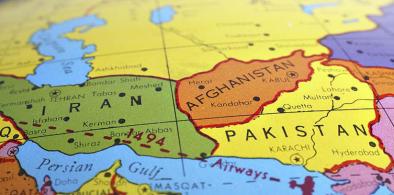
Having a porous border with Pakistan and Afghanistan, Iran should focus more on institutionalized Shia killings in these countries, not Gulf states normalizing relations with Israel, writes Lt Gen P. C. Katoch (retd) for South Asia Monitor

COVID-19 has ushered in a global movement for cycling and India is slowly catching up to that trend with cycling to work, cycling for leisure and fitness becoming more acceptable than ever before, writes Pankaj M Munjal for South Asia Monitor

Integrating complementary approaches into the primary care setting will help widen its reach and efficacy and help India promote a healthcare service delivery model that will be unique in its approach and act as an example for developing countries across the world, writes K R Raghunath for South Asia Monitor
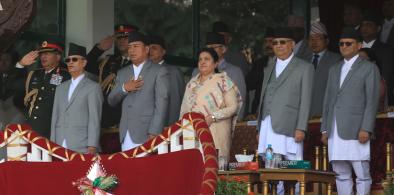
The ambitious provisions of fundamental rights mentioned in Nepal’s Constitution would lose its charm if the state turns a deaf ear in giving effect to its provisions in a true and material sense, writes Jivesh Jha for South Asia Monitor
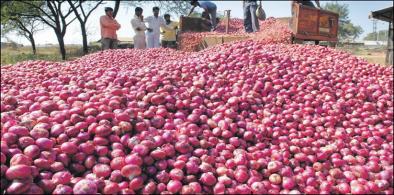
Onions may just be a singular example but if unwritten undertakings are violated, the saga of bans exemplify a larger story of how a trust deficit ensures that trade within South Asia remains perhaps the lowest in the world, writes N Chandra Mohan for South Asia Monitor
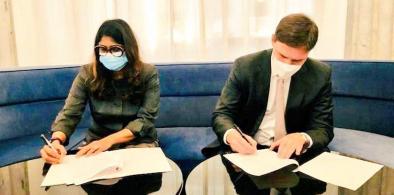
The new defence agreement is a clear shift in the Maldives position towards the US after a period when the government in Male forged close economic and political ties with Beijing, writes Shubha Singh for South Asia Monitor

The progress of India’s air bubble agreements with neighbouring South Asian countries bears watching in the period ahead, writes N Chandra Mohan for South Asia Monitor
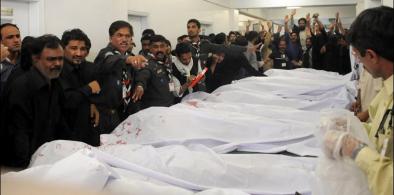
Though, the Pakistan government does not officially support discrimination against Shias, it is failing to efficiently counter the influence of extremists and bring an end to violence against the community, writes Sanchita Bhattacharya for South Asia Monitor
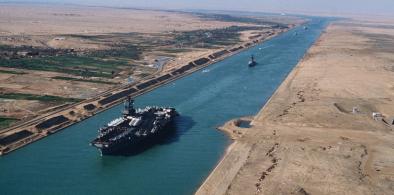
Had the Kra Canal come up, China would have taken control of it in all probability like the Hambantota Port in Sri Lanka giving it a tremendous strategic advantage, writes Lt Gen P. C. Katoch (retd) for South Asia Monitor