

Trump-Xi Summit: Managed Rivalry, Unresolved Contest
China buys more than 80 percent of Iran’s shipped oil. In 2025, China purchased an average of 1.38 million barrels per day of Iranian oil, accounting for around 13.4 percent of China’s seaborne oil imports.China has therefore become the largest economic absorber of Iranian oil and Tehran’s principal economic lifeline. Without Chinese demand, Iran’s sanctions-hit economy would face far greater pressure.
 May 19, 2026
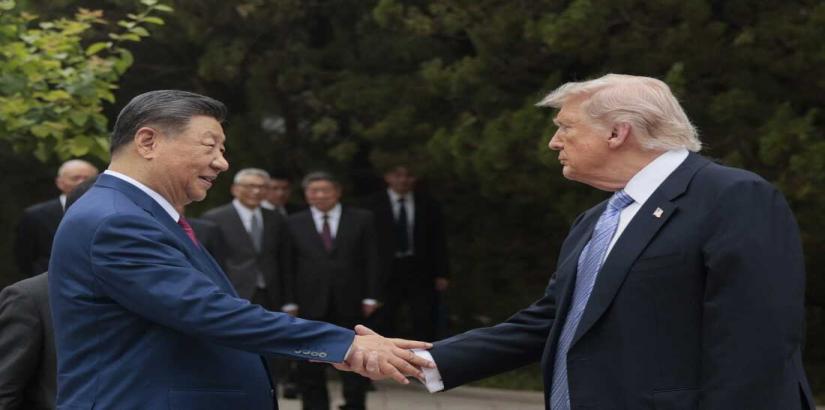
The just concluded Trump-Xi summit is fundamentally different from the last meeting that took place in China during President Trump’s first term, or even from the most recent face-to-face encounter last October in Busan, South Korea.
This meeting took place at a moment when several major fault lines in the global order are converging at once: the Iran war, Taiwan, trade tensions, rare earths, artificial intelligence, semiconductor controls, energy security and the future balance of power in the Indo-Pacific. Both leaders wanted to maintain clarity and a managed relationship in the years ahead, while also maximising leverage and preserving strategic cards.
As expected, no substantial high-consequence deal was reached, as the focus was overwhelmingly on setting stabilising factors, maintaining personal diplomacy and boosting trade and technology returns, all while testing one another’s limits within this managed relationship and assessing options on sensitive issues, especially Taiwan.
Their previous encounter was largely about managing competition within a controlled diplomatic framework and seeking stabilisation. Now, it is about crisis bargaining.
For Trump, the summit was a chance to secure visible outcomes and negotiate from a position of strength, extract concessions, and maintain American supremacy while also opening pathways for Beijing to reset ties in ways that benefit both sides. He needs deliverables on trade, supply chains, energy stability and possibly Chinese pressure on Tehran.
Taiwan as Ultimate Red Line
Xi used the meeting with Trump to send a carefully veiled but unmistakable warning: the United States may pursue trade deals, technological bargaining, tariff resets and other arrangements, but it must not cross Beijing’s core red line on Taiwan. His message was that stability is available, but only on terms that respect Beijing’s definition of sovereignty, national rejuvenation and historical destiny.
This explains why Xi’s reference to the Thucydides Trap was not random, but a strategic device. By invoking the theory that conflict can emerge when a rising power confronts an established power, Xi framed the US-China rivalry as a historical test while also placing the burden of maintaining peaceful relations on Washington, portraying the United States as the side expected to show restraint first.
It was also meant to place psychological and political pressure on Trump by suggesting that the danger lies not in China’s rise, but in America’s refusal to adjust to it.
The subtext from Xi was clear: China’s rise is inevitable, its position in the world is irreversible, and any US attempt to block China over Taiwan, technology, trade or regional influence would only confirm Washington’s inability to accept a changing world order. This sums up the broader narrative and intent of the summit, although great care was taken to maintain a positive tone on both sides.
Xi’s message was calibrated — a classic Xi approach: offer coexistence, but no compromise on China’s core interests; offer stability, but not subordination to the United States, while ultimately preserving Chinese interests and strategic advantages.
Taiwan remained the most sensitive unresolved issue. For Beijing, Taiwan is the core political test of whether Washington is serious about stabilising relations. For Washington, any visible concession on Taiwan would alarm Taipei, Tokyo, Seoul, Manila, Canberra and Congress. President Trump is well aware that Taiwan remains one of the strongest cards available to Washington in shaping ties with Beijing and reassuring allies across the region, and he would not want to squander it lightly.
There is quiet concern that the Trump administration might concede more to Beijing on Taiwan’s security and deterrence posture in exchange for deeper Chinese cooperation in restraining Tehran, Pyongyang and even Moscow, as well as for greater trade and rare earth benefits for the United States.
Xi is seen as likely to link Iran, directly or indirectly, to Taiwan — not by demanding an outright US reversal, which is unlikely, but by pushing for gradual erosion through slower arms deliveries, softer US language and fewer public commitments, thereby creating a perception that Taiwan is negotiable.
The real risk, therefore, is not an open abandonment of Taiwan, but a quieter trade-off that could weaken US credibility and alarm allies across the Indo-Pacific.
Such trade-offs may not appear starkly. They could emerge through vague diplomatic wording, delayed arms packages or the avoidance of strong public statements on Taiwan in order to preserve Chinese cooperation on Iran, trade or energy stability. This is precisely what worries Taipei and other US allies in the region.
In great-power diplomacy and conventional international statecraft, the most important concessions are not always announced openly; they are often embedded in tone, sequencing and omission.
For Taiwan, the fear is not simply abandonment but gradual dilution. If Washington starts treating Taiwan as merely another bargaining chip, the concern is that it would hand Beijing a psychological and strategic victory by reinforcing the impression that pressure tactics work.
This will shape how allies and partners interpret American resolve. It will shape how China calculates future pressure against Taiwan. It will shape whether middle powers continue to see the United States as a consistent strategic anchor or increasingly as a transactional actor willing to adjust commitments for short-term gains.
Trump’s strategic ambiguity was therefore fully on display. By refusing to commit publicly or directly answer Xi’s questions on Taiwan, he maintained leverage and preserved uncertainty. This stance alone encapsulated the entire summit in Beijing: while Trump appeared warm, complementary and accommodating toward Xi, he remained fully aware of the subtle messaging and underlying strategic realities. Washington may seek a more managed relationship with Beijing, but not at the expense of core American interests or strategic leverage.
Iran as Beijing’s Strategic Leverage
Iran emerged as one of the central issues in the talks. China is highly exposed to any disruption in the Strait of Hormuz, through which nearly half of its energy imports pass. Beijing therefore has a strong interest in de-escalation, but it also recognises that Washington may need Chinese cooperation to achieve that goal.
This gives Xi leverage, though not unlimited leverage.
At the same time, China is unlikely to act as an American proxy or appear to submit easily to Washington’s demands. Beijing’s goal is to prevent an escalation that threatens energy security in West Asia while also seeking opportunities to capitalise strategically on the situation.
Beijing will continue presenting itself as a responsible power advocating de-escalation, though Xi also faces constraints. China does not want a crisis that jeopardises vital energy flows, nor does it want to inherit responsibility for Iran’s behaviour or trigger instability in global markets.
Trump’s message to Xi was likely direct: Beijing cannot continue enjoying the benefits of Gulf energy flows, global trade stability and great-power status while simultaneously serving as Tehran’s principal economic lifeline and using that leverage to reshape global power dynamics.
China buys more than 80 percent of Iran’s shipped oil. In 2025, China purchased an average of 1.38 million barrels per day of Iranian oil, accounting for around 13.4 percent of China’s seaborne oil imports.
China has therefore become the largest economic absorber of Iranian oil and Tehran’s principal economic lifeline. Without Chinese demand, Iran’s sanctions-hit economy would face far greater pressure.
China’s calculation is strategic. Iran serves Beijing in three key ways.
First, Iran diverts US military and diplomatic bandwidth away from the Indo-Pacific.
Second, Iran strengthens China’s image as an alternative diplomatic pole. Beijing can present itself as a mediator, a voice for the Global South and a critic of US military coercion.
Third, Iran provides bargaining leverage. If Trump needs Xi’s cooperation to stabilise Hormuz and pressure Tehran, Xi can seek concessions elsewhere — on tariffs, export controls, sanctioned Chinese firms or Taiwan-related language.
For Trump, the challenge is to prevent China from converting American needs into strategic concessions, while using his negotiating style to extract as many returns as possible. He may seek Chinese cooperation on Iran, but he is unlikely to allow Beijing to dictate the strategic cost.
Similarly, while he may pursue trade stabilisation, he is aware that it cannot come at the expense of America’s long-term technological edge, or burden American taxpayers, farmers and industries. He may seek to reduce crisis risks, but without sending any signal that Taiwan is negotiable.
America’s Stronger Cards
Despite the complexities, the United States under Trump still retains stronger structural advantages. Washington continues to possess unmatched leverage in finance, technology, semiconductors, military alliances, market access, energy security, dollar dominance and the Indo-Pacific security architecture.
First, the US still controls the world’s most powerful sanctions architecture and retains the capacity to sustain it. Iran’s access to global finance, energy markets and payment systems remains heavily shaped by US pressure.
This matters greatly for China because many Chinese firms, banks and shipping networks remain exposed to the dollar system and global markets. The fear of losing access to dollar clearing, Western markets and advanced technology remains a serious concern. Trump therefore retains a significant instrument of leverage: if China refuses to restrain Iran, Washington can expand enforcement measures against Chinese entities involved in Iranian oil, banking, shipping or supply chains.
Second, the US remains militarily unmatched in the Gulf. Beijing benefits from maritime stability there, but it has not replaced the United States as the primary hard-security provider.
China is therefore deeply exposed to crises that it does not fully control.
Third, Washington still holds substantial leverage in the US-China trade relationship because China remains heavily dependent on access to the American consumer market — still the largest in the world.
The trade deficit gives Trump political justification to maintain tariff pressure and push Beijing to rebalance trade ties. China may be a manufacturing superpower, but its economic model remains vulnerable to external demand, particularly when domestic consumption is weak, the property sector remains under pressure and industrial overcapacity continues driving Chinese firms outward.
Fourth, the United States continues to maintain an edge in key advanced technologies. While China has made major gains in manufacturing, electric vehicles, batteries and shipbuilding, it still faces constraints in high-end semiconductors, chipmaking equipment and advanced AI infrastructure due to continuing US restrictions.
Fifth, the dollar remains the central currency of global finance. This financial structure gives Washington strategic reach that Beijing still cannot easily match.
The visit did not erase the economic-security logic that now defines US-China rivalry, nor did it reduce the deep mutual suspicion and strategic wariness on both sides.
This remains a phase of managed rivalry, not reconciliation. The visit bought time; it did not resolve the contest.
(The author is a Kuala Lumpur-based strategic and security analyst. Views expressed are personal. He can be contacted at collins@um.edu.my.)




Post a Comment