

Bangladesh's 'Red Telephone' Breach: More to it Than Meets the Eye?
More importantly, the alleged sabotage occurred during a period of political transition following the developments of August 2024. Institutional loyalties, political rivalries, and competing networks of influence continue to shape Bangladesh's political landscape. In such a context, any breach involving the Prime Minister's secure communications infrastructure deserves careful examination.
 Jun 08, 2026
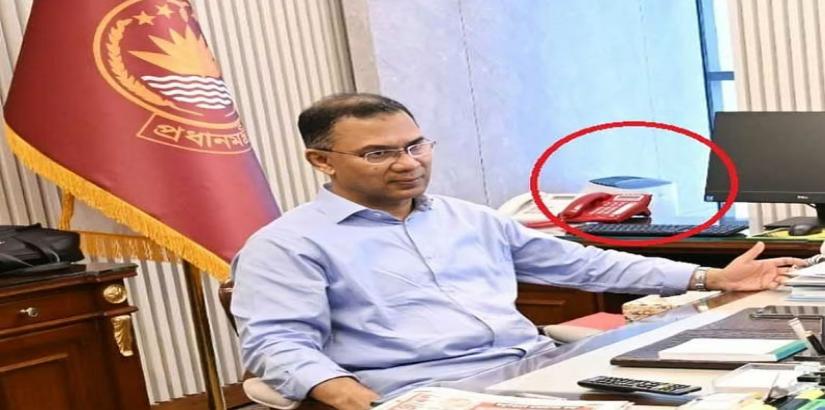
During the seven-day Eid-ul-Adha holiday, something extremely alarming reportedly took place inside the office of Bangladesh Prime Minister Tarique Rahman. Security experts view the incident as an alarming sign that may indicate vulnerabilities in the Prime Minister's security arrangements.
According to media reports, staff at the Prime Minister's Office in the Bangladesh Secretariat discovered that the 'Red Telephone' was not functioning. After the matter was reported to the authorities and the Bangladesh Telecommunications Company Limited (BTCL)—the state-owned operator of landline communications—the connection was restored. Speaking to local media, a BTCL official stated that the 'Red Telephone' enables the Prime Minister to make direct calls anywhere in the world instantly and serves as a critical communications tool during emergencies.
Meanwhile, agencies investigating the matter have presented an explanation that many security experts may find difficult to accept. According to official accounts, on the morning of May 22, 2026, an individual climbed onto the rooftop of Building No. 3 inside the heavily guarded administrative complex housing the Prime Minister's Office, cut copper cables, and left the premises undetected.
It is worth noting that the 'Red Telephone' is reportedly part of Bangladesh's most sensitive communications infrastructure, used for secure government communications.
The official response—that thieves scaled the rooftop of a highly secured government building to steal approximately nine kilograms of copper wire—has been viewed by some security analysts as implausible. Subsequently, two suspects were arrested: a scrap dealer named Rezakul Islam and a Secretariat outsourcing employee named Ranjan Chandra. The stolen copper was allegedly destined for the scrap market, where it would have fetched only a few thousand taka.
More Alarming Than Official Narrative Suggests
The investigation appears to have largely concluded with the assumption that the matter has been resolved. In my view, such a serious incident warrants deeper scrutiny. Even a casual observer of investigative journalism may find it difficult to believe that someone would risk entering one of the country's most secure facilities merely to steal copper worth approximately BDT 5,400 (about US$43).
To understand why this incident may be more significant than the official narrative suggests, one must first understand what the Red Telephone system represents. This is not an ordinary communications line. It is reportedly part of Bangladesh's secure government communications architecture, with a dedicated exchange at Sher-e-Bangla Nagar and a main switching station linked to the Prime Minister's Office. Its lines carry sensitive communications among senior policymakers. Security is maintained by specialized government agencies, while much of the infrastructure has reportedly been upgraded from copper to optical fiber to reduce vulnerability to interception and tampering.
Recent years have demonstrated that attacks on communications infrastructure can have consequences far beyond temporary technical disruption. From cyberattacks targeting government networks to physical sabotage of telecommunications facilities, states across South Asia increasingly face hybrid threats that blur the line between criminal activity and national security challenges. This evolving threat landscape requires governments to adopt a more integrated approach to infrastructure protection.
Yet copper cables connecting critical Secretariat buildings were physically cut. For days, authorities reportedly did not know who was responsible. Security personnel monitoring CCTV cameras and other sophisticated surveillance systems apparently failed to detect the entry and exit of the alleged perpetrators.
For security professionals, such a scenario raises serious questions. It is difficult to imagine that a communications system serving the Prime Minister could remain disconnected for days without triggering immediate concern. Such a lapse naturally raises questions about security protocols and whether the incident involved factors beyond simple theft.
In my view, rather than treating the matter primarily as a case of copper theft, the government should have considered establishing a high-level investigation team jointly led by the Directorate General of Forces Intelligence (DGFI) and the National Security Intelligence (NSI). If necessary, international forensic experts could have been consulted to assist in determining the full circumstances surrounding the incident.
Work of an Organized Gang Behind Theft?
Intellectual honesty requires moving beyond the comfort of a straightforward scrap-theft explanation.
Is it possible that this was simply a petty crime motivated by profit? Certainly. Bangladesh's informal scrap economy is extensive, and theft from government facilities is not unprecedented.
But is it equally possible that the theft served another purpose—perhaps to gain access, test security responses, or identify vulnerabilities within sensitive communications infrastructure? That possibility cannot be entirely dismissed.
The Dhaka Metropolitan Police Commissioner reportedly suggested that an organized group may have been involved in the theft of infrastructure within the Secretariat. If the operation was organized rather than random, then questions regarding motive become increasingly important.
This is not merely a theoretical concern. Bangladesh's political history includes the assassinations of two national leaders—Sheikh Mujibur Rahman in 1975 and President Ziaur Rahman in 1981—as well as multiple assassination attempts against former Prime Minister Sheikh Hasina.
More importantly, the alleged sabotage occurred during a period of political transition following the developments of August 2024. Institutional loyalties, political rivalries, and competing networks of influence continue to shape Bangladesh's political landscape. In such a context, any breach involving the Prime Minister's secure communications infrastructure deserves careful examination.
Bangladesh Faces Complex Security Environment
History shows that successful security establishments treat anomalies seriously and investigate them thoroughly before drawing conclusions. Those that dismiss warning signs prematurely often discover their significance only after a larger crisis emerges.
The incident involving the Prime Minister's 'Red Telephone' should therefore not be viewed as a routine matter. Bangladesh faces a complex security environment that includes political rivalries, extremist threats, and competing domestic and external interests. For that reason, investigators should examine all plausible possibilities and avoid prematurely ruling out any line of inquiry.
For the security and safety of Prime Minister Tarique Rahman, no potential angle should be dismissed without thorough investigation. Unless the actual—not speculative—cause behind the disruption of the 'Red Telephone' is conclusively established, agencies responsible for protecting the Prime Minister should avoid becoming overly reliant on the explanation that it was merely a case of copper wire theft.
(The writer is an award-winning journalist, columnist, editor and publisher of the Bangladesh-based publication Blitz, and a commentator on Islamist extremism, terrorism and South Asian geopolitics. Views expressed represent the author's views and have not been independently verified. He can be reached at noman14@gmail.com and on X: @Salah_Shoaib.)





Post a Comment