

Sri Lanka’s 'Survival Balancing' is a Test of its Foreign Policy in This Gulf War
For three decades, Sri Lanka successfully navigated the India-China rivalry, turning great-power competition into economic opportunity. Today, the country faces a far narrower and more dangerous corridor. Balancing between India and China was a game of leverage. But, balancing between the United States-Israel axis and Iran is a test of survival.
 Mar 24, 2026
Sri Lanka’s foreign policy has long resembled a careful tightrope walk, first between rising Asian giants, and now amid a far more volatile West Asian conflict. For the last three decades it was a strategic balancing act between India and China which, in recent weeks, has evolved into a delicate and potentially dangerous navigation between the United States-Israel axis and Iran.
Since independence, Sri Lanka has publicly adhered to the principle of “friendship towards all, enmity towards none,” rooted in its early pioneering role in the Non-Aligned Movement. However, the post-2000 era saw a more pragmatic shift. Colombo increasingly leveraged competition between India and China to secure financing, infrastructure, and political backing. By 2020–2023, the two countries together accounted for a dominant share of Sri Lanka’s bilateral loans and investments.
Successive governments refined this balancing act with claims that India remained the geopolitical anchor and immediate neighbour and China emerged as economic partner, primary infrastructure financier and strategic investor.
More Complex Balancing Act
Even under the current administration, this dual engagement continues. President Anura Kumara Dissanayake’s early visits to both New Delhi and Beijing signaled continuity, seeking Indian cooperation in energy and security while maintaining Chinese-backed projects like Hambantota and Port City.
The ongoing conflict involving the United States, Israel, and Iran has now forced Sri Lanka into a new and far more complex balancing act. Recent developments show how Sri Lanka is no longer a distant observer. The island has been directly affected by conflict spillover, when on March 4 the US torpedo attack had sunk an Iranian warship near Sri Lankan waters. Sri Lanka Navy crafts rushed to the area and rescued 32 Iranian sailors and later recovered 188 bodies of Iranian sailors and cadets.
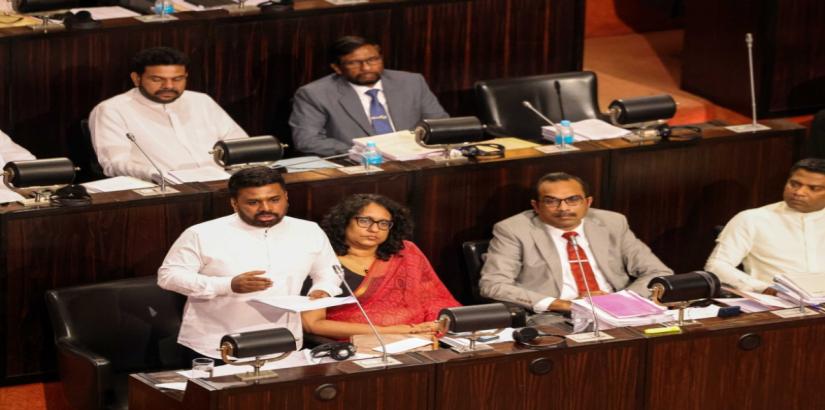
President Dissanayake was lauded by most countries for the humanitarian act, but some sections in the opposition found fault with the government for not allowing the Iranian ship to enter a Sri Lankan port before it was attacked by an American submarine. Speaking in Parliament this week, President Dissanayake reiterated the country's neutrality, and said not only Iranian war ships, but also US aircraft were refused permission to enter Sri Lankan ports.
However, some opposition members expressed their doubts about the announcement, as the United States Embassy, in its recent media release on high-level talks between the two countries, did not mention any request for US aircraft to enter Sri Lankan air bases.
No Neutral Middle Ground
Analysts believe this critical shift is tricky as Sri Lanka is no longer balancing abstract geopolitical interests, but managing immediate economic survival and security risks. Unlike the India-China equation, the US-Israel-Iran triangle presents sharper contradictions, as there is no neutral middle ground.
India and China, despite their geopolitical rivalry, both engage Sri Lanka economically. In contrast, the US-Israel bloc and Iran are in open conflict, reducing diplomatic flexibility. In light of the Middle East conflict and the US hand in it, Sri Lanka faces dilemmas on energy security as well as exports. The United States remains Sri Lanka’s largest export market and Iran is a key energy and trade partner. Hence any tilt risks economic retaliation from one side.
The Indian Ocean - once a zone of strategic competition- is now a potential theatre of conflict spillover, as seen in naval incidents near Sri Lanka. Unlike the India–China rivalry, this conflict directly affects daily life - fuel queues, power shortages, and economic instability. Despite these pressures, Colombo’s response shows continuity in policy of neutrality by refusal of military access to all sides, emphasis on neutrality and sovereignty and humanitarian engagement without strategic alignment
About Minimising Damage
Yet, the context has fundamentally changed. Earlier balancing was about maximising opportunity; today it is about minimising damage. Sri Lanka’s foreign policy appears to be entering a new phase, what may be termed “survival balancing.” Key features of this strategy are strict neutrality in military matters, selective economic engagement with all sides, crisis-driven diplomacy rather than long-term alignment, and heightened sensitivity to energy security. As one recent analysis notes, even fuel procurement has become intertwined with foreign policy decisions, underscoring how geopolitics now directly shapes domestic stability.
Sri Lanka has to tread on this path with caution as there is limited space to manoeuvre. For three decades, Sri Lanka successfully navigated the India-China rivalry, turning great-power competition into economic opportunity. Today, the country faces a far narrower and more dangerous corridor. Balancing between India and China was a game of leverage. But, balancing between the United States-Israel axis and Iran is a test of survival.The tightrope remains, but the headwinds have grown far stronger.
(The author, a former Sri Lankan diplomat, is a political and strategic affairs commentator. Views expressed are personal. He can be reached at sugeeswara@gmail.com.)







Post a Comment