Though India and Pakistan showed great restraint to prevent any escalation, the missile episode has raised eyebrows among those who consider South Asia to be a 'nuclear flashpoint'
The government is also engaging doctors, psychologists, lawyers, civil society organisations, NGOs, religious leaders and community representatives to facilitate de-radicalisation and reintegration. Young people are encouraged to participate in constructive social activities that promote communal harmony and reduce the appeal of extremist ideologies.
But it may be the smaller South Asian states that feel the most pressure. Countries such as Bangladesh, Sri Lanka, Nepal and the Maldives are faced with a more polarised geopolitical environment. They want Chinese investment to boost development and keep close diplomatic and security ties with India and western partners.
A big development happened in 2025. Nepal started exporting electricity to Bangladesh through India's transmission network. This was the first time Nepalese hydropower was commercially transmitted to Bangladesh via Indian territory. The initial export volume was 40 megawatts. The significance of the agreement is much bigger. It showed that regional energy cooperation can overcome political barriers.
In the effort to combat this multi-dimensional challenge, democratic states are faced with deep policy constraints, many of which can be paralyzing. The fundamental paradox is how to maintain the open, democratic character of the digital commons while at the same time countering more advanced opponents who are not held back by democratic principles. Disseminating disinformation is a tactic governments use to influence public opinion that has the potential to conflict with the strong constitutional freedoms of expression that exist in liberal democracies.
Though India and Pakistan showed great restraint to prevent any escalation, the missile episode has raised eyebrows among those who consider South Asia to be a 'nuclear flashpoint'
The research relied upon by the petitioners, which was unceremoniously sidelined as being unauthentic and without proper credentials of the researchers, showed that head coverings are commonplace for most Hindu, Muslim and Sikh women outside their homes
It is, however, apparent that Imran Khan and his aides have forgotten the norms of political battles a long ago
Sara’s name is on Sapan’s Founding Charter calling on South Asian nations to institute soft borders and a visa-free South Asia
Unless the national programme for TB is made strong, we may end up well short of the desired impact
The BJP government has done better in preparing lists of those officers who are inefficient or corrupt
Within the Congress also, the entire blame cannot be put at the door of the Gandhis
Tibetans wonder why the world is largely indifferent to their plight at the hands of the Chinese government and has not responded the way it sympathizes with the plight of Ukrainians
Neutral alliances of smaller countries are again becoming important in the tug of war between the major superpowers in the region
Women in civil service in India are still a small minority. Yet they have achieved so much and broken glass ceilings in their individual journeys
If credibility is to come to corporate governance, the pool of directors must be widened to include people from a variety of fields
The US has started to consider Bangladesh as an important security partner in the region
India’s decision to abstain from voting against Russia in UNSC could turn the world opinion against New Delhi if there is a war with China and Pakistan
For the first time in many decades, the Indian electorate is facing a political outfit which believes more in winning polls than governance
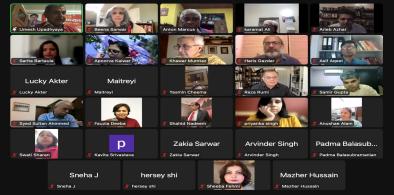
Hosted by *Khushi Kabir*, social activist, feminist and environmentalist, Dhaka. Bangla tribute to Lata Mangeshkar by *Sohana Ahmed*