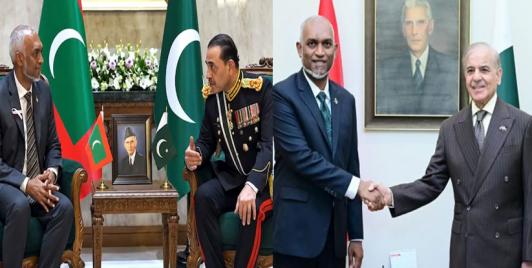


Representational Photo

The Race for Strategic Minerals: South Asia's Geopolitical Moment

The Quad's Critical Minerals Initiative provides an important platform for achieving these objectives. Through coordinated investments, technology sharing and supply-chain diversification, the initiative seeks to create resilient and transparent mineral supply networks. Australia contributes abundant mineral reserves, Japan offers advanced processing technologies, the United States brings investment and innovation capabilities, while India provides a rapidly expanding market and growing manufacturing base.

Ganga Water Treaty Renewal: A National Priority for Bangladesh, a Strategic Opportunity for India

Renewing the Ganges Water Sharing Treaty could also serve as an important confidence-building measure between Bangladesh and India. A renewed agreement would help restore mutual trust and strengthen regional cooperation over shared water resources. It would further reinforce the role of the Joint Rivers Commission (JRC), which remains a key institutional mechanism for addressing transboundary river issues.

Top EU Diplomatic Visit Signals Reassessment of Pakistan's Strategic Value

By recognising Pakistan’s role in the Iran crisis, Brussels is signalling that influence in today's international system is increasingly distributed across multiple actors, not concentrated solely in Washington, Beijing, or Moscow. This fits with the EU’s broader effort to develop a more autonomous and flexible foreign policy in a more multipolar world.

Regional Geopolitical Powerplay a Challenge for Improved India-Myanmar Relations

China is a major defence exporter for Myanmar, but it has been arming both the Tatmadaw and the rebel forces. China’s aim is to secure its strategic highway through Myanmar to the Bay of Bengal and counter American and Indian influence in the region, including Myanmar and Bangladesh.

More on Geopolitics and Strategic Affairs

South Asia: Emerging economic compulsions and the need for regional cooperation

A look at the South Asia Subregional Economic Cooperation (SASEC) countries - Bangladesh, Bhutan, India, Maldives, Myanmar, Nepal, and Sri Lanka - shows the importance of effective and modern trade facilitation measures, writes Partha Pratim Mitra for South Asia Monitor

Are EU and India sleepwalking their way to another lost decade on FTA?

India and EU today need innovative new ideas to enhance their trade and economic cooperation, this being the key component for stronger partnership promoting economic growth in these troubled times, writes Sunil Prasad for South Asia Monitor

COVID-19 battle revitalized SAARC in 2020; momentum should not be lost

Coronavirus emergency brought together these South Asian nations as they reposed trust in SAARC. Thus, the pandemic delivered a promising indication of revitalization, writes Harsh Mahaseth & Saumya Pandey for South Asia Monitor

Kashmir's local polls only half a step forward towards normality

This is the BJP’s first success in the valley where it has always been regarded as untouchable. However, since local elections generally reflect the popularity of candidates belonging to the area, an outcome that ignores the wider political divisions is not unusual, writes  Amulya Ganguli for South Asia Monitor

Forging farmer-student solidarity: Joining hands to strengthen participatory democracy

The return of active engagement with agrarian issues in university spaces is central to forging student-farmer solidarity, contends Arsh Ajmera for South Asia Monitor

Is China orchestrating Afghanistan's future through its proxies?

Afghanistan wants Beijing to formally apologize for China’s spy-cum-terror module caught operating in Kabul violating international norms before the Chinese detainees are released. However, China will consider this demand an affront, writes Lt Gen Prakash Katoch (retd) for South Asia Monitor

South Asia: Structural transformation, trade openness and self-sufficiency

The region’s dependence on imports for production, as well as the contributions of its exports through value chains place some of its economies in an influential position within the global production and trading network, writes Partha Pratim Mitra for South Asia Monitor

Terrorists may not seize power in Pakistan, but enabling environment for extremism remains

The legacy of the Pakistani state’s sponsorship of some terror groups - mainly those used to help pursue its objectives in Afghanistan and India - means that the infrastructure of terror will prove difficult to dismantle (though Islamabad has made progress in curbing terror financing networks, amid strong international pressure), writes Michael Kugelman for South Asia Monitor

Was Nepal’s parliament dissolved at Beijing’s behest?

Dissent within Nepal’s Communist Party was brewing for a long time but dissolving parliament without a provision in the Constitution is unprecedented. China has invested too much in Nepal to let go of control of Nepalese politics, writes Lt Gen Prakash Katoch (retd) for South Asia Monitor

India's swelling farm protests: Battle of attrition amid trust deficit

If contract farming is an idea whose time has come, it is necessary to ask why did it take off from 2002-03 and then sharply decline by 2011-12 in this vanguard agrarian state, writes N Chandra Mohan for South Asia Monitor

Sustainable consumption in South Asia: Making use of sustainable opportunities from the pandemic

More importantly, the South Asia region needs to realise that workers and farmers have a key role to play in promoting sustainable consumption as they are both the end consumers as well as the producers at the start of the supply chain, writes George Cheriyan & Simi T.B. for South Asia Monitor

Bangladesh war of 1971: Pakistan's blinkered vision

But it is interesting to note that 49 years hence, there seems to be no change in how the nation views the civil war and a bloody separation of its eastern province, writes Mahendra Ved for South Asia Monitor

Pakistan should be compelled to apologise to Bangladesh for 1971 genocide

The ‘uncultured’ state of Pakistan has not apologized yet for the 1971 genocide.  It should be compelled, writes Farabi Bin Zahir for South Asia Monitor

Biden's Asia policy: Will India be able to cultivate its proximity with Washington?

New Delhi also needs to recognize that the rules of diplomacy are changing and that country, especially the US under Biden, would not hesitate to make remarks about human rights violations or on communal tensions and certainly, the changes in the status of Jammu and Kashmir. None of these would qualify, for Biden’s Administration, as being ‘internal matters,’ writes Amb Amit Dasgupta (retd) for South Asia Monitor

Afghanistan, Bangladesh or undocumented Indians in US: Plight of displaced people needs attention

On this International Migrants Day, it is worth noting that not every migrant succeeds in an adopted land. For evidence, one need not go beyond the Indian American community. While the community’s many successes and accomplishments have been well-documented, a less-publicized fact is the plight of hundreds of thousands of Indian nationals in the United States, writes Frank Islam for South Asia Monitor