
Colombo Port City

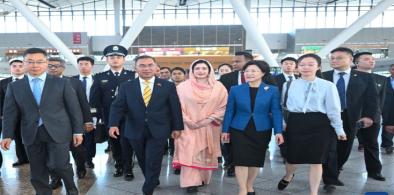
China’s Criminal Footprint in Sri Lanka has Regional Security Implications

When a Chinese company won the contract to establish hybrid wind and solar energy projects on three islands off the northern Jaffna peninsula—just 45 km from Rameswaram in Tamil Nadu—the security implications extended far beyond economics. Against this backdrop, India’s concerns are entirely justifiable. Sri Lanka faces a pressing question: how will the nation confront the infiltration of Chinese global criminal networks? Since Mahinda Rajapaksa’s tenure, Chinese presence in Colombo has steadily increased, with Sri Lanka positioned as a partner state in Beijing’s Belt and Road Initiative.

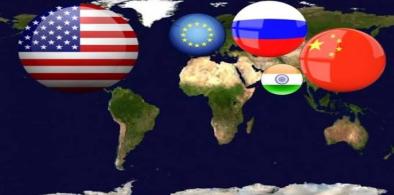
Wolf World or a Multipolar World? How Major Powers Exercise Power Will Determine Emerging International Order

The growing role of middle powers adds another layer of complexity. Yet the term itself remains imprecise. Not every country outside the United States and China qualifies as a middle power, and many reject the label altogether. India, for example, increasingly sees itself as a leading power pursuing strategic autonomy rather than as a middle power seeking alignment with one bloc or another.

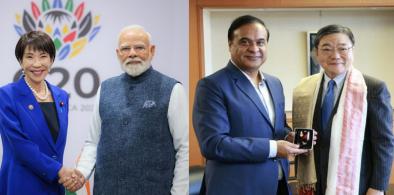
Is Northeast India's Permit System Inhibiting India-Japan Paradiplomacy? Colonial-Era System may be Stumbling Block to Subnational Exchanges

If India and Japan genuinely envision Northeast India as the gateway connecting South Asia with the Bay of Bengal and the Indo-Pacific, then the next chapter of the partnership cannot remain confined to New Delhi and Tokyo. It must also be written in Guwahati, Shillong, Aizawl, Imphal, Agartala, Kohima, Gangtok and Itanagar 

Bangladesh's Strategic Balancing and India's Neighbourhood Challenge: China Will Consolidate Influence if New Delhi Fails to Deliver

In several neighbouring countries, including Bangladesh, Sri Lanka and Nepal, China has demonstrated an ability to move from agreements to implementation far more rapidly than many competitors. India, despite enjoying unmatched geographic and cultural advantages, has often struggled with delays 

More on Geopolitics, Security and Strategic Affairs

Policy lessons from Mahatma Gandhi: Decentralised development and sustainable living

Gandhi was an engineer at heart. He improvised and built equipment like better snake-catching tools, small cotton-spinning wheel (takli) and chappals (sandals) from used tires. In 1929, he even instituted an INR one lakh prize (INR 20 crores in today’s value; 2.6 times bigger than the Nobel Prize) for the design of a modern charkha (spinning wheel), writes  Anil K Rajvanshi for South Asia Monitor

The Afghan deadlock: Was it a Trump subterfuge or a secret understanding?

Trump realized that the draft deal, if signed, would be labeled a surrender to the Taliban, which would be politically damaging for him. Another reason could be that he never really wanted to meet the Taliban, but wanted to showcase the peace efforts made, and place indirect pressure on them through the subterfuge writes Lt Gen PC Katoch (retd) for South Asia Monitor

Quietly, India crafts a new strategic partnership with Africa

With India's growing political and strategic interest in the continent, and inclination to leverage its diaspora as an instrument of soft power, it’s natural for New Delhi to establish a beachhead in Somalia, that straddles the Horn of Africa,  the source of the Nile and a gate to the Red Sea and the Gulf of Aden, through which tens of thousands of vessels pass through Somali waters every year in what is one of the world’s busiest sea-trading lanes, writes Tarun Basu for South Asia Monitor

Trump cancelling Taliban pact brings relief to world capitals, including Delhi

Delhi has not yet made an official statement, but legitimizing the Taliban at a Camp David ceremony would  have had an adverse impact on India’s strategic interests in the region, writes C Uday Bhaskar for South Asia Monitor

Putting NRC in perspective: Assam is not communal, has never been

For an outsider, the NRC process has come to be perceived as anti-Muslim. This is drawing the line along religious identity—a factor to which the indigenous Assamese Muslim community does not agree, but whose voice has been largely ignored in this massive debate, writes Azera Parveen Rahman for South Asia Monitor

Af-Pak region can become another Syria after US withdrawal

Trump ordering withdrawal of some troops is very much on the cards. The situation in Afghanistan over the next few months is unpredictable, with the internal turmoil and economic situation in Pakistan also deteriorating, writes Lt Gen Prakash Chand Katoch  (retd) for South Asia Monitor

Vatican diplomacy can help Sri Lanka leverage its strengths

Sri Lanka, being an Indian Ocean island nation strategically located at the international maritime crossroads, has significant diplomatic influence in the West due its Christian community, write Srimal Fernando and Mizly Nizar for South Asia Monitor

Credible deterrence must remain leitmotif of India’s security policies

The creation of a CDS cannot (and must not) be an isolated action because it carries with it a whole new ecosystem that can transform India’s national security paradigm. writes Admiral Arun Prakash (retd) for South Asia Monitor

India must rethink its Balochistan policy

Why can’t India begin by addressing the Balochistan problem at international forums, especially the heavy-handed suppression and continuing human rights abuses the people of that province face?, writes Nilova Roy Chaudhury for South Asia Monitor

India needs to watch out for Pakistan's diabolical moves to stir conflict

Pakistan's only real option is to provoke large scale communal conflict simultaneously in states like Gujarat, Maharashtra, Uttar Pradesh, Assam and Kashmir, which can spread to other regions. That can be blamed on the ruling dispensation's 'anti-Muslim' policies, against which many voices have been raised in India, writes Subir Bhaumik for South Asia Monitor

To craft peace in Kashmir its youth must be given confidence

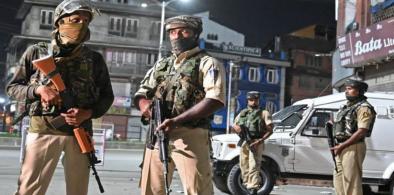
Showing political will at the highest level is of little help unless it works at ground level. The government must take Kashmiri people, particularly the youth, into confidence to instill buoyancy into every faith-filled Kashmiri's heart, writes Debasish Bhattacharyya for South Asia Monitor

Has dengue become a security threat to Bangladesh?

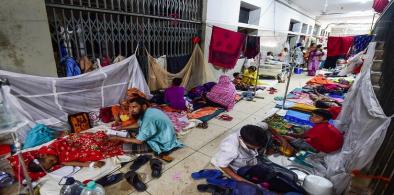
Hundreds of dengue-affected patients are receiving treatment in different public and private hospitals in Dhaka, but hospitals are full to the brim and facing challenges to handle the crisis due to lack of sufficient equipment and manpower, writes Akmal Hossain for South Asia Monitor

Nepal-India relations must overcome the trust deficit

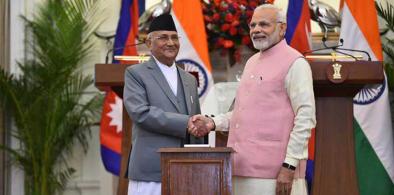
There is a clear sense that something is missing in the present relationship between the Indian and Nepali governments. Both should work to develop harmony and trust and mitigate the trust deficit, writes Gaurab Shumsher Thapa for South Asia Monitor

India should guard against terror, communal violence over Kashmir

Pakistan will try to enhance terrorist activities not only in J&K but in all of India. Pakistan’s Inter-Services Intelligence may activate and instruct its sleeper cells to carry out terrorist activities in communally sensitive places so that communal riots erupt in the country, writes J K Verma for South Asia Monitor

Some deft 'Modiplomacy' at G7, but Kashmir handling a challenge

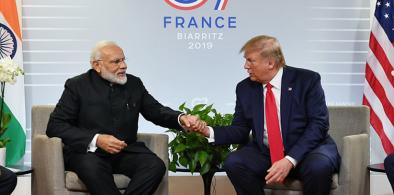
The Kashmir issue may have been handled deftly at the global politico-diplomatic level, but the abiding challenge for India remains domestic, writes C Uday Bhaskar for South Asia Monitor