

Seychelles' Importance to India: Modi Visit and Quest for Maritime Security and Stable Indian Ocean
Great powers realise the strategic value of small island states - refuelling facilities, logistics hubs, electronic listening posts, maritime surveillance nodes, diplomatic partnerships and access to vast EEZs. Their influence derives more from geographic position and political choice than from demographic size. Seychelles exemplifies this reality.
 Jun 28, 2026
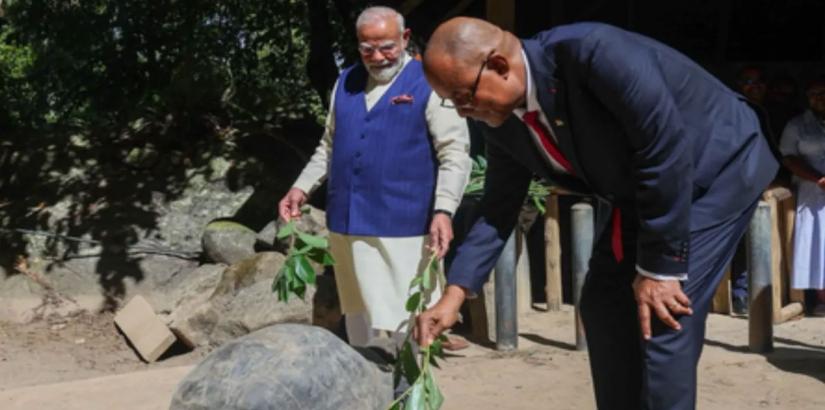
Prime Minister Narendra Modi's ongoing visit (his second after eleven years) reaffirms and advances that strategic continuity. It is far more than another bilateral engagement or the celebration of fifty years of diplomatic relations. It reaffirms India's determination to strengthen trusted partnerships across the Indian Ocean, as New Delhi increasingly sees maritime security as central to its national security and global aspirations.
A Permanent Geographic Advantage
Seychelles (115 islands; population under 110,000) is important because it lies close to the Sea Lines of Communication (SLOC) linking Asia with Africa, Europe and the Middle East; it overlooks approaches to the Mozambique Channel and the Cape Route. Its significance arises because ships pass nearby in enormous numbers, not because they routinely call at its ports.
Its Exclusive Economic Zone (EEZ) extends across almost 1.37 million sq km—nearly 3,000 times its land area of just 455 sq km.
India's Maritime Transformation
As India transitions from a continental power with maritime interests to a maritime power with continental responsibilities, Seychelles has become an enduring node in New Delhi's Indian Ocean strategy. For decades India regarded Seychelles as a friendly partner. Today it has become an integral element of India's wider maritime architecture, stretching from the eastern Indian Ocean to Africa's eastern seaboard. Together with Mauritius and other western Indian Ocean partners, Seychelles provides India with strategic depth across an increasingly contested maritime domain.
China's expanding presence has reinforced this reality, but it did not create it. Geography had already ensured Seychelles' enduring strategic relevance. Beijing's maritime expansion merely accelerated India's efforts to strengthen an existing partnership. India is responding to geography first, and geopolitics second.
Sea Power has Changed
Maritime power is increasingly measured by Maritime Domain Awareness (MDA) rather than simply by fleets, aircraft carriers or overseas bases. Coastal radar chains, satellites, maritime reconnaissance aircraft, underwater sensors, information sharing and data fusion now constitute the foundations of effective maritime security.
Sea power is increasingly measured not by the ability to control the oceans, but by the ability to understand them.
Viewed through this lens, Seychelles becomes an important information node within India's evolving maritime architecture. Indian assistance in coastal surveillance radar systems, Dornier maritime reconnaissance aircraft, hydrographic surveys, EEZ surveillance, training and information sharing contributes directly to collective maritime awareness against piracy, illegal fishing, narcotics trafficking and other non-traditional threats.
India's Maritime Vision
The evolution from SAGAR (Security and Growth for All in the Region) to MAHASAGAR (Mutual and Holistic Advancement for Security and Growth Across Regions) reflects India's expanding strategic vision. Maritime security today encompasses disaster relief, digital connectivity, resilient supply chains, climate resilience, renewable energy and the Blue Economy, alongside traditional naval cooperation.
The Blue Economy deserves particular strategic attention. Fisheries, marine resources, seabed minerals, ocean governance and environmental sustainability are no longer merely developmental concerns; they are increasingly becoming instruments of national power. Future competition in the Indian Ocean is likely to revolve as much around maritime resources and governance as around military presence.
Why Small States Matter
Great powers realise the strategic value of small island states - refuelling facilities, logistics hubs, electronic listening posts, maritime surveillance nodes, diplomatic partnerships and access to vast EEZs. Their influence derives more from geographic position and political choice than from demographic size. Seychelles exemplifies this reality.
The Assumption Island stalled infrastructure development experience also offers an enduring lesson. Strategic logic alone cannot determine outcomes. Domestic politics, environmental concerns and national sovereignty remain decisive considerations. Successful partnerships therefore demand patience, political sensitivity and respect for local priorities. Importantly, India demonstrated these qualities by not allowing this project to define the broader partnership.
Trust Capital as Statecraft
Unlike transactional relationships centred primarily on infrastructure financing or military access, India's engagement has consistently emphasised institution building, technical and economic cooperation, education, healthcare, capacity building, disaster relief and human resource development. The small but influential Indian and Indo-Seychellois community has further strengthened these historic bonds.
The author's two-year deputation by the Government of India as Advisor to the Government of Seychelles reinforced a lesson of wider strategic significance: enduring partnerships with small island states are founded on trust, political sensitivity and continuity. Technical cooperation, economic assistance, capacity building and development partnerships are important instruments of statecraft, but they derive their enduring effectiveness from these deeper foundations. Trust is the most durable currency of statecraft. These intangible assets remain among India's greatest strategic advantages in the Indian Ocean.
Seychelles has also become one of the clearest examples of India operationalizing its role as a Net Security Provider through partnership and capacity building rather than military dominance.
Prime Minister Modi's previous visit in 2015 marked India's renewed strategic engagement with the western Indian Ocean. His current visit builds upon that foundation. Previous agreements on maritime security, capacity building, development cooperation and the Blue Economy reaffirm that both countries continue to view their relationship through a long-term strategic lens rather than short-term diplomacy. Outcomes of the ongoing visit are awaited.
Ultimately, the question is not why India needs Seychelles. The more important question is: What kind of Indian Ocean order does India seek to build? If New Delhi's objective is a stable, inclusive and rules-based maritime region built upon trusted partnerships rather than coercive dominance, Seychelles emerges as an indispensable strategic partner.
Geography endures; strategy and statecraft determine how well nations leverage it. India's evolving partnership with Seychelles demonstrates this well.
(The author, an Indian Army veteran, is a former Security Advisor, Ministry of Home Affairs, Government of India and former Advisor, Government of Seychelles. The views expressed are personal. He can be reached at sanjayaggy1@gmail.com/ https://www.linkedin.com/in/brigsanjayagarwal/recent-activity/all/





Post a Comment